
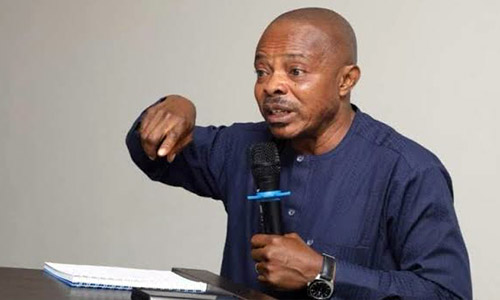
The Nigeria Labour Congress (NLC) has called on the Federal Government to deploy additional revenue arising from higher international crude oil prices to cushion Nigerian workers and other citizens from the impact of soaring petrol prices, transportation costs, food inflation and declining purchasing power.
NLC President, Comrade Joe Ajaero, who spoke at the 2026 National Pre-Retirement Summit organised by XEM Consultants Limited, argued that Nigeria, as an oil-producing country, was earning additional revenue from the rise in global crude prices linked to disruptions around the Strait of Hormuz while workers were bearing the consequences of higher energy costs.
“As one of the oil-producing countries, they are making trillions because of the problem in the Strait of Hormuz. You can see that oil was pegged at maybe $70 or whatever dollars. It’s $100, so they are making an extra $30 or $40,” Ajaero said.
He questioned why part of the additional revenue could not be channelled into temporary interventions to protect Nigerians from the current economic pressure.
“Now, can’t you use this money to embark on some interventionary measures like other countries where this is affected, so that we’ll now be alive till the time when they will say minimum wage?” he asked.
Ajaero maintained that discussions about wages should not be reduced to the nominal amount workers receive, insisting that the true measure should be what the money can actually purchase after inflation, food prices, transportation costs and other essential expenses are taken into account.
“Negotiations are not just figures,” he said.
Illustrating his argument, the NLC president said a seemingly large salary could become almost meaningless where the prices of basic necessities rise proportionately.
“Assuming one naira is equal to $1, I would advise Nigerian workers to remain at ₦70,000 because that would be big money for them, but you can see that you can equally get one million naira and a bag of rice is ₦500,000, so what of that? What happens?”
Ajaero said the rapid rise in petrol prices since the last minimum-wage negotiations demonstrated how policy and economic changes could quickly erode an agreed wage. Petrol has recently been selling around ₦1,400 per litre in Lagos and Abuja and even higher in some parts of the country amid increased international energy prices.
He therefore renewed the NLC’s call for the indexation of wages and pensions, arguing that workers’ salaries and retirees’ benefits should adjust in response to inflation or movements in the cost of living.
“Unless you index it either based on cost of living index or inflation, immediately inflation goes like this, automatically it will adjust to this, as it is affecting pension, so it affects salaries; and those are some of the things that will enable us to agree on something,” he said.
Ajaero also called for the minimum pension to be considered alongside the national minimum wage, stressing that pensioners face the same rising prices confronting active workers.
“You can’t stay here and say, ‘Oh, pension should be this,’ but like I said, it has to be negotiated. While you are negotiating minimum wage, you can equally look at minimum pension because you can’t control…” he said.
According to the labour leader, economic volatility was also one of the reasons organised labour pushed for the statutory minimum-wage review cycle to be reduced from five years to three years.
He said waiting five years before reconsidering wages could leave workers trapped for too long with incomes that had already lost substantial purchasing power.
“And that was what informed our decision to reduce the cycle from five years to three years. Today, you can see that minimum wage is to be negotiated every three years, but what we met on ground was five years. Assuming you have to wait for the next three years to make it five years, what would have been the condition of the Nigerian worker?” Ajaero said.
He further questioned the government’s ability to control the economic variables that determine how far workers’ salaries can go, including inflation, exchange rates and the prices of essential commodities.
“Can the government of this day check inflation? Can they check the value of the currency? Even if we had to take this, can they even check the issue of price? There was a time in this country when we had a price control mechanism,” he said.
Ajaero also raised concerns about food production and transportation, identifying them as major components of workers’ living costs.
He particularly questioned the effectiveness and accessibility of the Federal Government’s Compressed Natural Gas programme, which was introduced partly as an alternative to petrol-powered transportation following the removal of fuel subsidy.
“Are we even producing enough in terms of food, reliance on food? Now, between that time and now, the most troublesome problem for a worker, which happened to be transportation, the CNG policy, did it work? Where and where can you refill your tank? How many vehicles have been converted to CNG? How many electric vehicles are on the road?” he asked.
Ajaero said controlling some of these factors would make wage negotiations easier because improvements in transportation, food prices, inflation and other living costs would protect workers’ purchasing power.
“So if these factors were controlled, you can see that things would have been easier for us, but if not, then it’s like we’ll still be in the game again,” he said.
On when organised labour expects another review of the national minimum wage, the NLC president said the current arrangement was expected to reach the end of its three-year cycle around March or April, adding that discussions should begin early rather than waiting until the last moment.
“This minimum wage is supposed to expire March–April, so the conversation ought to start early. That’s a three-year cycle,” Ajaero said.
He, however, stressed that the NLC’s immediate concern was not simply waiting for another minimum-wage negotiation but finding ways for workers to survive the present cost-of-living pressures.
“But now we are more concerned on ‘give us this day’, how to survive today before that time. Because these policies of the fuel going up, jumping up, and the Nigerian government is making a whole lot of money from it,” he said.
... NLC Urges FG To Use Windfall Oil Revenue To Cushion Workers, Demands Wage And Pension Indexation ... TheNigeriaLawyer.