
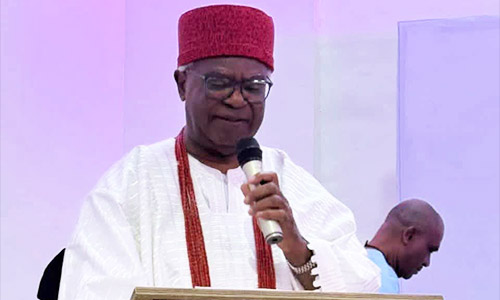
The Obi of Onitsha, Igwe Nnaemeka Alfred Achebe, has warned Nigerian editors that artificial intelligence has made political disinformation more dangerous and convincing, with technology now capable of fabricating the voices, images and movements of candidates and public officials within seconds.
Achebe, who chaired the 22nd All Nigeria Editors Conference (ANEC 2026) in Enugu, said the growing sophistication of AI-generated content could undermine informed electoral participation and erode public confidence in Nigeria’s democratic process unless news organisations strengthened verification and fact-checking ahead of the 2027 general elections.
The two-day conference, organised by the Nigerian Guild of Editors, brought together more than 500 editors and other stakeholders under the theme “The Ballot, the Media and the Task of Keeping Democracy Alive,” with a sub-theme focused on detecting and debunking AI-generated misinformation before, during and after elections.
Setting the tone for the gathering, Achebe described the media as a critical guardian of democratic values and urged editors to ensure that Nigerians were not deceived by fabricated information during politically sensitive periods.
He said rapid advances in AI had transformed both the speed and sophistication with which false information could be created and distributed.
“A voice that sounds exactly like a governor can now say what he never said. A video can place a candidate where he never was. An image can show riots that never occurred, timed to inflame passions 48 hours to an election,” Achebe said.
He warned that the challenge could be particularly serious in Nigeria because false content could now be produced convincingly in indigenous languages such as Igbo and Hausa and distributed rapidly through WhatsApp groups, family networks, town unions and other community platforms.
According to the traditional ruler, Nigeria’s ethnic and linguistic diversity, intensely contested politics and heavy reliance on informal community communication networks could enable fabricated information to spread rapidly before journalists or authorities have an opportunity to correct it.
Achebe therefore urged journalists to place verification ahead of speed, warning newsrooms against allowing the competition to break stories first to override the responsibility to establish whether information is genuine.
“The discipline of pausing to ask, ‘How do I know that this is true?’ must become as instinctive as the instinct to rush to publish used to be,” he said.
He called on media houses to deepen their understanding of artificial intelligence and develop the technical capacity needed to identify synthetic voices, manipulated photographs, fabricated videos and coordinated digital networks designed to give false information the appearance of widespread acceptance.
Achebe also urged the media to collaborate with institutions including the Nigerian Communications Commission, National Orientation Agency, universities and town unions to educate citizens on how to recognise AI-generated content.
“A people who believe everything are as much in danger as a people who believe nothing,” he warned.
The monarch stressed that the responsibility of editors went beyond identifying falsehoods circulated by political opponents.
He said professional integrity would be tested most seriously when misinformation benefited a political group or cause with which a journalist personally sympathised.
“It is easy to debunk a lie that favours your opponents. It is harder to debunk a lie that flatters your own camp,” Achebe said.
He consequently proposed the establishment of a joint Election Rapid Response Desk involving newsrooms, which would monitor viral election-related claims, verify suspicious content and quickly debunk false information before it caused widespread damage.
Achebe said such cooperation had become necessary because journalists were simultaneously facing economic pressures, political intimidation and an information environment in which falsehoods could spread nationally within minutes.
His proposal echoed concerns raised at the same conference by the Independent National Electoral Commission.
INEC Chairman, Prof. Joash Amupitan, SAN, separately warned that deepfake videos, cloned voices and fabricated result sheets could create competing narratives around elections and undermine confidence in genuine information. He called on media organisations to establish specialised fact-checking desks and strengthen digital verification.
Minister of Information and National Orientation Mohammed Idris also told the conference that AI-generated fake photographs, videos, audio recordings and documents presented a growing challenge to democratic trust, demonstrating that concerns about synthetic disinformation formed a major part of discussions at the Enugu gathering.
Achebe, however, placed the issue within a broader conception of the relationship between journalism, elections and democratic legitimacy.
He described democracy as “a fire lit to keep the house warm,” saying it required constant attention and protection if it was to survive.
According to him, the ballot box represents a modern expression of the traditional African understanding that legitimate authority derives from the consent and informed judgment of the people.
“The ballot gives the citizen a voice. The media is the mirror by which the citizen sees the world clearly enough to know what to say with that voice,” Achebe said.
“When the mirror is cracked, or worse, deliberately distorted, the citizen no longer votes from truth, but votes from illusion.”
He therefore challenged editors to ensure that the Enugu conference produced practical steps rather than ending with speeches and communiqués.
Achebe called for what he described as a declaration of war against falsehood and the erosion of truth in Nigeria’s public life.
“Enugu should be remembered as the place where Nigeria’s editors resolved to defend the public from the lie and the citizens from deception,” he said.
The Obi of Onitsha also urged Nigerians to register to vote, participate in elections and make electoral choices according to their conscience, while asking media organisations to intensify civic and voter education.
His remarks came as speakers at the editors’ conference examined several aspects of Nigeria’s electoral system ahead of 2027, including election technology, public confidence, electoral justice, misinformation and the role of the courts. Former NBA President Mazi Afam Osigwe, SAN, and Archbishop Emeritus of Abuja, John Cardinal Onaiyekan, were among those who addressed electoral and democratic issues at the gathering.
Welcoming participants to Enugu, Achebe described the Coal City as “a city built by the Igbo, tested by history and known for resilience,” saying it was fitting that discussions about sustaining democratic governance should take place there.
He concluded by urging the Nigerian media to remain a “constant compass” pointing the country towards truth whenever political tensions rise or public institutions come under strain.
... “It Is Easy To Debunk A Lie That Favours Your Opponents; Harder When It Flatters Your Own Camp” — Obi Of Onitsha Challenges Editors ... TheNigeriaLawyer.