
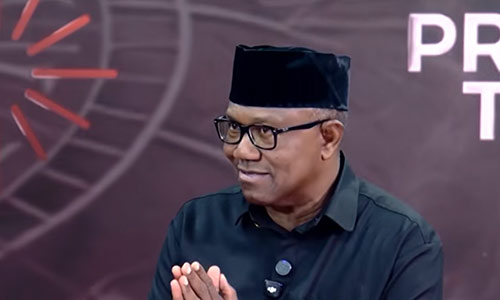
The presidential candidate of the Nigeria Democratic Congress (NDC), Mr. Peter Obi, has said that governors are entitled to support any presidential candidate of their choice, but has appealed to them to allow rival candidates to campaign freely in their states.
He spoke in a television interview covering the dispute with the Anambra State Government over the financial record of his eight years in office, the obstruction of his convoy in Benue State, the prolonged absence of President Bola Ahmed Tinubu from the country, and the friction between his party and its support groups.
The interview opened with an explanation for his recent silence. He said he had been quiet in recent days and had not commented because he was mourning the death of a close friend whom he described as an elder brother.
Asked about what the presenter described as a bitter dispute with the Governor of Anambra State, Professor Chukwuma Soludo, the candidate rejected the characterisation.
“Since you said ‘bitter dispute’, I have no dispute at all,” he said. “Rather than being in bitter conflict with my respected elder brother, Governor Soludo, we are still brothers. He is the governor of my state and I respect him, and he needs all the calm and tranquillity to be able to govern the state.”
He extended that to the whole body of state chief executives.
“I have no problem with any governor in Nigeria. Not one of them. My appeal to them is that they have the right to support any presidential candidate they choose. But at the same time, I humbly ask them to allow and support the other presidential candidates, and candidates who may be contesting for different offices, to campaign freely in the spirit of democracy, and let the people ultimately make their choice about who they want to serve them.”
He added that he would not attack them personally, and that he has no further interest in their office.
“You will never find me naming them or insulting them. That is a position I have already held. I will not run for governor again. Even if the constitution changes, I have passed that stage, and I do not intend to.”
He also urged a change of national focus. “My appeal is to the Nigerian people. Let us concentrate on the existential issues affecting Nigeria today, and the suffering of Nigerians, rather than being occupied with unnecessary distractions.”
Turning to the substance of the dispute, the candidate was categorical.
“Let me state this conclusively once again. I, Mr. Peter Obi, did not approach any financial institution to borrow money or to issue bonds on behalf of Anambra State during the eight years I spent in government.”
“On the day I left office, the Anambra State Government which I served was not owing any salaries, allowances or pensions due for payment by the state government. We were not owing any contractor or supplier who had completed their work, certified and verified. We were not owing anybody. That was the position when I left office.”
He drew a distinction on contractual obligations. “There may be people who did not complete their work, and when you do not complete your work, we do not owe you anything. We only owe you when you complete your work and it is verified and certified.” He gave an illustration: “If we ordered vehicles from someone and he did not supply the vehicles, we do not owe him anything.”
On the items presented as bank loans, he said the documents had been misrepresented.
“The way they have been presented is wrong public accounting,” he said.
“First, those were concessionary development support which the Federal Government of Nigeria obtained and on-lent to eligible state governments, or to those they wished to support with particular projects. These are concessionary facilities repayable over a period of between 25 and 35 years,” he said, adding that they carry zero or low interest and are structured as multi-year programmes with drawdowns programmed accordingly.
He set out the figures. “At the time I assumed office in the state, the recorded external debt was about 18 million dollars. At the time I left office in March 2014, our external debt position was about 30 million dollars. In fact, in December 2014, nine months after I left office, our total external debt was 45 million.”
“So how is that now aggregated and the claim made that at the time I left office I left 123 million and something? That is wrong, a very big error in public accounting.”
He said a fair presentation would have identified only the drawdowns. “They could have said, this is what Peter Obi drew down, this is the amount you can consider a debt he incurred. If you look at 18 and 30, that is a drawdown of 12 million dollars, or even if you go to December, you could say there was a drawdown of 25 million dollars.”
The candidate then set the alleged liability against what he says he left behind.
“At the time I left office, I left the dollar-denominated portion of my savings invested in various bonds at more than 150 million dollars, which gives Anambra State a guaranteed income of about 10 million dollars a year.”
He invited the state to assume the worst case. “Assuming Anambra State was right, although it is wrong, they are wrong, it is a lie, I did not leave 123 million, but assuming that were the case, that 123.7 million was outstanding when I left, I left more than 150 million dollars which was yielding about 10 million dollars.”
“If they had only kept that money I left and used the income to service the loan, they would have finished repaying it by now, with the 150 million principal intact, and Anambra still receiving 10 million a year. Assuming that was not the case, they took the option of leaving that money and going away.”
He projected the position forward. “By June 2026, when the loan outstanding against Anambra State according to their claim was 92.3 million, if the money I left had been left as it was, without addition or subtraction, the compounded return, principal plus interest accrued and then reinvested, would have reached about 335 million dollars. By that month, if they decided to repay the debt, they would deduct 92 and something, and they would be left with 242 million dollars, yielding more than twenty times what it was on the day I left office as governor of Anambra State.”
He issued a challenge. “I left it in a very strong financial position that no other state in Nigeria, and I repeat, can claim. So if you find any governor since the founding of this country who says he left more than 50 million dollars, show me how.”
“I left a financial position which, if they had followed it, they would today have paid all the external debts and would have at least 240 million dollars remaining, which today is perhaps about 350 to 400 billion naira, and it would yield at least 20 million dollars a year for the state and still growing.”
He also addressed a separate claim, saying water companies are not on the schedule of payments by the state government. “It is merely an agency the government established. Yes, the government can support it.”
Pressed that the Soludo administration’s case is simply that loans and obligations existed, the candidate offered an analogy.
“I have just given you the story. Even if you say there are loans, I have told you these are not loans. I did not go to the bank, I did not take them, I did not go to get them,” he said.
“Assuming your father left you an inheritance of 100 million, and suddenly someone comes and says, if your father owed ten million, would you go to the market and say your father left you burdened with debts, unless there is something else? You would be unfair.”
He drew out the distinction between borrowing and being selected for support.
“There is a difference, Charles. You go to the bank to borrow money. Then the Federal Government sees that this state is doing well in education. They chose Anambra, Ekiti and Bauchi. They said these three states are doing well, why don’t we give them concessionary multilateral support to help them?”
He confirmed that the decision was taken by the Federal Government and the World Bank. “It was not that we went to the bank and said give me this or that. The education fund, you will see that the drawdown came long after I left office.”
He added a further distinction between approval and expenditure. “Even if you go to the bank and borrow money, but I did not spend the money, you cannot call it a debt I left, as if I had gone to the bank and said, bank, lend me 10 billion, and I spent the money. If they gave me a loan of 10 billion naira, Charles, and I drew down only 500 million, you cannot say I owe 10 billion, because you know the amount. That is why I said it is not sound public sector accounting.”
He cited the testimony of a former Director-General of the Debt Management Office.
“The then Director-General of the Debt Management Office, Abraham Nwankwo, who served for about a decade, on the day he left office invited me as party chairman and announced before everyone at that gathering that the reason he chose me was that I was the only governor in Nigeria who never came to his office for approval to borrow money.”
He explained the process. “To borrow money as a governor, you must go to the Federal Government of Nigeria for approval. I did not go to the Debt Management Office. I did not go to the minister. I did not do it. That is how borrowing is done. No state government can borrow money today, let alone borrow externally, without the approval of the Debt Management Office and the Minister of Finance. In both cases, it never happened.”
Asked to make the matter one of verifiable figures rather than competing political narratives, the candidate produced a document in the studio.
“This is my handover note,” he said. “If you go there, you will see how much naira was left in investments, naira in cash, and the foreign currency component, and I backed that with statements, because I backed all the foreign components with statements, because that is part of this book. I documented it fully.”
“So if I say I left more than 150 million dollars, you will see it there. The banks in which it is held have been documented, and how the bonds were issued, it is all there. You can see there is no room for doubt.”
He said he had also excluded money expected from the Federal Government. “If you look at it, you will see that even the money that was expected to come from the Federal Government as refunds for contractor obligations, I excluded it, because it is not in our account.”
He urged verification rather than argument. “Publish the documents. I urge you, please, the World Bank is in Abuja and they can give you the history of the drawdowns. And the banks I have named here are Nigerian banks, and you have access to their head offices to ask whether this money is there.”
Asked whether he believed the dispute was connected to his presidential ambition, he declined to speculate. “I do not know. All I am saying is that I have no problem with the Anambra State Government. All I do daily is pray for Governor Soludo and other governors to focus on their work, because Nigeria is passing through a very difficult situation. I just wonder why this is coming up now, especially as they are now in a second term.”
Turning to the obstruction of his movement, the candidate disclosed that he is under pressure from more than one direction.
“Beyond that, as I speak to you, I also have a petition and I have been investigated everywhere. I have said here that I am not even sure whether I will remain alive at the end of this,” he said.
When the presenter expressed the hope that he would be, he replied: “I pray God protects me, because at this stage, at this stage, I am not sure what is happening.”
He returned to his appeal. “This is a democracy. Some of them will campaign for the presidency tomorrow, and they will campaign for other offices tomorrow. Let us have peace.”
The candidate contrasted the present treatment with his own conduct as governor, recalling the campaign for his second term.
He said that when the then Governor of Lagos State, Mr. Babatunde Fashola, told him he was coming to Anambra State to campaign against him, “I gave him my car, my comfortable car that I use, to go on that campaign.”
He recalled that when the President of the day came to Anambra to campaign for another candidate, he accompanied him. “He was there. He even said that people had performed well, but this man will perform better. No problem. When they all came to campaign, I gave them lunch. After lunch, in front of me, while I stood with him, he told the entire press, and told the Principal, that Peter performed well but he will perform better. That is democracy. Because I waited and invited people to vote. There was no problem.”
He set out what he expects in return. “When others were campaigning and I was governor, I provided them with facilities. What I expected now as a candidate is that governors should provide me even with transport when I arrive in their state, host me where necessary, and be able to give me all other support to go and meet the voters.”
Asked whether he was fighting for a principle beyond himself, he agreed. “That is it. To ensure that Nigeria works. For the future of our children.”
Asked what specific guarantees he would put in place as President to ensure an opposition candidate could campaign freely in a state whose governor opposed him, he set out a commitment.
“I have said it and I will repeat it. If I hold the office of President of this country, anyone who rigs elections will end up in prison. Even if it is the manipulation of one vote, he will go to prison. No political party will be harassed. We will support them and we will work side by side with the opposition political parties.”
“If there is a matter of state on which we must take a decision, especially in the situation we find ourselves in now, it is fundamental, we will invite all the opposition. This is a country in which everyone participates, and I want to involve everyone. I will ensure the opposition is involved, even if I have to make foreign trips. They will participate in decisions, because that is important. It is for the country and for our children. We must build a stable, united and secure country for our children.”
He added that it would not matter who held the office, and made a commitment about his own availability. “No one will find me [absent], asking ‘Where is Peter?’ I will not go on vacation. He must be in Nigeria.”
On the controversy over the President’s prolonged absence, the candidate said the problem went beyond the fact of travel.
“It is not only that he is outside the country. He has exceeded the days he was supposed to be away, and he has exceeded the days he himself said he would be away,” he said, with the presenter noting the 21-day period.
“The Vice President is not in the country, and I understand that the [Senate President] is also outside the country. And the Senate is not in a position to act. We do not need this level of recklessness at this difficult time, while Nigerians are being kidnapped and killed and things are going the way they are. We need a country led by someone with competence, capacity and compassion.”
He said the President’s place was at the scene of the latest tragedy. “He should be in Niger State now, shouldn’t he? Where some young people died for no reason.”
Asked whether presidential presence was merely symbolic given that a chain of command exists, he rejected the suggestion.
“No, no, it is extremely important. The presence of the President as chief executive is crucial in times of crisis, not delegation. Yes, you have a chain of command. Where is the President? Nigerians should know.”
“If I travel today, I tell people where I am. When I become President, Charles, people will know where I am, 24 hours. This is a public office, a public space.”
On the friction between the party and its support groups, following the position of the party’s founder and national leader, Mr. Seriake Dickson, that support groups must complement the party rather than operate as parallel structures, the candidate aligned himself fully with the leadership.
“First, this NDC is the political party we all belong to, and I agree completely with the leader’s position,” he said.
“The movement, the Obidient group and the other support groups are support groups. They must play their role as support groups supporting the party. They must not play the role of the party. We found a situation in which one of these support groups formed a presidential campaign council. It should not be so.”
Asked directly whether the campaign council announced by the Obidient Movement was created with his knowledge or approval, he answered: “Absolutely not. And I have said here that this is wrong. Your support for the Obidient Movement is support for Obi, so anything you do must have the express approval of both of us.”
Asked whether the group communicates with him, he said: “I am not saying whether they do or not. But sometimes, when doing these things, some of the people who are supposed to manage them act contrary to instructions.”
When it was put to him that something as significant as a presidential campaign ought to have had his approval, he agreed. “I agree with you completely, and that is why I reject it.”
On opposition unity, and the appointment of Professor Pat Utomi to bring the parties together and explore a consensus candidate, the candidate was supportive but cautious.
“Someone has been appointed. I do not want to take over his duties, but I believe the opposition parties should unite and fight for democratic space,” he said.
Asked how that could work when all of them have presidential ambitions, he said the common ground lies elsewhere. “It is not like that. All we want is that there are vital areas on which we can all unite and fight: free and fair elections, ensuring that elections are free of violence, and ensuring many other things.”
He rejected the claim that he opposes the other opposition parties as strongly as he opposes the governing party, and turned to turnout figures.
“That is not true. Let me tell you, in the last election only about 25 million Nigerians voted. Registered Nigerians at the time were 94 million. The number now is about 100 million, and only 25 million voted. So where did the 75 million go?”
“As for the other matter, I call it a lazy argument. Why don’t you go and look for the others? If someone can get 25 million, he will beat everyone here.”
Asked whether he would consider standing down if the process produced a single candidate, he declined to foreclose the question but would not commit.
“Well, I am not desperate to be president. I am desperate to see Nigeria succeed. So when they come, when he says the appointment has been made, when the time comes, it will be a discussion. It is not a discussion I can have with you now.”
Pressed again, he turned the question around. “Why don’t you say, what if the others step aside? What I am saying is that if it comes to that, we deal with the issue when it arises. But I assure you that I am for everything that makes Nigeria work and makes it a strong state. We need to start making sacrifices for our country.”
He closed with a statement of his commitments and of the preparation he says he has undertaken.
“Charles, I am committed to unity. I am committed to security. I am committed to the welfare of ordinary Nigerians. For too long, we have wasted everyone’s time. Let us put this country on the right track as a generation that keeps pace with the world.”
“That is why I have travelled everywhere. No other presidential candidate has taken the time to go to the countries that have succeeded. If you say Egypt has succeeded in energy, I went there to see it myself. If you say Indonesia has succeeded in something, I went there. I have been moving around to visit people and to do that, just to show that we are on the right path.”
“I am committed to it, and I tell people that if given the opportunity, the difference will be very clear. I have been mandated. I will be in front. I cannot be outside this country while our children are in the bush. Impossible. We will be in that bush with them.”
The interview followed the obstruction of the candidate’s convoy in Benue State while he was travelling to Yelwata. The Benue State Government has denied issuing any order or organising the blockade, and has said it was not properly notified of the visit. The police, however, have said they were aware of the visit and provided security. The circumstances of the obstruction remain in dispute.
... “No One Will Ask ‘Where Is Peter?’; I Will Not Be Outside Nigeria While Our Children Are In The Bush” — Obi Criticises Tinubu’s Absence ... TheNigeriaLawyer.