
For more than two years, Nigerians have been told that painful economic reforms are the price of a better future. Fuel subsidies were removed. The naira was floated. Electricity tariffs increased. Interest rates climbed. Inflation squeezed household incomes. Through it all, the government maintained that these sacrifices were necessary to restore fiscal discipline, attract investment and put the economy on a stronger footing.
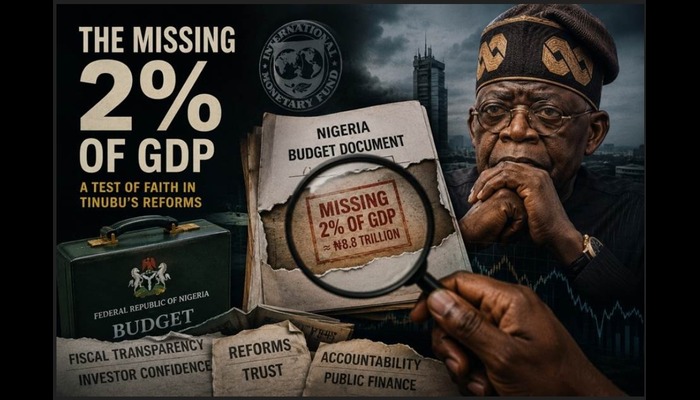
Now, a disclosure by the International Monetary Fund (IMF) is raising a question that goes beyond politics. According to the IMF, government expenditure equivalent to about 2 percent of Nigeria’s Gross Domestic Product (GDP) was omitted from recent budget documents. Christian Ebeke, the IMF’s Resident Representative in Nigeria, said the omission means “the fiscal deficit appears smaller than the government’s actual borrowing needs” because some capital expenditure was left outside the country’s budget framework.
That observation has opened a new debate about fiscal transparency at a time when the government is asking Nigerians to trust its reform agenda.
Atiku Abubakar, former Vice President and the African Democratic Congress (ADC) presidential candidate for the 2027 election, estimates the amount involved at about N8.8 trillion, based on the size of Nigeria’s economy. Calling for investigations by the National Assembly, the Auditor-General, the EFCC and the ICPC, he asked:
“If, as the IMF has revealed, expenditure amounting to two percent of Nigeria’s GDP was omitted from the budget process, then Nigerians are entitled to one simple question: Who stole the missing two percent of our GDP?”
Whether the omission ultimately proves to be a reporting issue rather than financial misconduct, economists say the bigger concern is confidence.
Economic reforms are built on trust. Citizens accept higher fuel prices, rising electricity tariffs and increased living costs because they believe public finances will become more transparent and efficient. Investors commit capital because they believe government accounts accurately reflect fiscal realities.
If spending takes place outside the normal budget framework, those assumptions begin to weaken. The IMF’s concern is not simply about bookkeeping. Budget documents are among the key tools used by investors, lenders and credit rating agencies to assess a country’s fiscal health. If expenditure is omitted, government deficits may appear lower than they actually are, making it harder to evaluate debt sustainability and borrowing needs accurately.
That matters for a country still trying to convince global investors that its reform programme is credible. Since the removal of fuel subsidies and the liberalisation of the foreign exchange market, Nigeria has recorded stronger foreign portfolio inflows and renewed investor interest in government securities. Those gains have been driven not only by high interest rates but also by growing confidence that economic policymaking is becoming more predictable.
Confidence, however, is easier to lose than to build. Atiku argued that the issue is “no longer an accounting discrepancy” but “a constitutional, legal and moral scandal.” He added: “Money does not simply disappear from a national budget. Somebody authorised it. Somebody approved it. Somebody spent it. Somebody benefited from it.”
Those are political allegations that require evidence. But they underscore a broader economic reality: fiscal credibility is now one of Nigeria’s most valuable assets.
The government has not yet provided a detailed response to the IMF’s observation. If the omission resulted from differences in fiscal reporting or accounting treatment, a clear explanation would help reassure both Nigerians and investors. If weaknesses exist in budget reporting, addressing them quickly would strengthen not weaken the credibility of the reform programme.
The challenge facing the Tinubu administration is therefore larger than defending one budget line. Its economic reforms have asked Nigerians to endure some of the highest living costs in decades in exchange for the promise of future stability. That promise depends not only on sound economic policies but also on confidence that every naira raised and every naira spent can be properly accounted for.
In the end, the missing 2 percent of GDP is not just about public expenditure. It is about whether Nigerians and global investors continue to believe that the country’s painful reforms are being matched by equally strong standards of transparency, accountability and fiscal discipline.