
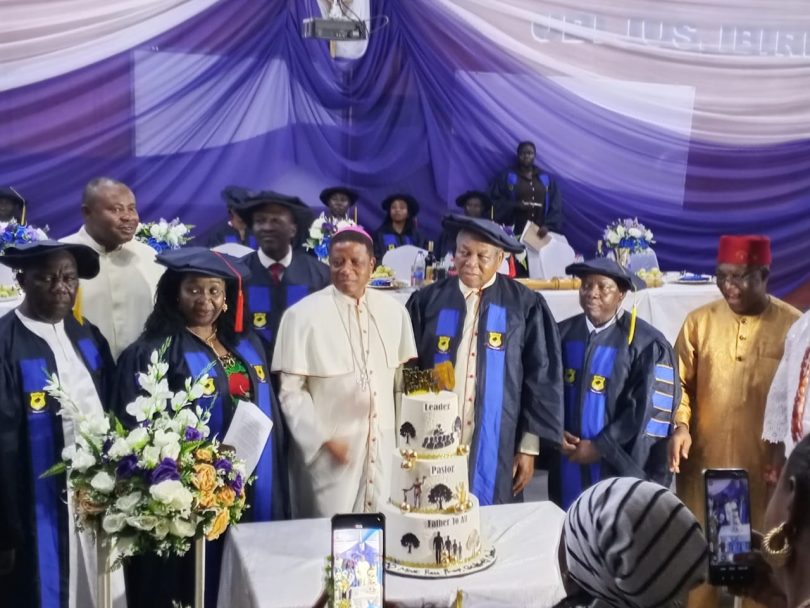
Archbishop Emeritus of the Catholic Archdiocese of Abuja, Cardinal John Onaiyekan, last night urged Nigerians to break the culture of silence, demand accountability from those they elected into government and address the country’s development challenges.
He made the call at Ave Maria University, Abuja Law Campus, during a ceremony organised to celebrate the 70th birthday of the Catholic Bishop of Nsukka Diocese, Most Rev. Prof. Godfrey Igwebuike Onah.
Onaiyekan said Nigerians must stop behaving as though they were powerless citizens unable to question those elected to govern them, stressing that public officials were elected to serve the people and must therefore be held accountable for their actions and policies.
“I’m hoping that before I go to paradise, I will see a nation where the government is for the people,” the cardinal said.
He called for stronger mechanisms through which citizens could hold public officials accountable, from local government councillors to the President.
“We elect people in government, and then they become our lord and master, they do whatever they like, and we keep quiet, and we are told to go to court. Now, we cannot continue like that,” he stated.
Onaiyekan commended Nigerians who had increasingly spoken out on national issues, saying their willingness to challenge the status quo offered hope that the culture of silence was gradually changing.
The cardinal also defended the right of Catholic bishops to criticise government policies they considered detrimental to the welfare of citizens, noting that such interventions should not be misconstrued as undue political involvement but as part of the Church’s responsibility to speak to the conscience of society.
ALSO READ: Tinubu reacts as hundreds abducted in Niger
“When we, as bishops, criticise policies of government, if we think they are not working for the good of the people, we are only doing the normal thing. Nothing extraordinary,” the cleric said.
Onaiyekan dismissed concerns over criticisms and insults directed at him following his interventions on national affairs, saying the support he had received from Nigerians was enough encouragement.
He added, “I don’t think I need any more approval than that. And because of that, I sleep fine with no concerns. At 82, you don’t worry yourself too much about anything from this world.”
Bishop Onah, on his part, cautioned against reducing the Church’s interventions in public affairs to political criticism of government, noting that the primary mission of bishops was to speak to the consciences of people and encourage them to become better human beings and citizens.
“You don’t honour us when you tell us we are speaking truth to power. That is not our mission. That is not our vocation,” Onah said.
According to him, the Church’s message was fundamentally about Christian life, with political and public issues only forming part of its broader application.
He warned against focusing only on portions of Church sermons that address government while ignoring the larger message directed at the moral transformation of citizens.
“It will be unfortunate if the rest of Nigerians don’t hear the 18 minutes of exhortation and only single out the two minutes they feel is addressed to government,” he said.
Onah, who also made an on-the-spot assessment of the level of progress achieved by the university, argued that the quality of governance in Nigeria was a reflection of the character of its citizens, stressing that better citizens would ultimately produce better politics and governance.
Earlier, the Vice-Chancellor of Ave Maria University, Prof. Ignatius Akhakhia Onimawo, welcomed Bishop Onah and described his visit as an important moment for an institution committed to combining academic excellence with moral and spiritual formation.
The Vice-Chancellor said the university was established to produce graduates who are intellectually competent, morally upright, spiritually grounded and socially responsible.
He said the institution currently offers more than 30 programmes across disciplines, including medicine, law, computing, administration, management, international relations, sciences and social sciences.
The university management said its broader objective was to develop graduates capable of providing innovative solutions to Nigeria’s challenges while upholding integrity, discipline and respect for human dignity.
The birthday celebration provided an opportunity for the two Catholic leaders to reinforce their calls for responsible citizenship, moral leadership and a stronger culture of accountability in Nigeria.
The Pro-Chancellor and Chairperson of the Governing Council of the institution, Mrs. Eucharia Onah, described the occasion as a moment of grace, thanksgiving and celebration of a life devoted to God, the Church, scholarship and service to humanity.
She said the university was particularly honoured to receive the bishop, whom she described as a father, brother, shepherd, scholar and son of Imilike.
Mrs. Onah noted that Bishop Onah’s journey of service had taken him through priesthood, teaching, scholarship, pastoral leadership and episcopal ministry. Born in Imilike on August 18, 1956, he was ordained a Catholic priest in 1984 and later became Bishop of the Catholic Diocese of Nsukka.
She said his intellectual achievements had brought honour to both the Church and the wider academic community.
Mrs. Onah also highlighted Bishop Onah’s episcopal motto, “Volumus Iesum videre” — “We want to see Jesus” — describing it as a profound expression of his ministry and a fitting message for his birthday celebration.
According to her, his life demonstrates that faith and intellectual excellence can work together in the service of truth, human dignity and God.
The Pro-Chancellor said Bishop Onah’s presence at Ave Maria University was especially significant because the institution seeks to combine faith, knowledge, character and service in the formation of students.
She urged the university community to draw inspiration from his life, stressing that excellence without character is incomplete and that education achieves its highest purpose when it serves humanity.
Mrs. Onah prayed that God would grant the bishop many more years in good health, wisdom, peace and fruitful service. She also invoked the intercession of the Blessed Virgin Mary and St. Joseph over his life.
She concluded by wishing him a happy 70th birthday, saying, “Ad multos annos!” and urging him to remain faithful to his episcopal call, “We want to see Jesus.”