
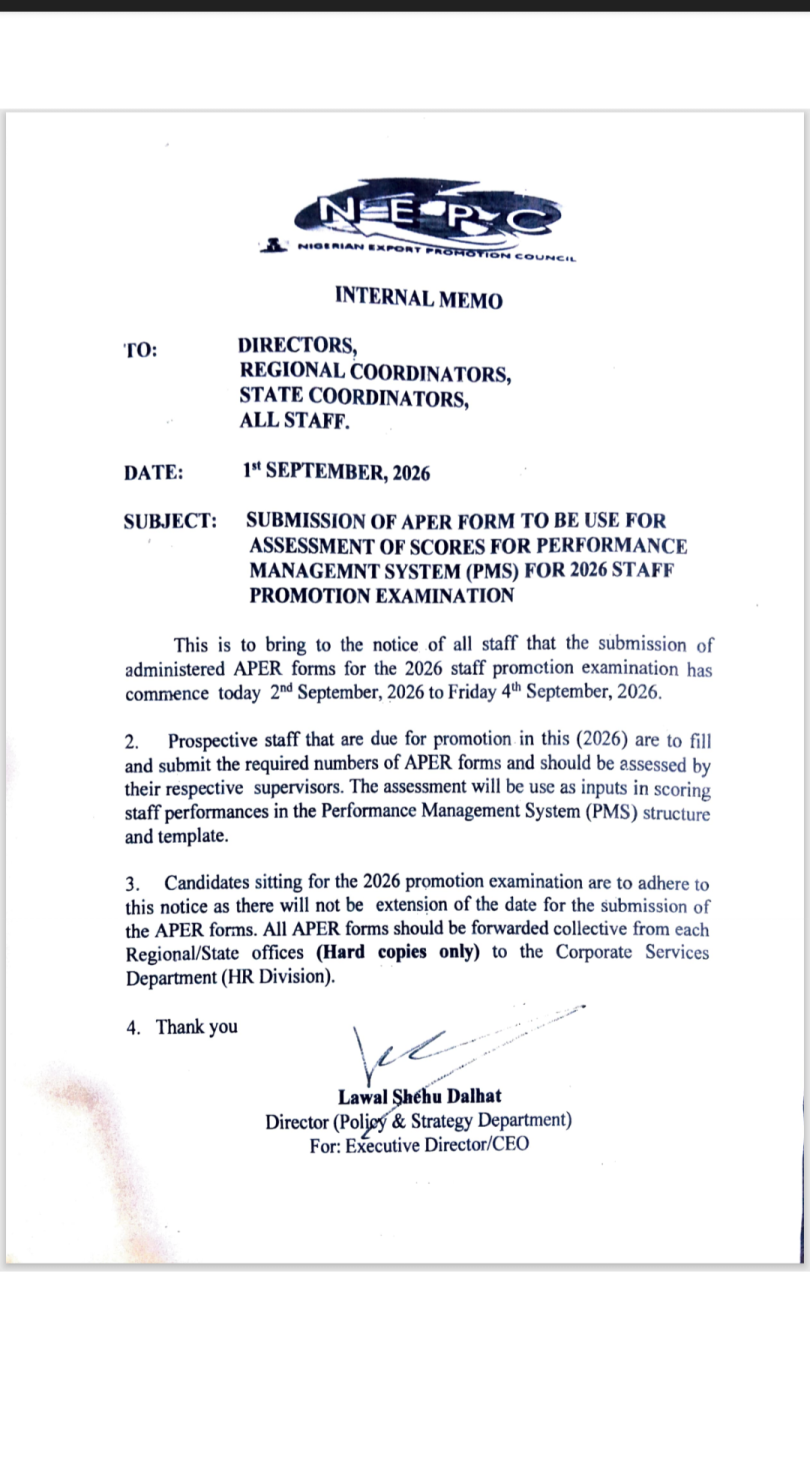
Fresh controversy is brewing at the Nigerian Export Promotion Council (NEPC) over its 2026 staff promotion exercise, with workers accusing Executive Director/CEO Mrs. Nonye Ayeni of reintroducing the long-abolished Annual Performance Evaluation Report (APER) system to manipulate the process and favour loyalists.
The controversy followed an internal circular dated September 1, 2026, titled: “Submission of APER Form to be used for assessment of Scores for Performance Management System (PMS) for 2026 Staff Promotion Examination.”
Staff due for promotion were directed to “fill and submit the required numbers of APER forms to be assessed by their supervisors and use as inputs in scoring staff performances in the Performance Management Systems structure and template.”
The directive caught staff off guard because APER had been formally replaced years earlier by the Performance Management System.
Section 050201 of the Public Service Rules states: “The Performance Management System (PMS) shall replace the Annual Performance Evaluation Report (APER) for the Federal Public Service. All Federal Ministries, Extra-Ministerial Departments and Agencies (MDAs) are expected to comply with the provisions of this rule.”
The transition was formalised through an OHCSF circular referenced HCSF/CMO/PMD/035/1/18 and dated December 21, 2022, conveying the President’s directive that PMS take effect from January 1, 2023, in place of APER.
Staff noted NEPC itself had already used PMS criteria for its 2025 promotion exercise, making the reversion to APER for 2026 harder to explain.
Staff Describe Circular As Contradictory
A staff member said the reversal would create “unimaginable” hardship for employees. Another called the circular self-contradictory, since it gave staff only two days to complete APER forms while stating those scores would feed into the separate PMS framework: “You cannot use APER form to assess scores for PMS because the format and weighted scoring criteria are clearly different. It’s like trying to use a landline to access data from a 5G network.”
The source explained that PMS is built around quarterly assessments tied to specific officer targets, unlike the older APER instrument, and added: “If the Management of NEPC cannot distinguish between the two, then it calls to question the administrative competence of the CEO and her Management staff.”
Another staff member noted NEPC’s lag behind peer agencies: “It is therefore shameful that while many organisations have since transited to Computer Based Test (CBT) in their promotion exercise… the NEPC is still battling with old APER forms that have been long discarded.”
‘Impossible’ Requirement, Questions Over Authority
Staff said the APER requirement is impractical: officers would need forms from the past three or four years, countersigned by Directors, many of whom have since retired or returned to their home states and should no longer be endorsing documents for serving staff.
A senior staff member questioned Ayeni’s authority to act unilaterally, saying, “Does Mrs. Ayeni have the power or authority to unilaterally reintroduce the use of APER form as a component of staff appraisal tool even when the APER form has since been abolished and discarded by the Federal Government?”
The source added this was not the first such episode. “This is not the first time she has been jettisoning extant rules to achieve her personal agenda,” the source said.
“In one of such instances, the office of the Head of Civil Service had to personally intervene and stopped her loyalists from taking the 2024 promotion exams which they were not qualified to take.”
Alleged Plan To Favour Loyalists
Workers said APER’s discretionary scoring leaves little room for appeal, and that the scoring architecture has not been explained to staff.
One employee alleged the reversion is designed to compromise the exercise.
“The plan is to compromise the promotion process and promote certain staff loyal to her. The only way she can achieve this is through the use of APER where marks can be arbitrarily inflated… The identified flaws of the APER form as a means of assessing civil servants was the main reason why the Federal Government abolished it in the first instance. So why re-introduce it, if not for some sinister [purpose]?” the employee said.
The source further alleged the rushed timeline was meant to pre-empt an anti-graft investigation.
“She is rushing the promotion exercise to pre-empt the outcome of the investigation by the antigraft agencies, so that whatever happens her loyalists would have been promoted,” and could be used to “‘deal with’ certain Officers [who] wrote or made negative statements against her before the anti-graft agencies.”
A separate source linked the APER reversion to the transfer of NEPC staff previously trained by OHCSF on PMS implementation, moved away from headquarters for reasons the source said were known only to Ayeni, part of what staff describe as a broader pattern of using transfers to pressure dissenting employees.
Senior Staff Demand Legal Basis
A senior official said the issue was about transparency, not challenging management.
“If the NEPC Management believes that reversal to APER form is necessary for its 2026 promotion exercise, then staff deserve to know the legal or administrative authority permitting it and the approved scoring framework under which it will be used,” the official said.
Staff are demanding clarity on what is being measured, who assesses it, the weighted criteria, and what recourse exists for officers who dispute their scores.
Secondment Of Three Directors Adds To Tensions
Documents seen by SaharaReporters show Ayeni, in a letter referenced ADM/CONF/CM/206/15 and dated May 4, 2026, wrote to the Minister of Industry, Trade and Investment requesting the posting of one Director, one Deputy Director and one Assistant Director, citing a need for “experienced officers with strong administrative capacity… to help strengthen administrative processes and procedures.”
Staff said the letter is double-edged: it implicitly admits NEPC’s administrative structure, despite more than 350 employees, was inadequate, while the seconded officers have since taken up scarce senior vacancies, threatening promotion prospects for existing staff.
The officers’ arrival reportedly deepened agitation after Ayeni allegedly denied knowledge of how they were redeployed, despite her own letter requesting them, nearly triggering a strike planned for August 18, 2026, which management and the NEPC Senior Staff Union averted while Ayeni was reportedly in the United States on holiday.
NEPC Responds
NEPC spokesperson Aliu Seidu Sadiq described PMS as a “noble initiative” whose uptake across government remains incomplete: “NEPC is not the only agency that has not fully automated its processes under the PMS,” Seidu said.
“This is about promotion, and it is a gradual process. That is why we cannot completely abolish the APER form yet. It is still being used during this transition.”
Sadiq said there is no fixed compliance deadline: “It is an encouragement. The Head of the Civil Service is encouraging MDAs to key into the PMS. However, as I said, implementing it requires software infrastructure and other resources. So, it is a gradual process to phase out the APER form from the system.
“What NEPC is doing is therefore not out of place. That is why we are implementing the APER alongside the PMS. We do not want to rush into the new system and eventually have problems with its implementation. That is why the APER form is still required as part of the grading and promotion process.”
On the exercise itself, he said: “As for the promotion exercise, the Senior Staff Committee met the day before yesterday and decided that the promotion exercise should be phased, which has already been done.
“These systems, the APER and PMS, have been in existence. The Head of the Civil Service is responsible for the policy, and it is not mandatory that every MDA must fully implement the PMS immediately. It is a gradual process. Certain things and infrastructure need to be put in place, and that is what NEPC is also doing.”