
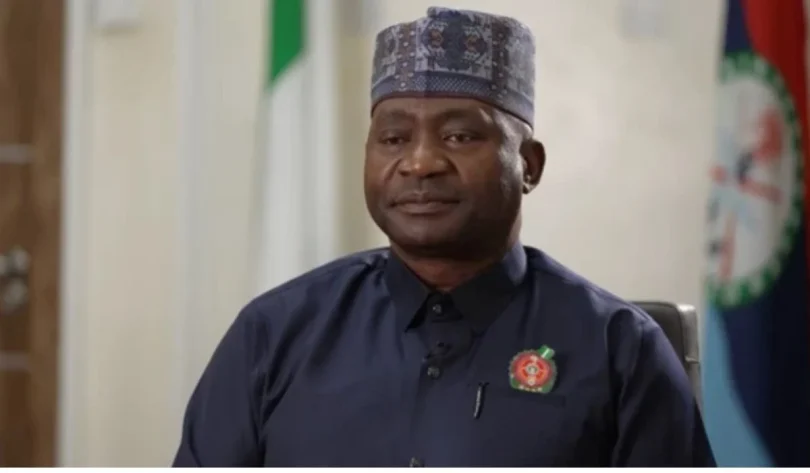
Minister of Defence, Gen. Christopher Musa (retd.), has said the Nigerian military, in collaboration with intelligence and security agencies, has significantly disrupted the financial networks sustaining Boko Haram and the Islamic State West Africa Province (ISWAP).
Musa said the sustained action had weakened the ability of major terrorist groups to launch the large-scale attacks that previously characterised the insurgency, forcing them to increasingly resort to abductions, kidnappings and other criminal activities to generate funds.
The minister disclosed this during a live interview in Abuja, where he spoke on Nigeria’s territorial defence, counter-terrorism financing, border security, political stability and the welfare of military personnel and veterans.
He said sustained military operations deep into terrorist enclaves had disrupted the operational capabilities of the groups and reduced their ability to carry out major attacks.
ALSO READ: CAS Aneke reaffirms commitment to personnel welfare
According to him, “Now, we don’t have those brazen attacks that used to be.
“Before now, Boko Haram would go to places, attack areas, and go. You don’t hear of that anymore. The trajectory has moved from insurgency back downwards toward terrorism, abductions, and kidnapping because that is the easiest way for desperate networks to try and raise money.”
Musa also linked the recent rise in security incidents in some parts of the country to a pattern that had previously been witnessed around major political cycles.
He said concerns had emerged that some of the incidents could be exploited by political actors to generate negative sentiments against the government ahead of the 2027 elections, with campaigns expected to begin in January.
The minister, however, assured Nigerians that security agencies were taking measures to contain the situation and ensure that political campaigns and other activities were conducted without hindrance.
On counter-terrorism financing, Musa said the government was intensifying efforts to dismantle the financial and logistical structures supporting terrorist operations.
He said the military was working with the Nigerian Financial Intelligence Unit to identify and block illicit funding channels, including proxy bank accounts, social media crowdfunding platforms and cryptocurrency transactions.
According to him, Nigeria was also adopting international counter-terrorism financing mechanisms following a high-level engagement with the United States Department of State.
He said the measures would help security agencies identify and isolate foreign influences and links between ISIS and its local affiliates.
Musa warned Nigerians providing logistical assistance to terrorists that such support was prolonging the conflict.
He specifically mentioned the supply of fuel, food and water to terrorist cells as part of the support networks being targeted by security agencies.
On border security, the minister said the government was strengthening surveillance along Nigeria’s borders, particularly areas historically vulnerable to the movement of terrorists, weapons and other criminal elements.
He said the Ministry of Interior and the Nigeria Immigration Service had activated specialised border-control hubs equipped with real-time cameras, with continuous drone surveillance also being deployed.
Musa identified the approximately 1,500-kilometre Nigeria-Niger border as one of the areas requiring increased surveillance.
Beyond technological measures, he said the military had expanded its operational structure from eight to 12 active divisions, with four new divisions established to improve localised security monitoring and response.
He added that the expansion was being supported by increased recruitment into the Nigeria Police Force and the Nigeria Security and Civil Defence Corps, as well as the creation of a new Homeland Adviser position to improve domestic intelligence coordination.
Speaking on the recently foiled plot allegedly aimed at disrupting Nigeria’s democratic process, Musa said investigations by the Department of State Services and the National Intelligence Agency were still ongoing.
He said the investigation would determine the circumstances surrounding the alleged plot and identify those involved.
The minister said the incident had also highlighted the need for stronger vetting procedures within the military and other sensitive government institutions.
He disclosed that stricter vetting protocols had consequently been institutionalised to assess the backgrounds, mental capacity and allegiance of recruits and personnel assigned to sensitive positions, including those deployed to the Presidency.
According to him, the measures followed the alleged involvement of a colonel who misled some younger officers into the plot.
Addressing concerns over the continued presence of terrorist cells despite sustained military operations, Musa said the government was also confronting the ideological roots of terrorism.
He said increased military pressure was encouraging low-level fighters to surrender after realising that they had been deceived into joining the groups.
The minister further disclosed that military operations had led to the rescue of more than 700 abducted persons from captivity.
He said the military would sustain the pressure on terrorist groups until their operational and recruitment capabilities were substantially dismantled.
On the welfare of serving personnel and veterans, Musa said President Bola Tinubu had approved upward reviews of salaries and pensions for serving military personnel and retired members of the Armed Forces.
The minister, who described himself as a military pensioner, also addressed concerns over delays in the payment of veterans’ pensions.
He said presidential directives had resolved the issue, adding that the next harmonised pension payments were scheduled for the end of September 2026.
Musa urged Nigerians to take greater responsibility for national security by promptly reporting suspicious activities to relevant authorities.
He stressed that public cooperation with security agencies remained essential to defeating terrorism and other forms of criminality.
“The armed forces are stable, inter-agency service rivalries have completely gone, and we are working assiduously as a unified unit to guarantee total tactical superiority,” the minister said.