
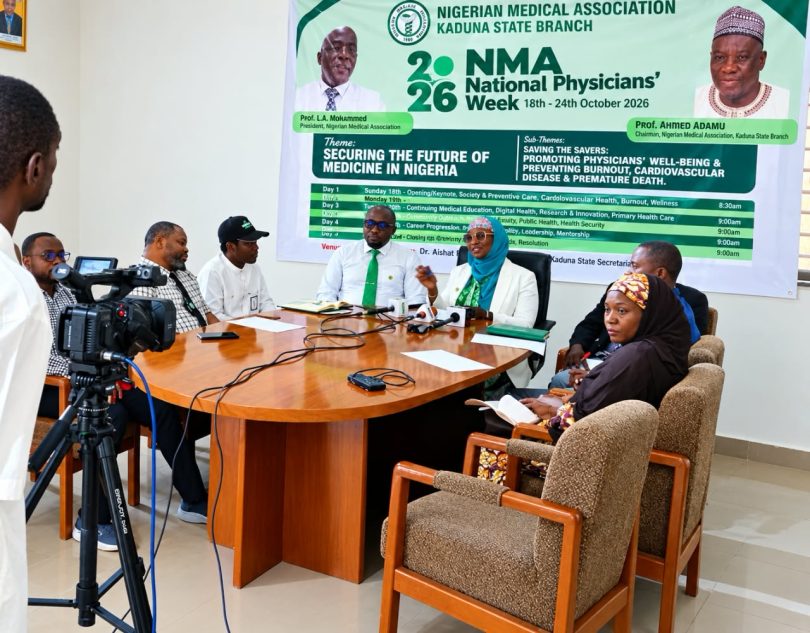
By Israel Bulus, Kaduna
The Nigerian Medical Association, Kaduna State Branch, has urged the government to improve doctors’ remuneration, working conditions and professional welfare to make Nigeria more attractive to medical practitioners and curb the migration of healthcare professionals abroad.
The association warned that poor pay, excessive workloads, insecurity and inadequate welfare threatened the future of healthcare delivery, calling for urgent measures to enable doctors to build fulfilling careers in the country.
The state chairman of the NMA, Dr Aisha Mustapha, made the call at a press conference on Monday ahead of the 2026 Physicians’ Week, themed, “Securing the Future of Medicine in Nigeria.”
Mustapha said doctors should not be expected to remain in Nigeria solely out of patriotism without decent working conditions, professional dignity, security and competitive remuneration.
“Patriotism should be supported by decent working conditions, professional dignity, security, competitive remuneration, opportunities for career development and a health system in which doctors can see a future for themselves and their families,” she said.
She said the association would continue to advocate policies that encouraged medical professionals to remain in Nigeria while promoting collaboration with doctors in the diaspora to strengthen the country’s health system.
Mustapha also expressed concern over threats, intimidation, assaults and other forms of violence against healthcare workers, insisting that hospitals should be places of healing rather than violence.
“The safety of doctors is not negotiable. And when doctors are safe, patients are safer,” she said.
She called for functional hospital infrastructure, adequate medical equipment, safe workplaces and improved conditions of service, adding that the association would engage governments, employers, hospital administrators and security agencies to develop practical measures to protect healthcare workers.
On doctors’ welfare, Mustapha warned against a work culture that glorified exhaustion and discouraged physicians from seeking medical attention or taking adequate rest.
She identified excessive working hours, occupational stress, unsafe working environments, inadequate staffing, delayed entitlements and poor remuneration as factors threatening the wellbeing of medical professionals.
“A physician who is physically exhausted, emotionally depleted, chronically stressed and personally neglected cannot indefinitely provide the quality of care our patients deserve,” she said.
The NMA chairman advocated regular medical checks, healthy lifestyles, adequate rest and access to confidential professional and psychological support for doctors, stressing that their wellbeing was essential to patient safety and effective healthcare delivery.
On technological advancement, she called for the modernisation of medical education to prepare doctors for developments in artificial intelligence, telemedicine, digital diagnostics and electronic medical records.
Mustapha said medical schools needed to equip students with relevant digital health skills while maintaining professional ethics and the human-centred nature of medical practice.
She noted that artificial intelligence could improve diagnosis, clinical decision-making, medical research and access to healthcare, particularly in underserved communities, if deployed responsibly.
However, she warned that technological advancement must not compromise patient confidentiality or widen the gap between urban and rural healthcare delivery.
Mustapha urged the government and other stakeholders to invest in medical education, teaching hospitals, research and the professional development of medical teachers.
She also called for unity among doctors, saying the NMA’s responsibility extended beyond negotiating salaries and conditions of service to defending professional dignity, promoting ethical practice and advocating policies that improved access to quality healthcare.
She said securing the future of medicine required collective action by governments, healthcare institutions, medical professionals and other stakeholders.
End.