
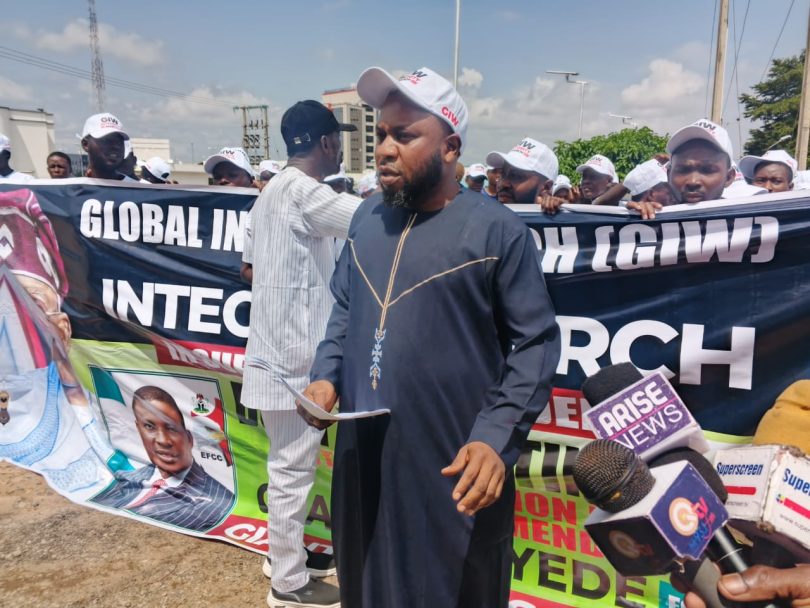
Global Integrity Watch (GIW), an international civil society organisation, has commended the anti-corruption efforts of President Bola Ahmed Tinubu’s administration through the Economic and Financial Crimes Commission (EFCC), while seeking a constructive partnership with the commission to strengthen public accountability.
The organisation also expressed confidence in EFCC Chairman, Ola Olukoyede, and pledged support for lawful initiatives aimed at promoting transparency, protecting public resources and strengthening accountability across public institutions.
GIW made the position known during its Integrity March to the EFCC, where it recognised the commission’s reported achievements in convictions and asset recoveries under Olukoyede’s leadership.
Address the youths during the march, GIW Country Representative, Comrade Eneji Mohammed, on behalf of the Executive Director, Comrade Abraham Temitayo Adewoye, said that the commission’s reported progress should be sustained through professionalism, transparency, fairness and respect for the rule of law.
According to the organisation, the EFCC reported securing 7,503 convictions and recovering approximately ₦566.32 billion, alongside foreign currencies and 1,502 non-monetary assets, between October 2023 and September 2025.
GIW also cited a stewardship briefing published by the EFCC chairman’s office in August 2026, which reportedly put the commission’s convictions at 10,872 between October 2023 and July 2026.
The briefing also reported recoveries of approximately ₦1.234 trillion and $684.48 million between October 2023 and June 2026.
The organisation, however, stressed that public recognition of the commission’s achievements should go hand in hand with continued scrutiny, accountability and respect for the rights of individuals.
Mohammed said: “GIW recognises the anti-corruption efforts reported under President Bola Ahmed Tinubu’s administration and the EFCC leadership. Public recognition should go hand in hand with continued scrutiny, accountability and respect for the rights of all persons.
“Progress is strongest when results are documented, recovered assets are properly accounted for, and investigations and prosecutions follow the law.”
He noted that its interest in collaborating with the EFCC followed discussions at a meeting in London, United Kingdom, on how the organisation could contribute to public accountability in Nigeria.
He said the proposed partnership would be subject to the EFCC’s agreement and respect for the independence of both institutions.
Explaining its approach, he said it promotes accountability through lawful Freedom of Information requests, reviews of published audit reports and official documents, and requests for clarification from public agencies over questioned expenditure, procurement decisions and missing or incomplete records.
He added that unresolved concerns could be pursued through public advocacy, media engagement or referrals to competent authorities, where appropriate.
Mohammed added, “Our work is not a personal attack on any public official or institution. It is a public-interest effort to strengthen governance, improve transparency and support a Nigeria in which public funds are managed responsibly.”
He emphasised that audit observations should be treated as issues requiring clarification rather than proof of wrongdoing.
He also reiterated its support for evidence-based reporting, the presumption of innocence, fair processes and the right of institutions to respond to allegations.
Through its New Nigeria Public Accountability Initiative (NNPAI), GIW said it intended to promote transparency, encourage responsible reporting of suspected wrongdoing and support stronger accountability standards across public institutions.
It clarified that the initiative was not intended to replace law enforcement agencies or prejudge allegations but to complement existing accountability mechanisms through civic engagement, public education, documentary evidence and constructive dialogue.
GIW further encouraged whistleblowers and citizens with credible information about suspected corruption to preserve relevant records and report their concerns through appropriate lawful channels.
The organisation urged public institutions to maintain reliable financial records, comply with disclosure requirements, respond to lawful Freedom of Information requests and explain corrective measures taken when irregularities were identified.
Responding, the EFCC chairman, Ola Olukoyede, represented by the commission’s spokesperson, Dele Oyewale, commended GIW for publicly recognising the agency’s efforts to tackle corruption in Nigeria.
Oyewale urged stakeholders across the country to emulate the organisation by acknowledging the commission’s work while supporting collective efforts to address corruption.
He said Olukoyede had been making sustained efforts to build a stronger and more prosperous Nigeria through the enforcement of anti-corruption laws.
According to him, the commission would continue its efforts to ensure that Nigerians benefit from the gains of the anti-corruption campaign.
Oyewale said: “We want stakeholders across the country to come forward in the same way to appreciate what the commission is doing.
“The Executive Chairman, Mr Olukoyede, is a Nigerian who has been making passionate efforts to engineer a newer, better, stronger and richer Nigeria by applying the instrumentality of anti-corruption laws.
“Every single thing that has been said here will be communicated to the Executive Chairman. I can assure you that, by the grace of God, the commission will continue on this winning streak to ensure that we all benefit from the dividends of the fight against corruption.”
Oyewale also cited the Nigerian Education Loan Fund and the Credit Corporation of Nigeria as examples of initiatives he said reflected the government’s efforts to strengthen institutions and address corruption-related challenges.
He called on citizens and stakeholders to join hands with the commission in tackling corruption, which he described as a major obstacle to national development.
He added, “We want stakeholders across the country to come forward in the same way to appreciate what the commission is doing. This is another reason why all of us should join hands to tackle the monster and cancer of corruption together.”
Oyewale assured GIW that its message would be conveyed to the EFCC chairman and the commission’s management and staff.
GIW reaffirmed its commitment to supporting lawful anti-corruption efforts, stressing that sustained progress required institutional independence, transparency, evidence-based accountability and equal application of the law.
The organisation maintained that protecting public resources and ensuring accountability remained a collective responsibility, adding that public funds belonged to Nigerians and must be managed in the public interest.