
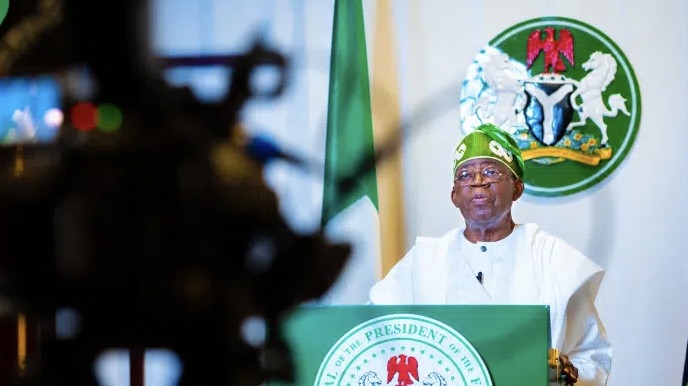
President Bola Tinubu has defended his administration’s plan to obtain additional loans from international institutions and banks, arguing that the impact of borrowed funds matters more than the amount borrowed.
The President said Nigeria must channel financing into projects capable of expanding economic activity, creating jobs and improving the country’s long-term productive capacity.
Tinubu’s position was contained in an essay titled “From Reforms to Delivery: Our Infrastructure Investment and Growth Strategy,” published by his spokesperson, Bayo Onanuga, on X on Thursday.
“The real question is not how much we borrow, but what we build, what value we create and what future we leave behind,” the President said.
He identified major infrastructure projects, including the Lagos-Calabar Coastal Highway, Sokoto-Badagry Superhighway and Trans-Sahara Superhighway, alongside electricity grid upgrades and the modernisation of key commercial ports in Lagos, as important components of the government’s economic strategy.
According to Tinubu, the projects are expected to improve connections between economic regions, reduce transportation costs, expand access to markets and encourage private-sector investment.
He also highlighted planned investments in healthcare, education and vocational training, saying they would complement infrastructure development and strengthen Nigeria’s economic potential.
The President said the Lagos-Calabar Coastal Highway could reduce logistics costs along its corridor by 15 to 20 per cent and contribute up to two per cent to Nigeria’s Gross Domestic Product through increased trade, tourism and industrial activity.
He also projected that the project could generate approximately 100,000 direct jobs in construction and engineering, as well as more than 150,000 indirect jobs across logistics, materials supply and related sectors.
“We are not simply building highways. We are opening economic corridors, connecting markets, unlocking industries and reshaping Nigeria’s economic geography,” Tinubu said.
He argued that the country would require modern infrastructure to support the administration’s ambition of growing the economy to $1 trillion by 2030.
“We cannot build a USD 1 trillion economy with infrastructure designed for an economy a fraction of that size,” he added.
President Highlights Economic Indicators
Tinubu also defended the economic reforms introduced by his administration in May 2023, saying they had helped restore macroeconomic stability, strengthen public finances and improve Nigeria’s position in international financial markets.
Citing government figures, he said Nigeria’s real GDP grew by 4.43 per cent in the second quarter of 2026, while headline inflation declined to 14.63 per cent in September from 20.98 per cent a year earlier.
Also Read: Makinde: We won’t abandon South-East because of Peter Obi
He further stated that the country’s gross external reserves stood at $55.1 billion as of October 9, 2026, including approximately $46 billion in net reserves.
The President also said Nigeria’s tax-to-GDP ratio had increased to 12.5 per cent from seven per cent.
“The decisions taken since 2023 were difficult but necessary,” he said.
Tinubu maintained that the economic indicators and improved investor confidence were creating opportunities for Nigeria to attract long-term financing at lower costs.
“Confidence has a price; our cost of borrowing is going down, and the country risk premium has drastically decreased,” he said.
He cited assessments by international credit rating agencies, index providers, regulators and investors as evidence of improved confidence in Nigeria’s economic management.
The President described the assessments as independent evaluations of the country’s external reserves, macroeconomic policies and financial credibility.