
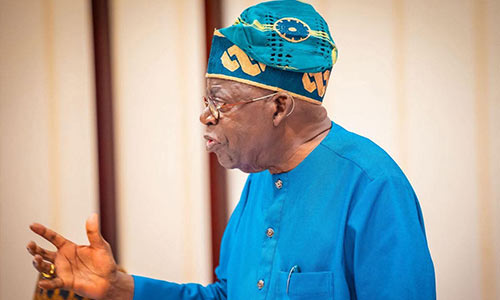
President Bola Tinubu has recalled how he worked as a taxi driver and took on other jobs in the United States to finance his education, saying the experience shaped his determination to expand access to education for Nigerian children regardless of their family backgrounds.
Tinubu, in a statement on Wednesday, said he initially postponed starting school for several months in order to save enough money before moving to Chicago, where he combined different jobs with his university education.
“When I first arrived in the United States as a young man, I drove a taxi to earn money for my education. I even had to postpone starting school for several months to save enough,” the President said.
“When I eventually got to Chicago, I worked different jobs to support myself and pay my way through university. I know what it means to worry about tuition, accommodation and how to make ends meet while pursuing an education.”
Tinubu said those experiences had remained with him and strengthened his belief that access to education should not depend on the financial circumstances of a child’s parents.
“Those experiences have stayed with me. I know what education made possible in my own life, and I believe every Nigerian child deserves that same opportunity, regardless of where they are born or what their parents can afford,” he said.
The President cited the Nigerian Education Loan Fund as one of the interventions introduced by his administration to reduce the financial burden on students and their families.
According to Tinubu, more than ₦372 billion has been provided through NELFUND for institutional charges and student upkeep. Recent disbursement figures have similarly placed total NELFUND funding above ₦372 billion.
He also said the Federal Government’s Technical and Vocational Education and Training programme had attracted more than 2.8 million applications, while 38 technical colleges had been rehabilitated or upgraded.
The upgrade of 38 federal and state technical colleges forms part of the government’s wider effort to strengthen practical and vocational training and equip young Nigerians with employable skills.
Tinubu added that students in federal and selected state technical colleges were benefiting from interventions covering school fees, boarding, textbooks and uniforms.
On university education, the President pointed to the Federal Government’s agreement with the Academic Staff Union of Universities, saying it included a 40 per cent upward review of academic staff remuneration and measures aimed at improving stability in the university system.
“A four-year course must take four years. Our young people deserve to complete their education on time and get on with their lives,” he said.
The Federal Government had earlier announced implementation of the 40 per cent upward review for academic staff from January 1, 2026, as part of its renegotiated agreement with ASUU.
Tinubu also highlighted investments in medical education, saying the government was committing ₦110 billion to the rehabilitation of medical schools as part of efforts to expand Nigeria’s capacity to train healthcare professionals.
He said annual nursing enrolment had increased from 28,000 to 115,000, while enrolment capacity for medical and dental programmes had also increased.
The Federal Ministry of Health and Social Welfare has separately confirmed that annual nursing enrolment capacity increased from 28,000 in 2023 to 115,000.
The President further said more than one million previously out-of-school children had returned to learning, while the government was investing in teacher development, girls’ education and curriculum reforms, including the restoration of Nigerian history to classrooms.
He commended the Minister of Education, Dr Tunji Alausa, the Minister of State for Education, Professor Suwaiba Sa’id Ahmad, and other officials involved in implementing the administration’s education programmes.
Tinubu urged Nigerians to explore opportunities under the Nigeria Education Sector Renewal Initiative, the Federal Ministry of Education’s broad reform programme aimed at improving access, skills development, infrastructure and education outcomes.
He also called on parents, students, teachers and other Nigerians to report challenges affecting education in their communities, saying public feedback would help the government identify gaps requiring attention.
“Our journey from reform to opportunities and shared prosperity must begin with education,” Tinubu said.
“The circumstances of a child’s birth should never determine the limits of their ambition. Our responsibility is to give every Nigerian child a fair chance to fulfil their potential.
“We have more work to do, and I am determined to see it through.”
Post Title: “I Drove A Taxi To Pay For My Education” — Tinubu Recalls U.S. Struggles, Highlights ₦372bn Student Loans By Naijaonpoint.