
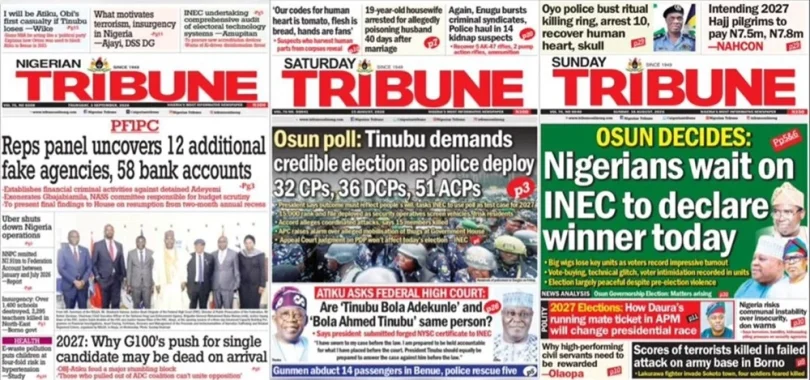
With newspapers’ front pages increasingly shared as screenshots, cropped images, and forwarded posts on social media to misinform people ahead of the 2027 general elections in Nigeria, it can sometimes be difficult to tell whether a front page is genuine or has been altered.
For readers who want to confirm that a newspaper front page is actually from the African Newspapers of Nigeria plc, publisher of the Nigerian Tribune titles, the masthead, positioning of key elements, typography, ear-pieces, colour treatment and overall page structure can provide useful clues.
The Nigerian Tribune (Monday to Friday), Saturday Tribune and Sunday Tribune have distinctive front-page identities. While the stories and visual treatment change from one edition to another, several design features remain useful in identifying each publication.
Here are some of the key things to look out for:
1. Check the position of “NIGERIAN” on the Monday to Friday title
One of the first things to examine is the word “NIGERIAN” above the main masthead.
On the Monday to Friday front page, “NIGERIAN” appears in solid black block letters directly above the “TRI” portion of the main red “TRIBUNE” masthead.
This positioning is an important visual identifier because the word is not simply placed randomly above the newspaper’s name.
2. Look at the Coat of Arms-like emblem and “SINCE 1949”
The Nigerian Coat of Arms-like emblem, extracted from the logo of the company, is another prominent feature of the Tribune masthead.
On the Monday to Friday title, the stylised Nigerian coat of arms icon and the “SINCE 1949” inscription are positioned around the centre of the masthead, with the logo aligned directly above the “I” in “TRIBUNE.”
A reader checking an unfamiliar front page should therefore pay attention to the relationship between the emblem, the masthead and the founding-year inscription.
3. Examine the three top ear-pieces
The Nigerian Tribune (Monday to Friday) typically features three distinct bordered ear-piece teaser boxes arranged horizontally across the top margin above the masthead.
These boxes carry short headlines designed to draw attention to other important stories inside the newspaper.
Their number, placement and bordered presentation can provide another clue when checking whether an image represents the newspaper’s front page.
4. Study the overall front-page grid
Monday to Friday editions generally use a text-heavy front-page grid, accommodating several stories beyond the main lead.
The layout can include secondary sub-lead stories, brief summaries, bullet-style information and a prominent captioned group photograph.
This dense presentation is part of the newspaper’s visual identity and distinguishes it from publications that rely more heavily on a single dominant photograph or a minimalist front page.
5. Look for solid category kicker boxes
Another useful feature is the use of solid rectangular kicker boxes to identify categories.
For example, a lower-grid story may carry a solid pinkish-red box labelled “HEALTH.”
These coloured category labels help organise secondary stories and are an additional visual clue when examining a suspected Nigerian Tribune (Monday to Friday) front page.
Saturday Tribune
The Saturday edition has its own visual characteristics and should not be confused with the regular Nigerian Tribune.
6. Check where “SATURDAY” appears
On the Saturday Tribune, the word “SATURDAY” appears in all-caps black text, aligned to the left directly above the “TR” of the main masthead.
This is one of the easiest features to check when identifying the weekend edition.
7. Examine the Coat of Arms-like emblem position
The company’s logo, which looks like the Nigerian Coat of Arms, remains central to the masthead.
On the Saturday Tribune, the emblem sits directly above the “I” in “TRIBUNE,” positioned between “SATURDAY” on the left and “SINCE 1949” on the right.
8. Look for two large ear-piece teasers
Unlike the three-ear-piece arrangement associated with the Nigerian Tribune description, the Saturday Tribune usually features two wide, high-impact ear-piece boxes across the top margin.
ALSO READ: UPDATE: Students loan forgiveness, six other Atiku’s recent campaign promises ahead 2027
These often highlight human-interest or feature-oriented stories and may include red page-callout ovals.
Their larger format gives the Saturday edition a more feature-driven appearance.
9. Check the main headline typography
The Saturday Tribune uses a highly prominent main headline treatment.
Its lead story can feature massive, ultra-bold black typography against a white background, giving the headline strong visibility on the page.
This high-contrast approach is one of the visual characteristics readers can examine when distinguishing the Saturday edition.
10. Look for the bottom accent banner
Another feature associated with the Saturday Tribune is a full-width coloured header box across the lower columns.
A solid red bar, for example, may be used to introduce or organise secondary story highlights.
The banner helps create a visual anchor at the bottom portion of the front page.
Sunday Tribune
The Sunday Tribune has an even more distinctive visual treatment, particularly in the way it presents major stories.
11. Check the “SUNDAY” prefix
On the Sunday Tribune, “SUNDAY” appears in a larger, distinct black sans-serif font directly above the “TR” of the main masthead.
This positioning is a useful first check when determining whether an image belongs to the Sunday edition.
The Nigerian coat of Arms-like emblem is positioned directly above the “I” in “TRIBUNE.”
It is flanked by “SUNDAY” on the left and “SINCE 1949” on the right.
The precise relationship among these three elements provides a useful visual reference for readers examining a suspected Sunday Tribune front page.
13. Look for large colour kicker banners
Sunday Tribune front pages can use oversized, full-width coloured background banners beneath the metadata strip.
Bright colours such as yellow or red may be used to highlight major investigative, political or special series.
These banners give the Sunday edition a particularly strong visual presence.
14. Examine the headline and portrait treatment
The Sunday Tribune can use oversized headline typography alongside large cutout images of political figures.
The portraits may extend or overlap into the headline area, creating a more dramatic front-page composition.
When checking a suspected front page, readers should therefore examine how the main photograph interacts with the headline rather than looking at the headline alone.
15. Check for angled red page badges
Another distinctive feature is the use of slanted red oval page badges placed beside lead and sub-lead stories.
Badges such as “p6,” “p7” or “p10” can direct readers to the pages where the full stories appear.
Their position, shape and relationship with the headlines can help establish whether the page follows the expected Sunday Tribune design.
16. Don’t judge authenticity by the headline alone
A genuine-looking headline does not necessarily mean that the entire front page is authentic.
A manipulated image can copy a real Tribune headline while changing the photograph, date, page number, quotation or other details.
Readers should therefore examine the masthead, date, story arrangement, typography, photographs and page references together.
17. Check the masthead before the story
The masthead is often more useful than the headline when identifying a newspaper edition.
Start by checking:
The position of NIGERIAN, SATURDAY or SUNDAY.
The red TRIBUNE wordmark.
The position of the Nigerian Coat of Arms-like emblem.
The “SINCE 1949” inscription.
The alignment of these elements with the letters in the masthead.
If these elements appear inconsistent with the expected Tribune design, the image deserves closer scrutiny.
18. Compare the page architecture
The overall architecture of the page can also provide clues.
Look at the number and position of ear-pieces, the size of the lead headline, the arrangement of secondary stories, photographs, kicker boxes and coloured banners.
A genuine newspaper front page normally follows a deliberate editorial and design structure rather than having unrelated elements placed together.
19. Verify the edition, not just the newspaper name
Finally, remember that the Nigerian Tribune, Saturday Tribune and Sunday Tribune are distinct editions.
The word “TRIBUNE” alone is therefore not enough to establish authenticity as The Daily Tribune is different from the Nigerian Tribune which is the regular edition for daily publication.
A proper check should establish:
Whether it is the Nigerian Tribune (Monday to Friday), Saturday, or Sunday edition.
Whether the edition’s prefix is correctly positioned.
Whether the Coat of Arms is correctly aligned.
Whether the ear-piece arrangement matches the edition.
Whether the headline typography is consistent.
Whether the colour kicker boxes and banners fit the publication’s design.
Whether the photographs, captions and page references appear coherent.
20. Look for the background colour of the lead story
While the Nigerian Tribune (Monday to Friday) consistently uses a plain white background for its lead story, both weekend editions (Saturday and Sunday) mostly use deep black and green, respectively, as the background for their lead stories.
Check samples below:


