
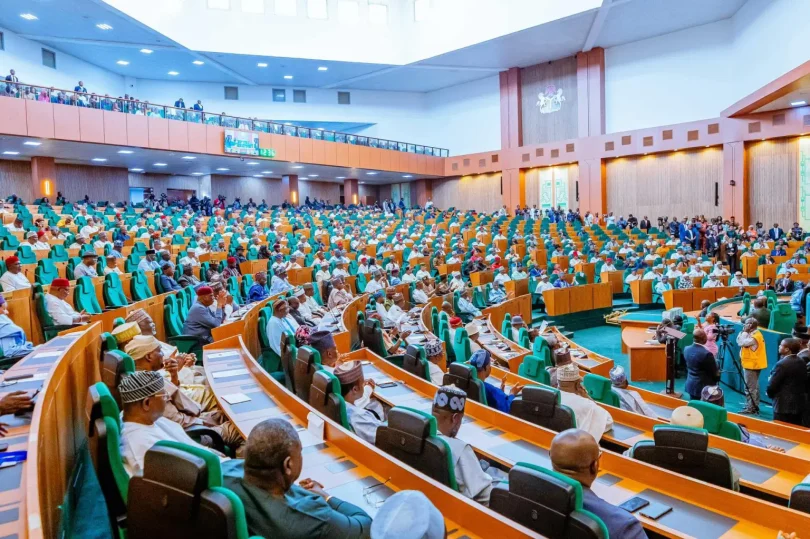
The House of Representatives has directed the Central Bank of Nigeria (CBN), the Nigerian Incentive-Based Risk Sharing System for Agricultural Lending (NIRSAL), and the Small and Medium Enterprises Development Agency of Nigeria (SMEDAN) to restructure the repayment system for COVID-19 loans disbursed to Nigerians.
Lawmakers called for reduced interest rates, extended repayment periods, and a more flexible repayment process to prevent small businesses from collapsing amid the country’s economic challenges. The decision follows widespread complaints from borrowers whose accounts were reportedly being debited without their consent.
The House also urged the Ministry of Finance to suspend all forceful recoveries and to consider waiving loans for low-income earners and small business owners. Rep. Saidu Abdullahi, who moved the motion, emphasized that many borrowers are genuinely unable to repay due to prevailing economic hardships.
Stakeholders have further called on the CBN and NIRSAL Microfinance Bank (NMFB) to release detailed records of the COVID-19 loans. Established in 2020, the Targeted Credit Facility (TCF) was designed to cushion the economic effects of the pandemic on individuals and small businesses. Records indicate that about ₦419.42 billion was disbursed to 792,936 beneficiaries, including households and small enterprises.
Some beneficiaries have raised concerns that their bank savings were being depleted without authorization. Economists and policy analysts highlighted the lack of transparency around repayments. Bola Adeola, an economist, noted that auto-debits for COVID-19 loans only began recently and that accountability remains limited.
Policy analyst Seidu Yusuf explained that many borrowers mistakenly believed the funds were grants. “Some people thought this money was free, but it is a loan that must be repaid. If not, NIRSAL can automatically deduct funds from any account linked to your BVN,” he said.
A banker, Emmanuel Owen, observed that several borrowers spent the funds without a clear repayment plan, contributing to frustrations as accounts are now debited.
An anonymous CBN official confirmed that NIRSAL manages the disbursement and recovery process, adding that tracking repayments has been challenging. Of the ₦419 billion disbursed, only ₦41 billion has been repaid, ₦261 billion remains in default, and ₦116 billion is being restructured or is under repayment.
The official stressed that beneficiaries’ BVNs allow NIRSAL to access linked bank accounts, a measure that has surprised many borrowers who assumed repayment would not be enforced.