
The Federal Government has said the removal of fuel subsidy and unification of the foreign exchange market have strengthened Nigeria’s fiscal position, improved economic stability and created resources for investments in infrastructure, security, human capital and social protection.
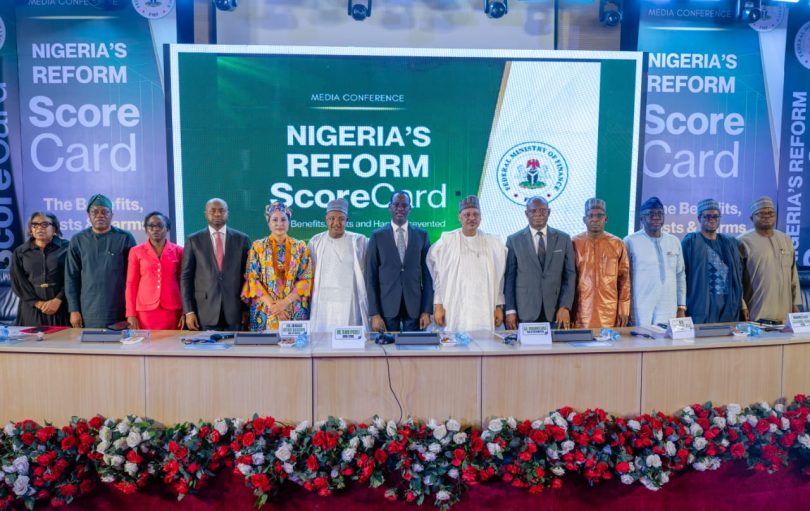
Minister of Information and National Orientation, Mohammed Idris, stated this on Wednesday in Abuja at a press conference where the government presented its “Nigeria’s Reform Scorecard: The Benefits, Costs and Harms Prevented.”
The scorecard provided details on the resources generated through the reforms and their broader impact on the Nigerian economy.
Idris described the removal of fuel subsidy as one of the most significant and difficult economic decisions taken by the administration of President Bola Ahmed Tinubu, acknowledging that the policy had imposed significant costs and adjustments on households, businesses and communities.
He, however, said the reform was necessary to redirect resources previously committed to what he described as an unsustainable subsidy regime towards investments capable of delivering greater and more sustainable value to Nigerians.
“Citizens have a right to know what resources have been freed up, what these resources mean for the Federation, and how the benefits of reform are being translated into tangible improvements in their lives,” Idris said.
According to him, the government’s responsibility goes beyond announcing policies to explaining their implications, accounting for their outcomes and demonstrating how difficult decisions are laying the foundation for a stronger and more sustainable economy.
The minister commended the Minister of Finance and Coordinating Minister of the Economy, Taiwo Oyedele, and the economic management team for presenting the reform scorecard and providing the facts, figures and methodology used in assessing the reforms.
Presenting the scorecard, Oyedele said the exercise was not intended to declare victory for the administration but to provide Nigerians with an honest assessment of the costs, benefits and harms prevented by the reforms.
He disclosed that between June 2023 and December 2025, savings from the removal of fuel subsidy generated ₦15.8 trillion for the Federation.
Of the amount, Oyedele said ₦5.4 trillion accrued to the Federal Government, while ₦10.4 trillion was shared among state and local governments.
He further disclosed that the Federal Government generated ₦3.1 trillion in incremental independent revenue and ₦11.9 trillion in incremental borrowing, bringing total incremental Federal Government resources to ₦20.4 trillion.
However, incremental expenditure during the period stood at ₦30.64 trillion.
“We are not here to pretend these reforms were painless. We are here to show you, honestly and with the numbers, what they cost, the benefits they delivered, and the harm they prevented,” Oyedele said.
The finance minister said the reforms had contributed to improvements in several macroeconomic indicators, including inflation, foreign reserves, market capitalisation and real Gross Domestic Product growth.
He said headline inflation had eased to 15.91 per cent as of June 2026, while gross foreign reserves stood at $52.5 billion. According to Oyedele, real GDP growth had also strengthened to 3.89 per cent.
He further highlighted Nigeria’s improved position within the international financial system, including a sovereign credit rating upgrade by S&P Global and the country’s exit from international anti-money laundering deficiency lists.
Despite the reported improvements, Oyedele acknowledged that the reform process was still a work in progress, particularly regarding household welfare and poverty reduction.
He said the next phase of the government’s economic programme would place greater emphasis on converting macroeconomic gains into tangible improvements in the living conditions of ordinary Nigerians.
Also speaking, the Minister of Budget and Economic Planning, Abubakar Atiku Bagudu, explained that the reforms were necessitated by the fiscal challenges inherited by the Tinubu administration.
According to Bagudu, Nigeria had one of the world’s lowest revenue-to-GDP ratios, leaving the country with limited fiscal capacity relative to its population and developmental needs.
He said the administration therefore had to make difficult choices to address fiscal leakages, restore confidence in the economy and create greater room for investment in security, infrastructure, human capital development and grassroots development.
Bagudu said President Tinubu chose to confront the economic realities inherited by his administration rather than apportion blame, adding that lessons from international experience informed the government’s approach to the reforms.
He said the reforms had also been accompanied by interventions aimed at cushioning their effects on vulnerable Nigerians.
The minister added that increased government revenues would provide greater capacity to meet constitutional responsibilities and fund development programmes.
He said resources generated and mobilised through the reforms were being invested in projects and programmes across the six geopolitical zones.
According to him, improved connectivity, security, infrastructure and economic opportunities would ultimately benefit Nigerians across the country.
Idris, meanwhile, reaffirmed the administration’s commitment to continued engagement with Nigerians on the progress, challenges and outcomes of its economic reforms.
He said the government would continue working to ensure that improved fiscal stability translates into better living conditions, greater economic opportunities and improved public services.
The press conference was attended by the Minister of State for Finance, Doris Uzoka-Anite; Accountant-General of the Federation, Shamseldeen Babatunde Ogunjimi; Statistician-General of the Federation, Semiu Adeyemi Adeniran; Permanent Secretary, Federal Ministry of Finance, Raymond Omachi; and other senior government officials.
Also present were the Executive Chairman of the Nigeria Revenue Service, Zacch Adedeji; Director-General of the Debt Management Office, Patience Oniha; Director-General of Budget, Yakubu Tanimu Kurfi; and Director-General of the National Orientation Agency, Lanre Onilu, among others.