
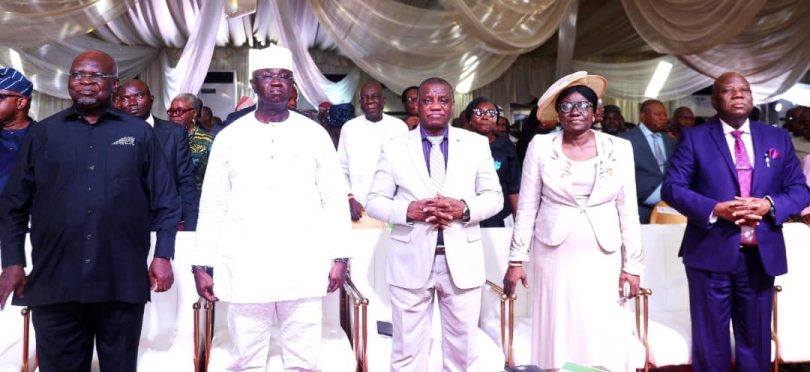
The General Overseer of the Foursquare Gospel Church in Nigeria, Rev. (Dr.) Sam Aboyeji, has called for greater attention to the values, institutions and leadership principles needed to build a nation capable of achieving sustainable development.
Aboyeji made the call on Thursday, September 10, 2026, at the 13th Annual Public Lecture of the Foursquare Gospel Church in Nigeria, held in Lagos with the theme, “Building to Last: Faith, Infrastructure and the Future of a Nation.”
He said nation building must go beyond the construction of roads, bridges, railways, airports, schools and hospitals, stressing that sustainable development also requires strong institutions, competent leadership, integrity and faith in the future.
Quoting Psalm 127:1, Aboyeji said, “If the Lord does not build the house, the work of the builders is useless; if the Lord does not protect the city, it does no good for the sentries to stand guard.”
The General Overseer said the church considered it a responsibility to contribute to Nigeria’s development beyond prayers, describing the annual lecture as a platform for intellectual discourse and the provision of godly counsel on governance, development and national transformation.
According to him, the Foursquare Gospel Church, with 71 years of presence and engagement across Nigeria’s 36 states, remained committed to contributing to the progress and prosperity of the country.
He said the lecture had, over the years, brought together scholars, technocrats, political leaders and religious figures whose contributions had enriched discussions on nation building.
Aboyeji expressed confidence that the guest speaker, Dr. Segun Aina, OFR, former Chairman of Odu’a Investment Company, would provide valuable insights into the theme.
He also acknowledged the event chairman, Prince Clem Agba, CON, former Minister of State for Budget and National Planning, as well as the panelists, including Engr. Olufunmilayo Kadri, Managing Director of the Association for Consulting Engineering in Nigeria; Engr. Joseph Ciroma, professional engineer and management executive; and Chief Osita Chidoka, OFR, former Minister of Aviation.
Aboyeji urged participants to ensure that the discussions translated into practical steps towards inclusive growth, economic stability and shared prosperity.
Citing Isaiah 58:12, which speaks of those who would “build the old waste places” and “raise up the foundations of many generations,” he urged Nigerians to embrace the responsibility of repairing and restoring the nation.
In his presentation, Dr. Segun Aina urged Nigerians to look beyond physical infrastructure and pay greater attention to what he described as the nation’s “invisible infrastructure.”
Aina’s central proposition was that “character sits upstream of infrastructure,” arguing that people are ultimately responsible for building, managing, maintaining and protecting roads, bridges, railways, power plants and other public assets.
He identified three interconnected dimensions of national development: physical, institutional and moral infrastructure.
While physical infrastructure consists of tangible projects, institutional infrastructure includes the courts, civil service, regulatory agencies, procurement systems and electoral bodies that enable society to function predictably. Moral infrastructure, he said, is anchored on trust, fairness, integrity, restraint and professional ethics.
According to him, the effectiveness of physical projects depends significantly on the quality of the institutions and people responsible for them. He therefore argued that investment in competent professionals and effective institutions should be regarded as developmental capital rather than merely recurrent expenditure.
Aina cited judges, engineers, regulators and civil servants as examples of human capital whose competence and integrity can determine whether public institutions deliver on their mandates.
He said Nigeria’s nation building aspirations should extend beyond physical development to creating a society founded on justice and freedom. Constitutional protections, judicial independence and restraints on political power, he noted, are important expressions of those ideals.
He stressed that institutional principles must apply consistently, regardless of the identity, political affiliation or status of the person affected. He also raised concerns about the practical operation of justice, including prolonged detention and bail, arguing that legal processes should continually be assessed against the objective of delivering justice.
The lecturer linked institutional quality to economic development, noting that investors consider not only infrastructure but also government predictability, contract enforcement, regulatory consistency and fairness in the application of rules.
He argued that strong institutions can shape public behaviour by rewarding integrity, making misconduct costly and ensuring that competence has consequences.
Aina therefore urged Nigeria to focus not only on finding virtuous leaders but also on building systems that encourage responsible conduct and restrain abuse of power.
He concluded that sustainable development requires both visible structures and the institutional and moral foundations that give them durability including competent institutions, justice, integrity and responsible leadership.
The Chairman of the event, Prince Clem Agba, has urged Nigerian leaders to shift from prioritising highly visible projects to investments that directly reduce poverty and improve citizens’ quality of life.
Agba, a former Minister of State for Budget and National Planning, made the call in his opening remarks at the lecture.
He warned that nations, like organisations, could drift into underdevelopment when leaders consistently choose projects that offer immediate political rewards over long term investments in education, healthcare, water, sanitation, rural roads and other basic infrastructure.
Drawing on Nigeria’s 2022 Multidimensional Poverty Index (MPI), which he supervised while in government, Agba said about 133 million Nigerians were multidimensionally poor, with rural communities and children bearing a disproportionate burden.
He noted that 72 per cent of rural Nigerians were affected, compared with 42 per cent in urban areas, while two-thirds of children aged 0–17 were classified as multidimensionally poor.
According to him, poverty varies significantly across states, ranging from 27 per cent in Ondo to 91 per cent in Sokoto, making state specific interventions essential.
He argued that infrastructure planning should therefore be guided by data and the actual deprivation levels of communities rather than political visibility or public applause.
Agba further maintained that more than 90 per cent of the deprivations measured by the MPI fall within the responsibilities of state and local governments, including basic education, primary healthcare, water, sanitation, housing and rural roads.
He consequently called for stronger accountability among governors and local government chairmen.
Linking nation building with Christian values, Agba said Nigeria must combine infrastructure development with righteousness, integrity and responsible stewardship.
He urged government, the private sector, churches, civil society and citizens to work together to build a country where prosperity is broadly shared and every citizen can fulfil his or her potential.
Agba charged public officials to measure their success by the lives improved through their stewardship, rather than by votes, titles, contracts or the visibility of projects.
“May today move us from reflection to action; may we build with wisdom, serve with integrity, lead with faith, and ensure that everything we build, under God, is built to last,” he said.