
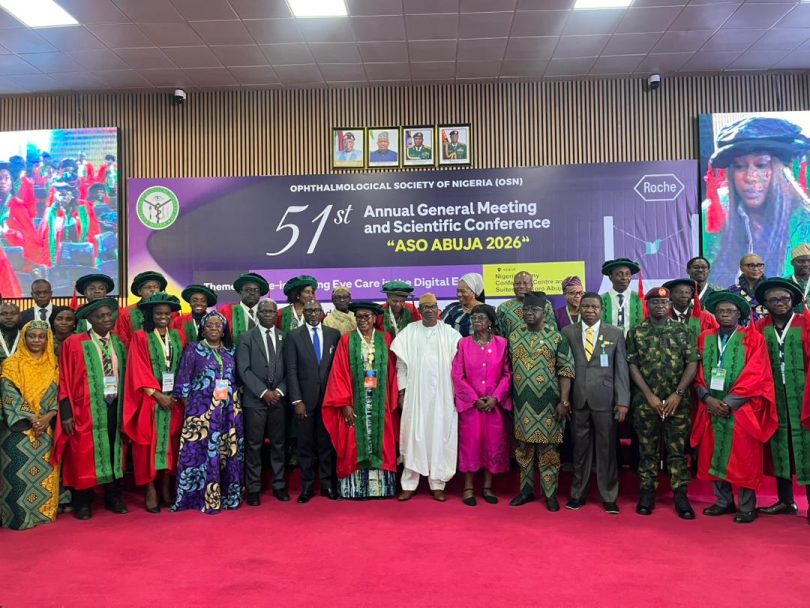
The Federal Government has stepped up efforts to tackle avoidable blindness in Nigeria, targeting the distribution of at least five million free pairs of spectacles and 25,000 cataract surgeries by the end of 2027 through expanded digital and primary healthcare interventions.
The Minister of State for Health and Social Welfare, Dr. Iziaq Adekunle Salako, disclosed this on Wednesday in Abuja at the 51st Annual General Meeting and Scientific Conference of the Ophthalmological Society of Nigeria (OSN), themed, “Re-imagining Eye Care in the Digital Era.”
Salako said the government was leveraging digital technologies, including tele-ophthalmology, remote screening, smartphone-based cameras, digital diagnostic tools and artificial intelligence, to extend eye-care services beyond tertiary hospitals to primary healthcare centres and underserved rural communities.
He said the expansion was being undertaken through the DigiBola 2.0 programme under the Renew Hope HealthConnect initiative.
According to him, nearly two million Nigerians have already been screened under the initiative, while more than 1.3 million people have received free reading glasses.
“Digital transformation is no longer a futuristic vision. It is now an active and indispensable tool for expanding access, improving clinical outcomes, and eliminating avoidable blindness across our nation,” the minister said.
He urged ophthalmologists, technology developers and other stakeholders to develop affordable digital solutions capable of functioning in low-resource and off-grid communities, warning that technology must not deepen existing inequalities in access to healthcare.
Salako also called for increased research and policy collaboration to strengthen national eye-health data and develop appropriate ethical frameworks for the use of artificial intelligence in clinical practice.
ALSO READ: FCTA begins investigation into Airport road, Lokogoma flooding incident
The President of the Nigerian Medical Association (NMA), Prof. Afekhide Ernest Omoti, said emerging technologies such as artificial intelligence, telemedicine, advanced diagnostics and data-driven clinical practice could transform eye care by making services more accessible, efficient and patient-centred.
He, however, cautioned that technological advancement must be accompanied by strong professional ethics, patient safety and equity.
“As we embrace innovation, we must remain firmly anchored on professional ethics, patient safety, equity, human dignity and higher standards of clinical practice,” Omoti said.
He urged stakeholders to deploy technology to bridge gaps in eye-care access, particularly in rural and underserved communities.
The Chairman of the House of Representatives Committee on Health, Dr. Amos Magaji, who represented the Speaker of the House of Representatives, called for the integration of eye care into primary healthcare to enable Nigerians to access basic services closer to their homes.
Magaji said the Basic Healthcare Provision Fund should be deployed to strengthen primary healthcare centres for basic eye screening, early detection, treatment of common eye conditions, health education and referral.
He also expressed concern over the growing effects of prolonged exposure to digital screens, particularly among children, young people and professionals.
“The increasing use of smartphones, computers, tablets, and other display screen equipment is contributing to digital eye strain, dry eyes, blurred vision, headache, and visual discomfort,” he said.
The lawmaker also advocated stronger regulation of ophthalmic technologies and digital health platforms, stressing that technological innovation must remain subject to ethical standards and patient-safety considerations.
“The future of eye care is not technology alone. It is technology guided by ethics, regulated in the public interest, delivered by health professionals, and centred on the dignity of our patients,” Magaji said.
The President of the Ophthalmological Society of Nigeria, Dr. Gloria Patrick-Ferife, said the country must adopt technology that is affordable, sustainable and equitable, particularly for people who remain underserved.
Patrick-Ferife disclosed that more than 24 million Nigerians were living with sight loss, with 84 per cent of the burden attributed to preventable and avoidable causes.
“Our job as Ophthalmologists and leaders of the Eye Care Team is to address the over 24 million Nigerians currently living with sight loss, 84 per cent of which is due to preventable and avoidable causes,” she said.
She called for stronger collaboration among ophthalmologists, optometrists, ophthalmic nurses, opticians and other members of the eye-care team to confront the country’s growing eye-health burden.
The conference planning committee chairperson, Prof. Regina Morgan, said digital tools should be deployed to expand access to eye care while preserving the human element of medical practice.
Morgan identified cataract backlogs, glaucoma-related blindness, childhood visual impairment and inadequate manpower as persistent challenges confronting eye care in Nigeria and across Africa.
“How do we leverage digital tools not to replace the human touch, but rather to expand our reach, improve accuracy, and make eye care more accessible, affordable, and excellent?” she asked.
She also raised concerns over burnout and brain drain among healthcare workers, stressing that the wellbeing of medical professionals remained critical to quality healthcare delivery.
“If we are to deliver digital, modern, excellent care, we must first protect our own mental health, our skills, our families, and our joy in the profession. A tired, broken carer cannot give excellent care,” Morgan said.
Meanwhile, the Mandate Secretary, Health Services and Environment Secretariat, FCT Administration, Dr. Adedolapo Fasawe, disclosed that the Federal Capital Territory had increased the number of eye surgeries performed annually from 745 in 2021 to more than 1,200 in 2025.
She said ophthalmology services were currently available in four FCT hospitals, while approval had been secured to establish a comprehensive and subspecialty eye-training centre at Bwari General Hospital.
“Our ophthalmology residency programme has received full accreditation from both the National Postgraduate Medical College of Nigeria and the West African College of Surgeons,” Fasawe said.
She added that FCT residents had emerged as the best candidates in Part One and Part Two examinations conducted by the two postgraduate medical colleges.
In Nasarawa State, the Governor, Engr. Abdullahi Audu Sule, represented by his Deputy, Dr. Emmanuel Akabe, pledged continued support for OSN activities and eye-care interventions in the state.
Akabe said the state was upgrading the former specialist hospital in Akwanga into a specialist hospital and trauma centre, with billions of naira committed to the project.
He said the government was also working to align the salaries of doctors in its specialist hospitals with those of their federal counterparts as part of efforts to attract and retain medical specialists.
“All the medical students and students of health, including nurses, are also going to be placed on salary from their clinical classes,” he said, adding that the state also planned to establish a medical school.
The Registrar and Chief Executive Officer of the Medical and Dental Council of Nigeria, Prof. Fatima Kyari, urged medical specialists to register their additional qualifications with the council as it updates its master register.
“We are updating our master register, which is the backbone of ethical medical practice, and it’s going to be published,” Kyari said.
She explained that proper documentation of additional qualifications was necessary for specialists to receive formal recognition of their areas of specialisation.
Representing the Chief of Army Staff, Lieutenant General Waidi Shaibu, the Corps Commandant, Nigerian Army Medical Corps, Brigadier General Innocent Omachola, disclosed that the Nigerian Army had upgraded eye departments in 44 Nigerian Army Reference Hospitals.
He said the military was also sponsoring advanced training, residency programmes and subspecialty exposure for its medical personnel in ophthalmology.
“The military has actively prioritised and sponsored the advanced training and specialisation of military personnel in the field of ophthalmology by building internal capacity, sponsoring residency training programmes, and encouraging subspecialty exposure,” Omachola said.
He added that specialised eye-care services provided by the military were available not only to personnel and their families but also to neighbouring civilian communities.