
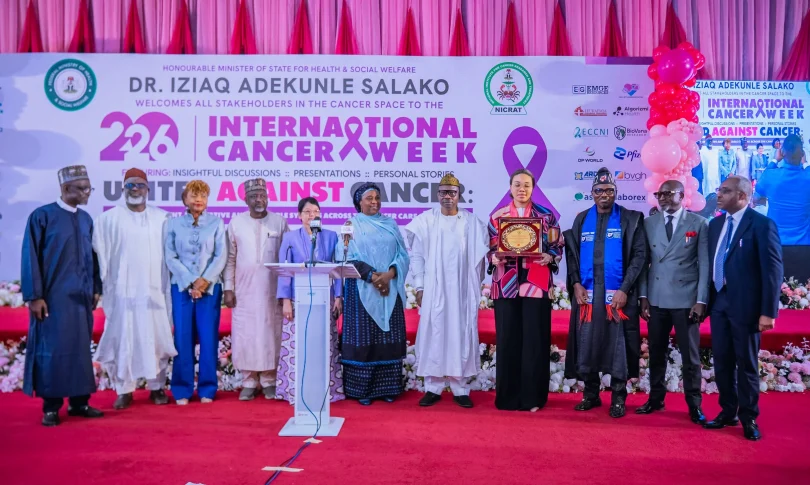
The Federal Government is expanding Nigeria’s cancer-treatment capacity with plans to procure 35 linear accelerators over the next three years and establish six cancer centres of excellence to improve access to diagnosis and treatment.
The Minister of State for Health and Social Welfare, Dr Iziaq Adekunle Salako, disclosed this on Tuesday in Abuja while declaring open the 2026 International Cancer Week, organised by the National Institute for Cancer Research and Treatment (NICRAT).
Salako said three cancer centres of excellence had already been constructed and commissioned, while another three were under construction, as part of measures to strengthen the country’s capacity to manage the growing cancer burden.
He said the government was also advancing cancer care through the NSIA-Medserve Cancer Centres, the construction of the NICRAT headquarters and the introduction of immunohistochemistry services under the Nigeria Cancer Access Partnership Programme, supported by Roche.
The minister said the investments were aimed at ensuring that a cancer diagnosis would no longer automatically translate into poor outcomes for Nigerians.
He said cancer remained a major public health challenge, with poor awareness, limited screening, gaps in diagnostic services, late presentation, financial barriers, workforce shortages and inadequate treatment infrastructure contributing to the burden.
Salako said the government was therefore adopting an integrated approach covering prevention, screening, early detection, timely diagnosis, treatment, rehabilitation, survivorship, and palliative and end-of-life care.
He said the Federal Government was also strengthening patient-centred cancer care through the Technical Working Group on Cancer Patient Navigation, while the National Cancer Health Fund and the Catastrophic Health Fund were being used to improve access to treatment and reduce financial hardship.
According to him, Nigeria has expanded prevention and early-detection services through eight NICRAT Preventive Oncology Clinics across the six geopolitical zones, alongside nationwide awareness campaigns.
He said more than 18 million girls aged nine to 14 had been vaccinated against future cervical cancer, while the National Taskforce on Cervical Cancer Elimination was coordinating efforts towards the World Health Organisation’s 2030 elimination target.
Salako said innovation would also play a central role in cancer control, with the government looking to deploy digitalisation, artificial intelligence, telemedicine, molecular diagnostics, precision medicine, cancer registries and data analytics.
He, however, stressed that such innovations must be affordable, appropriate, scalable and sustainable, while research should be translated into policies and programmes that improve patient outcomes.
The minister said the government’s cancer-control roadmap was contained in the costed National Cancer Control Plan 2026–2030 and the Nigeria Nuclear Medicine Strategic Plan.
He added that a technical working group and a global advisory committee comprising cancer experts from around the world had been inaugurated to support the implementation of the plans.
Salako said the Federal Government was targeting a 30 per cent reduction in the national cancer burden by 2030 through improved data management, early-diagnosis tracking and standardised treatment protocols.
Speaking at the event, the President and Chief Executive Officer of the Nigerian Cancer Society, Prof. Abidemi Emmanuel Omonisi, called for stronger coordination among stakeholders to translate cancer-control commitments into measurable action.
Omonisi said cancer-control efforts must remain centred on patients and communities, noting that prevention, early detection, accurate diagnosis, timely treatment, palliative care, survivorship and access to quality services must all be strengthened.
“Cancer control is not limited to major cities and tertiary institutions. The realities of underserved and vulnerable communities must remain at the centre of our national response,” he said.
He called for partnerships that move beyond meetings to implementation, research that addresses real-world needs, adequately financed policies and affordable innovations capable of reaching underserved populations.
“We need Nigerian evidence to inform Nigerian solutions. Research must therefore move beyond publication to policy, practice and measurable outcomes,” Omonisi said.
He also urged stronger community engagement through partnerships with traditional and religious leaders, community organisations, cancer survivors and patient advocates to improve awareness and promote early presentation.
Omonisi challenged stakeholders participating in the International Cancer Week to identify concrete actions that could be implemented after the event.
“Let ICW 2026 be more than a week of conversations. Let it be a week of commitments that lead to action,” he said.
Salako, who commended NICRAT for organising the event, also congratulated the institute and other stakeholders on the launch of the Nigeria Cancer Research Journal and the Standard Operating Procedures for Cancer Registries.
He said the two documents would strengthen the evidence base for cancer-control policies and programmes in the country.
The minister further urged Nigerians to take advantage of available cancer-prevention initiatives, stressing that prevention remained central to reducing the disease burden.
“Prevention, as we know, is not only better, it is cheaper, it is everything,” he said.
He subsequently declared the 2026 International Cancer Week open.