
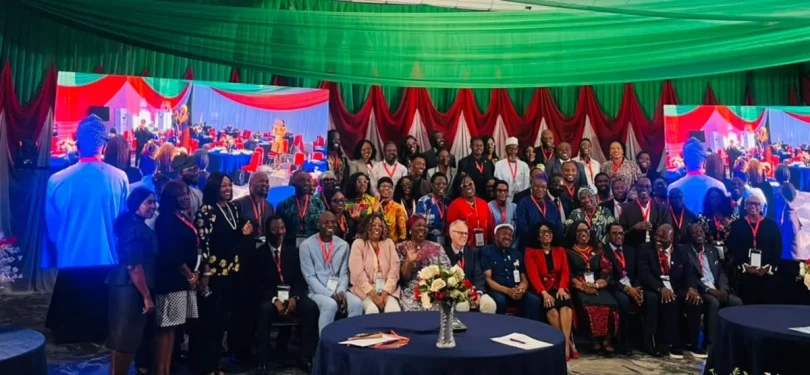
The Federal Government has called for stronger cancer research capacity and increased local clinical trials to generate evidence capable of improving cancer treatment and outcomes in Nigeria.
The call was made on Monday at the University of Abuja Global Research Summit, Clinician Investigator Track, themed “Developing the Next Generation of Clinician-Investigators in Global Oncology.”
The two-day summit brought together stakeholders from the Federal Ministry of Health and Social Welfare, Nigerian Cancer Society, Mayo Clinic, University of Abuja, West African College of Physicians and other research institutions to strengthen the capacity of clinicians, researchers and early-career investigators to design, conduct and translate high-quality cancer research and clinical trials.
Speaking at the event, the National Coordinator, National Cancer Control and Nuclear Medicine Programme, Federal Ministry of Health and Social Welfare, Dr Uchechukwu Emmanuel, said the initiative was aimed at equipping researchers, clinical researchers and administrators with the skills required to conduct high-quality cancer research.
He said the program, implemented in collaboration with the ICare and Prostate Cancer Trans-Atlantic Consortium (CAPTC) projects, would expand research beyond prostate cancer to other cancer types.
“This event is about capacity building in line with ICare and CAPTC projects, training researchers, clinical researchers, and even administrators on how to go about research,” Emmanuel said.
He said the research agenda would cover blood, liver, pancreatic and other cancers, as well as the full cancer care continuum, including prevention, early detection, diagnosis, treatment, quality of care and survivorship.
“When we talk about research, we are looking at research into prevention, research into treatment, research into diagnosis, and research into quality of care for cancer, even doing prevention to diagnosis, early detection to treatment, and survivorship. So it is the entire cancer continuum of care,” he said.
Emmanuel also raised concern over the financial burden of cancer treatment on Nigerians, particularly middle- and low-income families.
“Cancer has the capacity to cripple anyone’s economy. But of course, the middle class to the lower class are actually more vulnerable because the cost of treatment of cancer is so catastrophic in nature,” he said.
Similarly, the president/CEO of the Nigerian Cancer Society, Prof. Abidemi Omonisi, said Nigeria must move away from what he described as “guesswork” in understanding and responding to the country’s cancer burden.
“When I was elected as president two years ago, one of the things I promised to bring to the table is to promote cancer research and scientific evidence in the country. Before now, we had a lot of guesswork in the cancer space in the country,” Omonisi said.
He expressed concern over Nigeria’s low participation in global oncology research and clinical trials compared with other African countries.
“Nigeria is not part of global cancer oncology research in terms of clinical trials. It is very low, and we are losing a lot compared to some sister countries, like East Africa and South Africa, where there are a lot of clinical trials,” he said.
Omonisi called for stronger collaboration among government, researchers, clinicians, academics, cancer organisations and the media, stressing the need for clinical trials involving African populations.
“There are a number of drugs that we have in Nigeria that are products of research and clinical research that was conducted on the population, not on the blacks. That’s why you see some patients who take the same drug in Africa have minimal or different responses,” he said.
Also speaking, Prof. Solomon Rotimi, Professor of Clinical Biochemistry and Cancer Genomics at Covenant University and Principal Investigator of the Prostate Cancer Trans-Atlantic Consortium, said insufficient population-specific evidence remained a major gap in effective cancer treatment in Nigeria.
“One of the gaps that we have in the effectiveness of treatment for cancer is the insufficient evidence based on our population. You may know that our population, we have our own uniqueness,” Rotimi said.
He said the capacity-building programme would equip investigators and research administrators with the skills to properly design, conduct and report research addressing Nigeria’s specific health challenges.
Meanwhile, Prof. Obiageli Nnodu, Director of Research and Grants at the West African College of Physicians, said the programme was designed to develop the next generation of clinician-investigators while strengthening institutional research capacity.
“The objective of this journey is actually to build the next generation of clinician investigators in Africa, next generation of researchers. And also to build the institutional capacity for research,” she said.
In her presentation, Prof. Folakemi Odedina of Mayo Clinic Comprehensive Cancer Center advocated a consortium-based approach to cancer research, saying the complexity of cancer made collaboration among institutions and disciplines essential.
Odedina urged early-career investigators to join research consortiums to accelerate their development and gain access to mentorship, funding and international partnerships.
“If you are an early investigator and you’re just reaching into research, I would tell you right now, get into a consortium. Get into it,” she said.
She also stressed the need to translate research findings into practical improvements in healthcare and policy.
“It’s not only about doing the study and disseminating it, but it has to have policy implications,” Odedina said.
Earlier, the Vice-Chancellor of the University of Abuja, now Yakubu Gowon University, Prof. Hakeem Babatunde Fawehinmi, said the summit represented an unusual convergence of major national and international institutions committed to strengthening research in Nigeria.
He said the university’s ambition to become a world-class institution must be demonstrated through concrete improvements in research capacity.
“This university has set for itself the task of becoming a genuinely world-class institution, and that ambition means very little if it stays at the level of a mission statement without determining effort. So we need to walk the talk,” Fawehinmi said.