
The Federal Government has awarded contracts for the rehabilitation of 13 police training institutions across the country.
This is just as the Vice President, Senator Kashim Shettima has charged the National Economic Council (NEC) to sustain ongoing reforms until improvements in the economy translate into jobs, stronger purchasing power, business confidence and better living conditions for Nigerians.
The rehabilitation of the 13 police training institutions, which is set to last for a period of three weeks, is aimed at putting the institutions in shape for the commencement of training programme by the Nigerian Police Force.
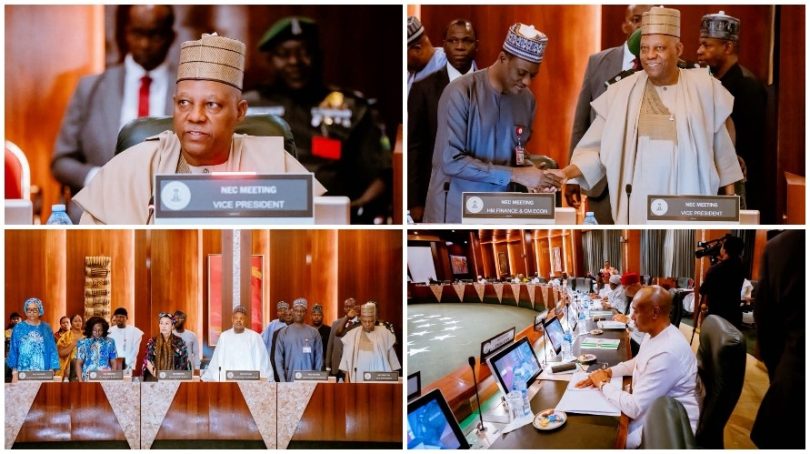
The update was presented on Thursday in Abuja during the 160th meeting of the National Economic Council (NEC), chaired by Vice President Shettima.
NEC also endorsed the Revised National Social Protection Policy, (NSPP: 2026 – 2030) as presented by the Minister of Budget and Economic Planning, Senator Abubakar Bagudu, and urged states to align with the Social Protection Policies, Laws, Budgets and Implementation plans with the Reviewed National Social Protection Policy.
NSPP: 2026 – 2030 is a national policy framework for strengthening social protection coordination, financing, implementation, monitoring and accountability across the federation.
The policy proposes the establishment of a National Social Protection Council which will provide overarching oversight of coordination and implementation.
The Council is to be chaired by the Vice President, with the Ministers of Budget and Economic Planning, Labour and Employment, and Humanitarian Affairs and Poverty Reduction as Vice Chairs.
The Federal Ministry of Budget and Economic Planning is to serve as Council’s Secretariat, while 6 governors representing each of the 6 geopolitical zones will serve as members.
Speaking at the NEC meeting, Vice President Shettima charged NEC to sustain ongoing reforms until improvements in the economy translate into jobs, stronger purchasing power, business confidence and better living conditions for Nigerians.
Senator Shettima said the government must remain focused on implementing policies beyond their announcement, stressing that continuity and measurable outcomes were critical to earning public confidence.
“There is no doubt that a serious government is measured by the matters it refuses to abandon. While attention may reveal a problem, continuity determines whether the problem yields to policy,” he said.
The Vice President noted that revenue, debt, production, investment and the cost of living ultimately converge at the household level, making it imperative for macroeconomic improvements to reach ordinary Nigerians.
“Macroeconomic progress must therefore continue its passage into jobs, purchasing power, business confidence and stronger subnational economies, because numbers become politically meaningful when citizens recognise themselves in their improvement,” Senator Shettima said.
The Vice President urged the Council to maintain follow-through on existing programmes and commitments, warning that new priorities should not displace unfinished government responsibilities.
“Continuity is a form of accountability: yesterday’s promise still deserves a place on today’s table, and no new priority absolves us of an old responsibility,” Senator Shettima said.
He added that President Bola Ahmed Tinubu had placed on NEC the responsibility of making cooperation across the federation productive and converting policies into outcomes Nigerians could see and feel.
“A government that remembers earns the confidence of its people because its promises do not expire when the microphones are switched off,” the Vice President said.
Stanley Nkwocha
Senior Special Assistant to The President on Media & Communications
(Office of The Vice President)
27th August, 2026