
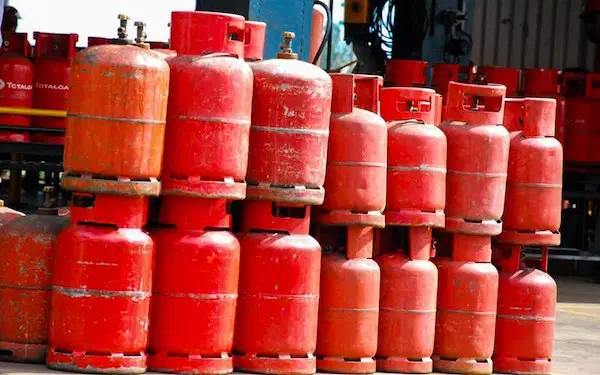
The price of cooking gas has again increased in the Federal Capital Territory (FCT), with residents lamenting its impact on household expenditure after months of declining prices.
The residents who spoke in Abuja on Sunday, said the latest increase in the price of Liquefied Petroleum Gas (LPG), known as cooking gas, has once again forced them to reconsider how they manage their expenses.
After months of declining and relatively stable prices, residents in parts of Abuja are now paying between N1,450 and N2,000 per kg for cooking gas, depending on the location and retail outlet.
A survey of some retail outlets in the FCT showed that the development had pushed the cost of refilling a 5kg cylinder to between N6,759 and N10,000, while a 12.5kg cylinder cost between N18,875 and N25,000.
The latest increase has come after a period of gradual price reductions, which had offered some relief to households following an earlier sharp rise earlier in the year that pushed the commodity to about N2,000 per kg.
Mrs Rosemary Paul, a public servant and resident of Gudu, told NAN in an interview that the increase in the price of cooking gas meant spending more on an essential household commodity.
“Cooking gas is the only cooking source I use because I consider it safer and cleaner. So, no matter how expensive it becomes, I still have to buy it.
“This latest increase is not a welcome development. I now spend more than I budgeted for, buying gas at N1,700 per kg, compared with N1,350 per kg in August.
“Every extra naira spent on cooking gas is money that could have been used to meet other household needs,” she said.
Mr Fidelis Akpan, a resident of Lugbe and businessman, said the rise in cooking gas price was affecting the amount available for other household needs.
“For many families like mine, the rising cost of cooking gas is forcing painful adjustments. Some are buying smaller quantities, cutting spending on food, transportation and other household needs.
“Others are turning to charcoal and other cheaper cooking alternatives to cope with the high cost of gas, he said.”
Ms Obi Nonso, a banker and resident of Garki, said the frequent fluctuations in cooking gas prices make it difficult for households to plan their monthly expenditure.
“Many average households rely on cooking gas, so frequent price increases will definitely affect their daily expenses.
“If you budget N15,000 for gas in a month and the price suddenly increases, requiring you to spend N17,000, the additional N2,000 has to come from somewhere.
“You either buy less gas with the N15,000 budget or take the extra money from other household needs, which ultimately disrupts your budget,” she said.
Mrs Safiya Haruna, a civil servant and resident of Kubuwa, said the frequent fluctuations in cooking gas prices had forced her to adopt an alternative source of cooking energy to reduce household expenses.
“I bought a charcoal stove, which I alternate with cooking gas, especially for boiling water and cooking foods such as beans that take a long time to cook because I have a large family.
“If I rely solely on cooking gas, I may not be able to meet other household expenses, including food and electricity.
“We just have to find ways to survive in this country because waiting for the government to address everything can be frustrating,” she said.
Mr Justice Efe, a teacher and resident of Lokogoma, appealed to the Federal Government to take measures to stabilise the price of LPG and make the commodity more affordable.
“Given the country’s abundant gas resources and the increasing adoption of LPG for domestic use, the government needs to intervene to ensure that the commodity remains affordable to Nigerians,” he said.
Mr Hassan Idris, a manager at an LPG retail outlet in Gudu, attributed the latest increase to higher supply costs, saying the outlet had received its latest consignment at a price higher than the previous one.
According to him, developments in the international energy market, including the ongoing Israel-Iran conflict, can continue to affect supply and pricing.
“The new supply we got was more expensive than our last supply. As long as the conflict remains, it is expected for us to witness a price increase,” he said.
An Energy expert, Mr Chris Modi, attributed the increase to supply disruptions, higher logistics costs and foreign-exchange volatility.
Modi said international energy market developments could also affect local LPG prices, as higher procurement and distribution costs were often passed on to consumers.
According to him, developments in the international energy market also have implications for local LPG marketers, particularly where supply chains are exposed to global price movements.
Modi, however, stressed the importance of addressing the structural factors behind price volatility rather than relying solely on short-term interventions.
He called for improved domestic supply and distribution infrastructure to help reduce price volatility and ensure greater stability in the LPG market.