
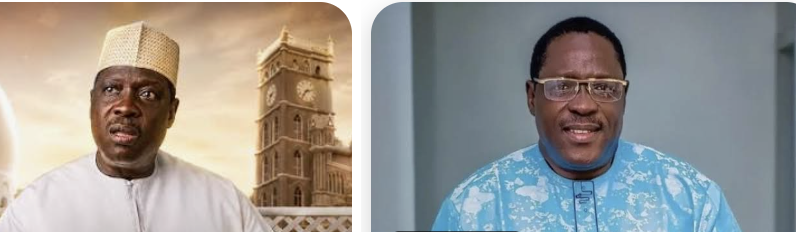
FACT CHECK!!! Is Nollywood Actor Taiwo Hassan Ogogo Dead?
Ailing Nollywood actor, Taiwo Hassan, popularly known as Ogogo, is not dead, The Eagle Online can authoritatively reveal via multiple sources.
This report comes amid rumours on social media of the death on Tuesday of Ogogo, whose children revealed has a Stage 4 cancer.
One of his daughters, Mira, had on Monday revealed the illness of her father, calling for assistance in terms of treatment and not financially.
Mira revealed that the governorship candidate of the All Progressives Congress for the 2027 polls in Ogun State, Senator Olamilekan Adeola, popularly known as Yayi, had been footing the medical bills of Ogogo.
She, however, said the actor has been ejected by the hospital treating him.
As such they are looking for any form of treatment for their father.
As earlier reported by The Eagle Online, the ailing actor cannot seek medical assistance outside the country because he is not fit to fly.
Media outreach services
Multiple sources confirmed to The Eagle Online that Ogogo is still alive on Tuesday.
One of the sources said: “It’s not true.
“I just spoke with Jide Kosoko now.
“He said Ogogo is still alive, and that he needs our prayers.
“He said Ogogo’s condition is critical.”
According to one of the sources, the cancer has spread to all of the vital organs of Ogogo
Read the full speech below:
Chairman of the Central Planning Committee, the honourable Abbas Umar Masanawa, holder of the Order of the Niger; Director General of this lecture, Honourable Chineme Onyeke; distinguished members of the Organising Committee; your excellencies of the diplomatic corps; nananom and the revered custodians of our traditions; members the academia; leaders of commerce, of the bar and of the faith; gentlemen and ladies of the press; dear students; and, above every other person in this hall, the young women and men of Africa in whose hands the morning after tomorrow is already being written. All protocols are respectfully and gratefully observed.
Permit me to begin not with a thesis but with a confession. I am a Nigerian. And yet I stand before you this afternoon in Accra, in a city that did not give me birth, having crossed the Gulf of Guinea to build my life, my work and no small part of my heart in the Republic of Ghana. I teach here. I write here. I mentor young minds here. So when your committee did me the honour of asking a son of Nigeria to give the lead address at a lecture that carries the name of the great Zik of Africa, in the very country of Kwame Nkrumah, I understood at once that the invitation was already the argument. The theme was proved before a single word was spoken. For if a Nigerian can find a home, a calling and a family in Ghana, then the border between us was always thinner than the men who drew it wanted us to believe.
I thank you for that honour. Allow me now to be worthy of it.
There is a proverb told across this continent, from the dry savannah to the forest belt, that until the lion learns to write, every tale will glorify the hunter. For the better part of five centuries, Africa has been the hunted, and the story has belonged to the hunter. We have been the object of other people’s sentences and rarely the subject of our own. We were discovered, they said, as though we had not been here all along. We were developed, as though we had built nothing before the ships came. We were civilised, as though the scholars of Timbuktu had not gathered tens of thousands of manuscripts on law, astronomy and medicine while much of the wider world still struggled to read.
Let us remember who we are. Long before the partition of Africa was signed away by strangers in a berlin drawing room in the winter of 1884, this continent carried empires. The Mali of old grew so wealthy that the pilgrimage of one of its kings across the desert to Mecca is still spoken of seven centuries later. In the south, the builders of Great Zimbabwe raised a city of dry-stone walls so fine that the colonisers who found them refused, for years, to believe that Africans had made them. In my own country, the artisans of Benin cast bronzes of such mastery that today they sit in the great museums of Europe, and Europe is only now, slowly and reluctantly, beginning to send them home.
I do not recite this history to make us nostalgic. Nostalgia is a poor foundation for a nation. I recite it because a people who do not know that they were once great will never dare to believe that they can be great again.
And here is the heart of what I have come to say. Africa is not a problem to be managed by others. Africa is a perspective the world is missing. There is an African way of holding time, of keeping community, of weighing the one against the many and the many against the whole, that the modern world, in its loneliness and its haste, quietly needs. When the global table is set and every chair is filled but ours, the meal is incomplete, because the balance we bring is absent. African problems, i have long held, require African solutions. Not because we scorn the friendship or the wisdom of others, but because a remedy imported without understanding is a suit tailored for another man’s body. It may hang on us. It will never fit.
We are, remember, the youngest continent on earth. While much of the world greys and worries over who will care for the old, Africa is young, restless and multiplying, more than 1.4 billion of us now, and by the middle of this century one in every four human beings alive will be an African. That is not a burden. Handled with wisdom, it is the single greatest reservoir of energy, labour and genius that the 21st century will possess. The only question is whether we will lead it, or whether we will once again allow it to be led away from us.
Which brings me to the two men whose spirit fills this hall.
We honour today the memory of Nnamdi Azikiwe, the Zik of Africa, and we do so in the home of Kwame Nkrumah. Consider, for a moment, how tightly their two lives were braided together, and what that braiding teaches us. Both men, a Nigerian and a Ghanaian, crossed the Atlantic in the early decades of the last century and found themselves at the same small college, Lincoln University in Pennsylvania, the oldest historically black college in America. Azikiwe went first. It was Azikiwe, the senior man, who lit the fire in the younger Nkrumah and pointed him toward that very institution. There is a building on that campus today named, jointly, the Azikiwe-Nkrumah Hall. Two West African presidents. One corridor of memory.
And their friendship did not stay on foreign soil. In 1934, Azikiwe came here, to the then Gold Coast, and it was on this very land that he mentored the young Nkrumah before returning home to Nigeria to found the West African Pilot and to help birth a nation. Think about the direction of that traffic. A Nigerian pouring himself into a Ghanaian, on Ghanaian soil, so that both nations might one day be free. They were not alone in that labour. In the grey autumn of 1945, in a modest hall in Manchester, a gathering of Africans and people of African descent, Nkrumah among them, standing beside Jomo Kenyatta of Kenya and the venerable W. E. B. Du Bois, resolved that the age of empire must end. Within twelve years they made good on that resolve. When Nkrumah stood before his people on the 6th of March, 1957, and declared the Gold Coast free at last, he did not say that Ghana’s freedom was enough for him. He said that the independence of Ghana was meaningless unless it was linked to the total liberation of the African continent. And he meant it. Six years later, in 1963, that same conviction helped raise the Organisation of African Unity in Addis Ababa, the grandmother of the African Union we know today.
I want you to sit with the geography of this evening. We gather in a hall that carries the name of the British Council, an instrument of the very empire that once ruled us both, in order to celebrate an African who helped bring that empire’s hold to an end. The room itself is a lesson. The tools of yesterday’s domination can become the meeting places of tomorrow’s dignity, if only we are bold enough to walk in and claim them. Zik and Nkrumah did not ask permission to be great. Neither should we.
Now, I promised you honesty, and I will not insult your intelligence with a speech made only of anthems. We must look plainly at the distance between the Africa our founders dreamed and the Africa we have actually built.
Let me be direct. Too many of our failures are no longer the fault of the colonisers who left. They are the fault of the sons and daughters who stayed. When a road contract is paid for three times over and the road is never built, that is not colonialism. That is greed wearing a national flag. When a hospital has a budget on paper and no medicine on the shelf, when a school is funded and the children still sit under trees, we are not being robbed by strangers. We are being robbed by our own.
Consider a single figure, and let it sober us. The United Nations has estimated that Africa loses close to 89 billion US dollars every single year to illicit financial flows, money that drains out of this continent through corruption, through the false pricing of our exports, through tax evasion and outright theft. 89 billion dollars. That is nearly 4% of everything our entire continent produces in a year, vanishing into foreign accounts and shell companies. It is more, on its own, than all the foreign aid and much of the investment we receive, put together. And the same studies tell us something that ought to keep every leader awake at night. The countries that bleed most heavily through these flows spend, on average, a quarter less on the health of their people and well over half less on their children’s education. Every stolen dollar wears a face. It is a child who never saw a doctor. It is a girl who never finished school.
So let me say the unfashionable thing at a lecture on peace. There is no peace without accountability. A society in which the powerful steal and are applauded, in which wealth without explanation is celebrated rather than questioned, in which we ask a young man how much he has but never how he came by it, that society is not at peace. It is merely quiet. And quiet is not the same as peace. Quiet is what you have in the moments before the pressure finds the crack.
Financial transparency is not an accountant’s hobby. It is the oxygen of trust, and trust is the true currency of every nation that has ever risen. The lesson our founders left us, and that far too many chose to forget, is a simple one. Public office is a trust and not a harvest. Leadership is a debt you owe, not a prize you have won. Until that idea lives not merely in our constitutions but in our consciences, we will keep pouring our future into other people’s vaults.
And yet I did not come here to bury us. I came to point at the door that stands open.
If there is one place on this earth where the dream of Zik and Nkrumah is being turned, patiently, into policy, it is here, in this city. Accra is the home of the Secretariat of the African Continental Free Trade Area. Think of what that means. 54 of our nations have agreed to build the largest free trade area on the planet by number of member states, a single market of about 1.3 billion people with a combined output of some 3.4 trillion dollars. Since the first day of 2021, goods have begun to move under its rules. And through a new Pan-African payments system, an African trader can now, for the first time, pay another African in their own currencies, without first bowing to a foreign one. For centuries our raw materials were shipped across oceans and sold back to us finished, at a profit that was never ours. This is how that ends. Not with a speech, but with a system. Not with a slogan, but with a market that at last faces inward, toward one another.
But let me temper hope with truth, for integration is not a straight road, and this region knows it painfully. The Economic Community of West African States, founded in 1975 and headquartered in my own country, in Abuja, has this very year suffered the deepest wound of its life. In January of 2025, three of our sister nations, Mali, Burkina Faso and Niger, formally walked out of the bloc and banded together in their own Alliance of Sahel States. Whatever one makes of the politics of it, and there is a great deal to debate, the lesson for those of us who lead is unmistakable. Integration that does not deliver for the ordinary farmer, the ordinary trader, the ordinary soldier facing insurgents in the bush, will not hold. And the stakes here are not abstract. The Sahel now accounts for more than half of all the world’s deaths from terrorism. When our union frays, it is not only trade that suffers. It is the safety of the mother walking her children to school.
So integration is not a document to be signed and then forgotten. It is a garden to be tended every single day. There is an old African wisdom you have all heard, and it has never been truer than it is now. If you want to go fast, go alone. If you want to go far, go together. Africa has spent too long going alone, and arriving nowhere. It is time, at last, for us to go far.