
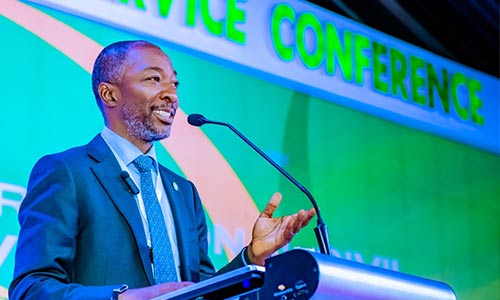
The Nigeria Social Insurance Trust Fund has called on the Nigerian Bar Association to take a leading role in expanding Nigeria’s legal framework for workplace protection and social security to cover workers in the informal economy, as well as gig and platform workers who currently fall outside many traditional employment arrangements.
Managing Director and Chief Executive of NSITF, Mr Oluseun Faleye, made the call at the 66th Annual General Conference of the NBA in Port Harcourt, Rivers State, where he spoke on the theme, “Beyond Limits: Expanding the Legal Frontiers of Workplace Protection and Social Security in Nigeria.”
Faleye, who was represented by the General Manager, Abuja Region of the Fund, Mrs Bridget Ashang, said Nigeria’s rapidly changing labour environment required the law to move beyond its traditional concentration on workers in formal employment and recognise the realities of people earning livelihoods outside conventional employer-employee relationships.
According to him, the growth of informal work, digital platforms and the gig economy had created new categories of workers whose employment status and access to workplace protection are not always adequately addressed under the existing legal framework.
He said social security, as defined by the International Labour Organisation, is intended to provide access to healthcare and income protection in situations including unemployment, sickness, old age, employment injury, maternity, invalidity and the death of a breadwinner.
Faleye maintained that social security should not be viewed as charity but as an issue of social justice and workers’ dignity.
He said the Employees’ Compensation Scheme was established to ensure that workers who suffer injuries or other employment-related harm are not abandoned without financial and institutional support.
According to him, the scheme also reduces the liabilities faced by employers, facilitates workers’ recovery, supports continuity of income and productivity and contributes to stronger occupational health and safety standards.
Faleye noted that the ILO Social Security Convention No. 102 recognises nine branches of social security — medical care, sickness benefit, unemployment benefit, old-age benefit, employment injury benefit, family benefit, maternity benefit, invalidity benefit and survivors’ benefit.
He, however, observed that Nigeria’s existing framework still substantially reflects the traditional formal-sector employment model, leaving gaps for millions of people working in the informal economy and newer forms of employment.
The NSITF chief therefore urged the NBA to use its position within the legal profession to promote greater awareness and understanding of workplace protection and social security while also assuming stronger advocacy and advisory roles in the reform of labour laws.
He called on lawyers to consider corporate compliance audits and strategic or test-case litigation capable of clarifying and expanding the legal meanings of “employee,” “employer” and “workplace” in line with the changing nature of work.
Faleye also advocated amendments to existing labour legislation to expressly accommodate informal-sector workers, gig workers and workers engaged through digital platforms.
The NSITF boss further urged the NBA to support the ratification and domestication of relevant International Labour Organisation conventions, arguing that international labour standards could establish minimum benchmarks for social protection and strengthen confidence within Nigeria’s labour environment.
The NSITF boss further urged the NBA to support the ratification and domestication of relevant International Labour Organisation conventions, arguing that international labour standards could establish minimum benchmarks for social protection and strengthen confidence within Nigeria’s labour environment.
He also called for greater inclusiveness when laws establishing public institutions and organisations are drafted, stressing that legal frameworks should be designed in a manner that does not exclude entire categories of workers from protection.
According to Faleye, the central objective should be to ensure that the dignity and value of work are recognised irrespective of whether a person is employed by a conventional company, operates in the informal economy or earns income through a digital platform.
“Social security is how we honour that sweat. It is how we say: Your work has dignity and your life has value,” he said.
Faleye urged the NBA, NSITF and other relevant stakeholders to work together to strengthen both the legal and institutional foundations of social protection in Nigeria.
“Without the law, the Fund is silent. Without the Fund, the law is empty. Together, we can write a new social contract for Nigerian workers,” he said.