
**TrackNews Online | Investigative Report**
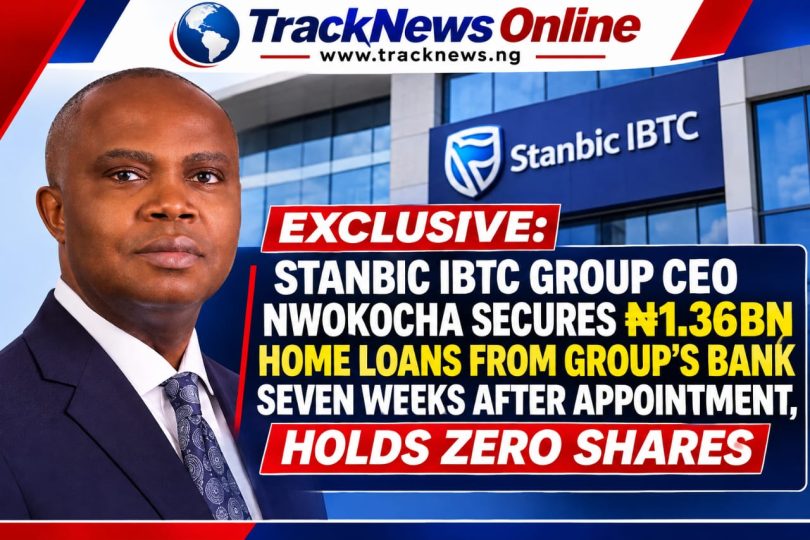
Seven weeks after assuming office as Chief Executive of Stanbic IBTC Holdings Plc, Adimohanma Chukwuma Nwokocha obtained two home loan facilities totalling ₦1.3625 billion from Stanbic IBTC Bank, a subsidiary of the financial group he was appointed to lead.
Documents obtained by TrackNews show that the two facilities were approved on November 25, 2025, less than two months after Nwokocha’s appointment became effective on October 2, 2025.
Both loans were granted under the bank’s staff home loan scheme, secured by legal mortgages over property and scheduled to mature on November 20, 2032.
The disclosures raise questions about executive lending, internal governance and the financial relationship between the chief executive of a holding company and the banking subsidiary operating within the same corporate group.
### ₦1.26 BILLION LOAN AT 20 PER CENT INTEREST
The larger of the two facilities carries an approved loan limit of ₦1,262,500,000, with an interest rate of 20 per cent.
According to the documents reviewed by TrackNews, the outstanding balance had risen to ₦1,270,771,412.27 as of December 31, 2025, just five weeks after the facility was granted.
The balance was therefore above the original approved facility limit, with accrued interest reflected in the outstanding amount.
The loan was classified as performing and secured by a legal mortgage.
A second facility of ₦100 million was approved for Nwokocha on the same November 25, 2025.
Unlike the larger loan, the second facility carries an interest rate of 10 per cent, half the rate charged on the first facility. It was equally secured by a legal mortgage and has the same maturity date of November 20, 2032.
Its outstanding balance stood at ₦99,126,255.71 as of December 31, 2025.
Together, the two facilities had an outstanding balance of approximately ₦1.37 billion at the end of 2025.
### ₦1.36 BILLION STILL OUTSTANDING IN JUNE 2026
The figures remained substantial six months later.
As of June 30, 2026, the outstanding balance on the ₦1.2625 billion facility stood at ₦1,269,900,000, while the second loan had reduced to ₦91,936,016.
The combined outstanding balance was ₦1,361,836,016.
The records classify the facilities as performing. TrackNews has not seen evidence indicating that Nwokocha defaulted on either loan.
However, the scale of the borrowing, the timing of the approvals and the fact that the loans originated from the banking subsidiary within the group he heads raise important questions about the applicable executive lending policies, approval procedures and safeguards designed to manage potential conflicts of interest.
### THE CEO WITH BILLIONS IN LOANS BUT ZERO SHARES
Beyond the two loan facilities, another detail in the company’s disclosures deserves attention.
Nwokocha does not appear among the shareholders listed in the register of directors’ shareholdings in Stanbic IBTC Holdings Plc.
The same register identifies other directors and their respective shareholdings, including Ballama Manu, with 637,524 shares, and Adekunle Adedeji, with 143,181 shares.
Nwokocha’s name is absent from the disclosed register.
This means that, based on the available shareholding disclosures, the chief executive overseeing the group holds no disclosed shares in the company, despite having obtained more than ₦1.36 billion in home loans from its banking subsidiary.
While executive share ownership is not necessarily a condition for holding a chief executive position, the contrast raises questions about the relationship between executive incentives, ownership interests and accountability to shareholders.
### QUESTIONS ALSO SURROUND THE BANK’S OWN CEO
The issue extends beyond the holding company’s chief executive.
TrackNews’ earlier findings also identified that Oluwole Adelaja Adeniyi, Chief Executive of Stanbic IBTC Bank, holds no shares in the institution he leads.
Documents previously reviewed by TrackNews also disclosed six personal credit facilities associated with Adeniyi, including a dollar card facility with a limit of $28,798,600, of which $18,074,490.94 had been drawn.
The disclosures present a broader picture of senior executives occupying the highest positions within the group’s corporate structure while maintaining substantial personal credit relationships with the institutions under their leadership.
The circumstances warrant closer examination of the group’s internal lending controls, related-party transaction policies and the procedures governing credit facilities extended to senior management.
### WHO IS ADIMOHANMA CHUKWUMA NWOKOCHA?
Nwokocha is an experienced banking executive with approximately three decades of experience in the financial services industry.
Before his appointment as substantive Chief Executive of Stanbic IBTC Holdings Plc, he served as chief executive of Standard Bank’s Mozambican subsidiary and later held a regional managing director position at Access Bank, overseeing operations across Angola, Botswana, Mozambique and Zambia.
He succeeded Adekunle Adedeji, who had previously occupied the position in an acting capacity.
His appointment took effect on October 2, 2025, following the necessary regulatory approvals.
However, just seven weeks into his tenure, the group’s banking subsidiary approved two home loan facilities totalling ₦1.3625 billion in his name.
Both facilities remain on the books as of June 30, 2026, with repayment scheduled to continue until November 2032.
### STANBIC IBTC RESPONDS TO TRACKNEWS
Before publication, TrackNews contacted Stanbic IBTC and requested confirmation of the two loan facilities, their approved limits, interest rates, outstanding balances and collateral arrangements.
The organisation also sought clarification on why the outstanding balance of the larger facility exceeded its original approved limit.
In its response, Stanbic IBTC declined to provide additional explanations beyond its published disclosures.
The bank stated:
“The accurate information on this matter is as factually reported in our Annual Report. We have nothing further to add beyond the disclosures contained in that report.”
It further stated that it trusted any report published would accurately reflect the facts and reserved all its rights regarding any publication containing information it considered inaccurate, misleading or otherwise not factually correct.
### THE GOVERNANCE QUESTIONS
The disclosures leave several important questions for shareholders, regulators and stakeholders to consider.
How were the two facilities approved just seven weeks after Nwokocha assumed office?
What internal safeguards governed the approval of the loans to the group’s chief executive by its banking subsidiary?
Were the facilities processed under the same conditions applicable to other eligible staff members?
What accounts for the larger facility’s outstanding balance exceeding its approved limit?
And what governance arrangements ensure that senior executives’ personal borrowing relationships do not compromise the independence of credit decisions within the group?
To be clear, the available documents classify both facilities as performing, and TrackNews has not established evidence of default or unlawful conduct.
Nevertheless, the timing, value and circumstances of the loans make the disclosures a significant corporate governance issue worthy of public scrutiny.
For a financial institution whose business depends heavily on public confidence, transparency in executive lending and strict adherence to internal governance procedures remain essential.
**TRACKNEWS ONLINE**
*Investigating the facts. Holding power accountable.*
Source: TrackNews