
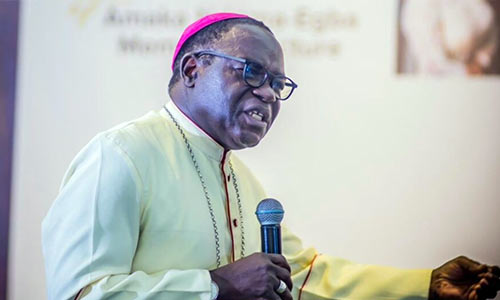
The Catholic Bishop of Sokoto Diocese, Matthew Kukah, has accused politicians of making unrealistic promises during election campaigns to secure votes, rather than preparing Nigerians for the realities and challenges of governance.
Kukah said politicians often deploy attractive images, grand promises and appealing narratives to present voters with a vision of a better society, only to abandon those commitments after assuming office and begin offering excuses for their inability to deliver.
He spoke on Thursday in Abuja at a public symposium organised by the National Institute for Legislative and Democratic Studies in collaboration with The Kukah Centre.
To illustrate the disconnect between campaign promises and governance, Kukah narrated the story of a politician who used impressive images of tarred roads, bridges, beautiful houses and children dressed in smart school uniforms to persuade voters during his campaign.
According to him, the politician won the election, but three years later, residents complained that none of the promised projects had been executed.
When confronted, the politician reportedly replied: “You are confusing campaign with governance. What I did was purely a simple campaign. Governance is a difficult part.”
Kukah said the response reflected what he described as a recurring pattern in Nigeria’s political system, where politicians make ambitious promises to win elections but resort to excuses after assuming office.
“And this is why we have Nigerian politicians turn around, once they have been sworn in and after telling us all the things they want to do, and say, ‘We didn’t know that the treasury was so empty.’ Then, they start giving one excuse after the other,” he said.
The bishop argued that politicians were often more interested in creating attractive campaign narratives than communicating the realities and difficulties associated with governance.
He, however, said voters also had a responsibility to interrogate political promises and assess their feasibility rather than accept campaign messages at face value.
“The point I am making is that it is the business of politicians to seduce, deceive or tell us things we can’t do just to win our votes. But we are sufficiently knowledgeable, and our experience should help us to test the limits of the claims that politicians make,” Kukah said.
He urged Nigerians to develop the capacity to question politicians, scrutinise their proposals and demand accountability rather than waiting until elections were over before engaging the political class.
Kukah also called on citizens to make political choices that transcend ethnic, religious and class considerations.
Earlier, former Chairman of the Independent National Electoral Commission, Prof. Attahiru Jega, said responsibility for addressing Nigeria’s electoral challenges should not rest solely on the electoral commission.
Jega urged political parties and candidates to promote issue-based campaigns and responsible political messaging, while calling on electoral and other government institutions to communicate transparently, consistently and promptly.
“Political parties and candidates must promote issue-based campaigns and responsible political messaging. Electoral and other government institutions must communicate transparently, consistently and promptly. Security agencies must provide credible information while maintaining professionalism,” he said.
Jega also urged stakeholders to draw lessons from previous electoral experiences and identify existing gaps ahead of the 2027 elections.
“I encourage us to draw lessons from our previous electoral experiences, identify existing gaps and develop practical recommendations for improving political communication and safeguarding election security ahead of the 2027 elections,” he said.
Post Title: “It Is The Business Of Politicians To Seduce, Deceive Just To Win Our Votes” — Bishop Kukah Urges Nigerians To Scrutinise Campaign Promises By Naijaonpoint.