
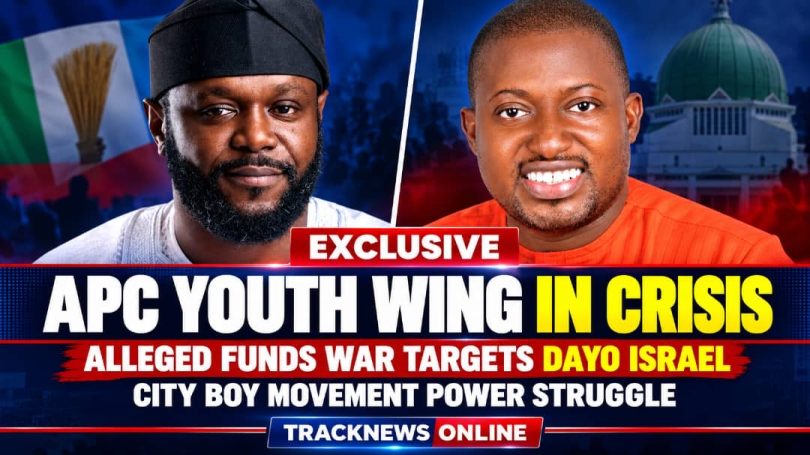
***Internal Exchanges Allege Funds Were Released to State Youth Leaders to Weaken National Youth Leader as Rival Mobilisation Groups Deepen Party Divisions
By NaijaonpointOnline
A fresh power struggle within the youth wing of the All Progressives Congress (APC) has exposed deepening divisions over youth mobilisation, political influence and control of the ruling party’s grassroots structure ahead of the 2027 general elections.
The controversy centres on National Youth Leader Dayo Israel, Seyi Tinubu’s City Boy Movement and allegations contained in internal exchanges that funds were released to state youth leaders to strengthen their structures and distance them from Israel’s leadership.
The allegations, if substantiated, could raise serious questions about internal party cohesion, the funding of political mobilisation and the influence of competing political networks within the ruling party.
According to the exchanges reviewed for this report, the dispute intensified after senatorial youth leaders reportedly signed a message expressing support for Israel. The exchanges subsequently alleged that funds were released to state youth leaders across the country to energise their activities and facilitate meetings aimed at consolidating a structure independent of the National Youth Leader.
NaijaonpointOnline could not independently verify the alleged disbursements, the identities of the funding sources or the intended purpose of the funds. Neither the APC nor the individuals implicated had publicly addressed the substance of the allegations as of the time of this report.
INTERNAL EXCHANGES REVEAL DEEPENING RIFT
The internal exchanges reportedly capture frustration among party youth officials over their roles and influence within the APC’s youth structure.
One participant complained of being sidelined, arguing that his position had become largely ineffective and that his activities were limited to assignments conducted through WhatsApp.
The complaint reportedly attracted dismissive responses from other participants, including remarks questioning the official’s authority and criticising his intervention.
The exchanges also featured Seyi Tinubu, founder of the City Boy Movement, who responded to accusations concerning the alleged release of funds.
According to the account of the exchanges, Tinubu initially responded with an insult followed by an expression of affection, insisting that nothing could separate the individuals involved.
When the allegation was raised again, he reportedly denied that the funds had been released by him.
However, the available account of the exchanges does not establish who allegedly authorised the disbursements, where the money originated or whether it was actually distributed to all state youth leaders.
Those questions remain central to the controversy.
The allegations should therefore be treated as claims requiring independent verification rather than established evidence of financial misconduct.
CAMPAIGN APPOINTMENT PLACES DAYO ISRAEL UNDER YOUTH MINISTER
The dispute has unfolded against the backdrop of a significant development in the APC’s 2027 presidential campaign structure.
On October 20, 2026, the PBAT/APC 2027 Presidential Campaign Council announced appointments that placed Minister of Youth Development Ayodele Olawande in charge of youth mobilisation, with Dayo Israel named as his deputy.
The announcement, signed by campaign council secretary and Imo State Governor Hope Uzodimma, placed the serving APC National Youth Leader below a federal minister within the campaign’s youth mobilisation directorate.
The arrangement has reportedly fuelled dissatisfaction among some of Israel’s supporters, who believe his position within the party should translate into greater authority over youth mobilisation and related political activities.
The development has also intensified questions about the relationship between the party’s elected youth leadership and other influential political figures involved in the president’s re-election campaign.
However, the appointment alone does not establish that Israel was deliberately sidelined or that any competing group orchestrated the decision to undermine him.
The controversy nevertheless highlights the potential tension between formal party positions and the informal networks that increasingly shape political mobilisation.
CITY BOY MOVEMENT AND MUMMY’S MEN MOVEMENT EMERGE AS RIVAL CENTRES OF INFLUENCE
At the heart of the disagreement are two political mobilisation platforms associated with different centres of influence within the president’s political circle.
The City Boy Movement, founded by Seyi Tinubu, has developed a network of coordinators and supporters promoting President Bola Tinubu’s political agenda and anticipated re-election bid.
On the other side is the Mummy’s Men Movement, convened by Dayo Israel and described by him as inspired by First Lady Oluremi Tinubu.
The emergence of these networks has fuelled speculation about competition for influence over young party members and the structures expected to support the APC ahead of 2027.
According to sources cited by SecretsReporters, individuals aligned with the competing camps have allegedly been encouraging party loyalists to abandon Israel’s leadership and rally behind Seyi Tinubu.
The sources reportedly described the disagreement as a struggle over political structure and influence rather than a simple personal disagreement.
Some individuals associated with Seyi Tinubu’s camp have reportedly accused Israel of being envious of the City Boy Movement’s growing reach, while critics of the arrangement argue that the National Youth Leader’s formal position has not translated into corresponding authority.
These competing accounts have not been independently established.
The broader issue is whether the rival movements can operate within a coordinated party structure or whether competition between them will weaken the APC’s youth mobilisation ahead of the next general election.
₦1.015 BILLION PRADO VEHICLE CONTROVERSY ADDS TO THE PRESSURE
The internal dispute has also been overshadowed by controversy surrounding a vehicle presentation announced by Dayo Israel on Sunday, October 25, 2026.
In a post on his X account, Israel said he had presented brand-new 2026 Toyota Land Cruiser Prado sport utility vehicles to selected youth leaders to support their election mobilisation activities.
He also expressed gratitude to the First Lady, Oluremi Tinubu, for what he described as her continued support for the party structure under his leadership.
Seven vehicles were reportedly visible in the accompanying video.
At an estimated price of approximately ₦145 million per vehicle, seven units would have a combined indicative value of about ₦1.015 billion.
The figure represents an estimate based on the stated per-vehicle price, not a verified purchase cost. Actual prices may vary depending on specifications, taxes, importation expenses and other factors.
... was reportedly deleted approximately three hours after publication amid public criticism of the display of expensive vehicles during a period of economic hardship for many Nigerians.
However, screenshots and video clips continued circulating online.
The central question raised by critics concerns the source of the money used to acquire the vehicles.
Israel’s post reportedly thanked the First Lady but did not identify the source of the funds or provide a breakdown of the transaction.
The available information does not establish whether the vehicles were purchased with personal funds, private donations, political contributions or money from another source.
No conclusion about the legality of the transaction can therefore be reached without further evidence.
Opposition figures, including former presidential candidate Atiku Abubakar, have reportedly called for an explanation of the funding arrangement.
The questions surrounding the vehicles have added another dimension to the controversy over financial transparency within the APC’s youth mobilisation network.
QUESTIONS OVER FUNDING AND POLITICAL ACCOUNTABILITY
The alleged disbursements to state youth leaders and the Prado vehicle presentation have placed the financing of political mobilisation under renewed scrutiny.
Political parties routinely rely on funding from members, donors and other lawful sources to organise campaigns and mobilise supporters. However, substantial expenditures and allegations of undisclosed financial support can generate legitimate public questions, particularly when the activities involve prominent political figures.
In this case, several issues remain unresolved.
Who financed the seven Prado vehicles presented by Israel?
Was the purchase funded by the National Youth Leader personally, through private contributions or by another organisation?
Were funds actually released to state youth leaders following the reported expression of support for Israel by senatorial youth leaders?
If such payments occurred, who authorised them, what was their source and what activities were they intended to finance?
Were the alleged disbursements connected to a legitimate mobilisation programme or to competition between rival political structures?
These questions require documentary evidence, clear explanations and responses from the individuals and institutions concerned.
The mere existence of competing political movements or the presentation of expensive vehicles does not establish wrongdoing. Equally, allegations involving substantial sums of money warrant credible answers where evidence is available.
APC’S 2027 MOBILISATION STRATEGY UNDER PRESSURE
The unfolding controversy comes as political parties begin strengthening their structures ahead of the 2027 general elections.
For the APC, youth mobilisation is expected to play a significant role in voter engagement, grassroots organisation, digital campaigning and the promotion of the president’s re-election bid.
A prolonged dispute between the party’s formal youth leadership and influential political movements could complicate those efforts.
The central challenge is balancing the authority of elected party officials with the activities of independent support groups operating within the president’s wider political network.
If the allegations of rival mobilisation and competing financial support are substantiated, the party may face difficult questions about the coordination of its youth structures and the mechanisms used to distribute resources.
The controversy could also test the ability of the party’s leadership to resolve internal disagreements before they affect campaign preparations.
However, the extent of the divisions and their potential electoral consequences remain uncertain.
KEY PLAYERS YET TO PROVIDE FULL PUBLIC CLARIFICATION
As of the time of this report, the APC had not issued a public statement addressing the specific allegations contained in the internal exchanges.
Israel had also not publicly provided a detailed explanation of the alleged funds disbursed to state youth leaders or the source of financing for the Prado vehicles, according to the information available for this report.
Seyi Tinubu reportedly denied responsibility for the alleged release of funds in the internal exchanges, but the account available does not contain a detailed explanation identifying the actual source of the money or addressing whether the alleged disbursements occurred.
The absence of a comprehensive public explanation does not establish that the allegations are true. It does, however, leave important questions unanswered.
NaijaonpointOnline recognises that the individuals mentioned are entitled to respond to the allegations and provide relevant documentation that could clarify the circumstances.
CONCLUSION: A PARTY YOUTH WING AT A CROSSROADS
The dispute involving Dayo Israel, Seyi Tinubu’s City Boy Movement and the emergence of competing youth mobilisation structures has exposed a potentially significant fault line within the APC.
What began as an internal disagreement over influence and responsibilities has expanded into allegations about money, political loyalty, campaign appointments and the financing of youth mobilisation.
The reported distribution of luxury vehicles, alongside claims of financial support for rival youth structures, has further intensified public interest in the matter.
Yet the most important issues remain unresolved: whether the alleged funds were released, who financed the vehicles and how the APC intends to manage competing centres of influence within its youth wing.
For a party preparing for the 2027 elections, the challenge is not merely to contain an internal disagreement but to establish clarity over authority, financing and accountability.
Until the individuals involved provide verifiable answers, the controversy is likely to remain a source of uncertainty for the party’s youth leadership and its broader campaign organisation.
NaijaonpointOnline will continue to follow developments and report any responses, documentary evidence or official clarifications that emerge.
Editorial note: This report distinguishes allegations from established facts.