
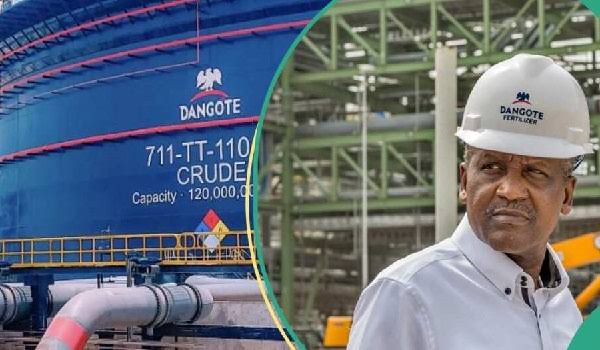
The Energy Watchdog has thrown its weight behind Dangote Petroleum Refinery and Petrochemicals’ decision to seek leave to appeal a Federal High Court judgment ordering the Nigerian Midstream and Downstream Petroleum Regulatory Authority (NMDPRA) to continue issuing petroleum product import licences to three major oil marketers.
The group said the appeal was necessary to protect Nigeria’s growing domestic refining industry, safeguard investments in the sector and accelerate the country’s drive towards self-sufficiency in refined petroleum products.
In a statement signed by its representative, Engr. Martins Tayo, the organisation described the September 28, 2026 judgment delivered by Justice Inyang E. Ekwo of the Federal High Court in Abuja as a setback to the objectives of the Petroleum Industry Act (PIA).
The judgment, delivered in Suit No. FHC/ABJ/CS/1363/2026, directed the NMDPRA to continue issuing petroleum product import licences to Matrix Energy, AA Rano and AYM Shafa.
The Energy Watchdog, however, argued that allowing import licences to continue despite increasing domestic refining capacity could weaken the investments made in Nigeria’s refining sector and undermine efforts to reduce dependence on imported fuel.
“We completely reject and condemn in totality the judgment of the lower court. It is a deeply flawed decision that disregards the clear intent of the Petroleum Industry Act and the national interest in building a robust domestic refining industry,” Tayo said.
The group pointed to reported changes in Nigeria’s fuel supply pattern in the first quarter of 2026, including a decline in petrol imports and increased contributions from domestic refineries, particularly the Dangote Refinery.
According to the organisation, the development demonstrates that Nigeria is gradually building the capacity to meet a greater proportion of its domestic petroleum product requirements locally.
It warned that maintaining a regime that permits continued fuel imports regardless of available domestic refining capacity could discourage further investment and undermine the economic rationale for establishing large-scale refineries in the country.
The Energy Watchdog also argued that Dangote Refinery, as an interested party with substantial investments in Nigeria’s downstream petroleum sector, was justified in seeking leave to appeal the judgment because of its potential implications for the future structure of the industry.
“The lower court’s decision amounts to a judicial endorsement of continued importation irrespective of local capacity. We condemn it without reservation because it threatens to reverse the hard-won gains of the last few years,” Tayo stated.
The organisation said the Petroleum Industry Act was enacted, among other objectives, to create a regulatory framework capable of attracting investment into Nigeria’s midstream and downstream petroleum sectors.
It warned that a judicial decision perceived as favouring continued reliance on imported petroleum products could send the wrong signal to investors who have committed billions of dollars to developing domestic refining capacity.
The group therefore urged the Court of Appeal to grant Dangote Refinery leave to challenge the Federal High Court judgment and ultimately set aside the order on the continued issuance of import licences.
It described the case as a critical test of Nigeria’s energy security policy and the country’s long-term ambition to become self-sufficient in refined petroleum products.
“Any judgment that forces the continued importation of fuel products when local refineries can supply the market is a setback for Nigeria. We condemn the lower court ruling in the strongest terms and fully support the appeal filed by Dangote Refinery,” the statement said.
The Energy Watchdog added: “The Court of Appeal must correct this error and reaffirm that the era of automatic import licences is over.”