
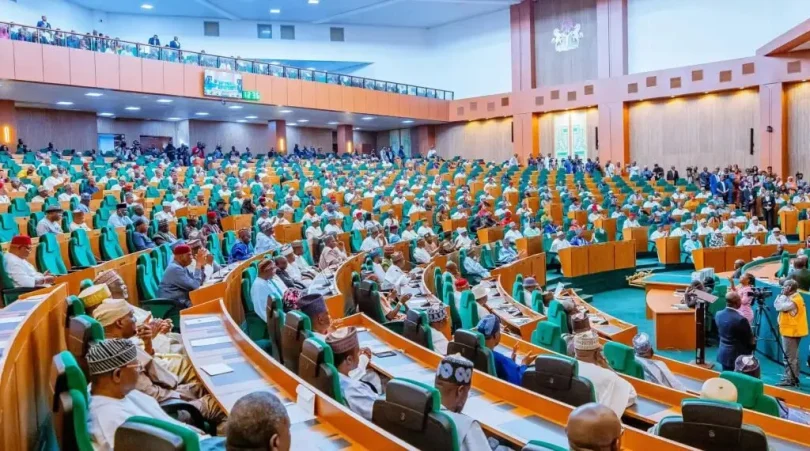
The House of Representatives has called on the Federal Government to reduce interest rates on loans to small businesses and approve special emergency funding for the Bank of Industry (BOI) and the Small and Medium Enterprises Development Agency of Nigeria (SMEDAN) to enable them to provide affordable loans at single-digit interest rates.
The resolution was passed following the adoption of a motion titled ‘Need to Reduce the Cost of Credit and Improve Access to Affordable Loan Facilities for Small and Medium-Scale Enterprises in Nigeria’, sponsored by the Chairman of the House Committee on Public Accounts, Rep. Bamidele Salam.
Leading the debate, Salam, who represents Ede North/Ede South/Egbedore/Ejigbo Federal Constituency of Osun State, highlighted the critical role of micro, small and medium-sized enterprises (MSMEs) in driving economic growth, creating jobs, promoting entrepreneurship and strengthening Nigeria’s productive capacity.
Citing the 2021 National Survey of MSMEs, conducted jointly by SMEDAN and the National Bureau of Statistics (NBS), the Osun lawmaker noted that MSMEs account for approximately 96.9 per cent of businesses in Nigeria, contribute 46.32 per cent to the country’s gross domestic product (GDP), provide 87.9 per cent of employment and account for 6.21 per cent of exports.
He, however, expressed concern that the high cost of borrowing continued to undermine the ability of Nigerian businesses to survive, expand and compete effectively.
According to him, commercial lending rates reportedly ranged from 20 to 46 per cent per annum, despite the Central Bank of Nigeria’s reduction of the monetary policy rate from 26.5 per cent to 23 per cent in September 2026.
Salam also highlighted the disparity between Nigeria’s lending conditions and those of other economies, citing SME lending rates of approximately 10.97 per cent in the CEMAC region, 16.6 per cent in Kenya in 2024 and 10.7 per cent in South Africa in 2025. He further referenced interest rates of between 8 and 13 per cent for loans backed by United States Small Business Administration programmes.
The lawmaker identified high interest rates, stringent collateral requirements and cumbersome loan application procedures as major barriers to business expansion, investment and job creation.
He warned that expensive credit forced businesses to increase the prices of their goods and services to meet repayment obligations, potentially driving away customers, reducing profitability and making it more difficult to service existing loans.
Salam maintained that access to affordable credit should be treated as a national economic priority, given its implications for poverty reduction, employment generation and sustainable private-sector growth.
Following the adoption of the motion, the House urged the Federal Government to approve special emergency funding for BOI and SMEDAN to enable them to provide affordable loans to SMEs at single-digit interest rates.
The lawmakers also called on the Central Bank of Nigeria (CBN), in consultation with deposit money banks, development finance institutions and SME associations, to review monetary, prudential and risk-pricing measures affecting lending to small businesses.
The proposed review is expected to establish a transparent framework for affordable single-digit or other concessional financing for qualifying enterprises in the productive sector, while safeguarding the stability of the financial system.
At plenary, the House also urged the Federal Ministry of Industry, Trade and Investment to convene an emergency national summit on affordable SME finance within 30 days of the adoption of the motion.
The proposed summit is expected to bring together relevant stakeholders to develop practical, time-bound measures to reduce borrowing costs, simplify loan application requirements, speed up disbursements and improve access to government-backed credit facilities.
To ensure implementation, the House mandated its Committees on Industry, Banking Regulations, Small and Medium-Scale Enterprises, Finance, and National Planning and Economic Development to monitor compliance with the resolutions and report back within four weeks for further legislative action.
The directive is intended to ensure that the resolutions translate into concrete interventions capable of improving the business environment and supporting enterprise development across the country.
Salam expressed optimism that implementing the resolutions would strengthen Nigerian SMEs, unlock their economic potential, stimulate private-sector-led growth and create more employment opportunities, particularly for young people.
He called on relevant government institutions and financial-sector stakeholders to demonstrate the political will and institutional commitment needed to translate the House’s resolutions into tangible economic relief for entrepreneurs, manufacturers, traders, innovators and other business operators across Nigeria.
At the end of Tuesday’s proceedings, the House resolved to adjourn plenary until Thursday, 15 October 2026.