
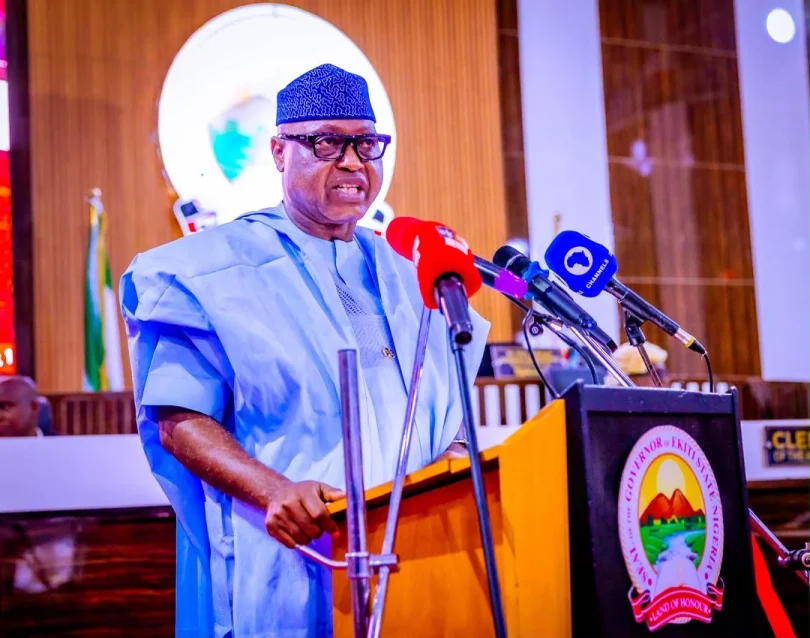
Ekiti State has generated a cumulative N88.4 billion in internally generated revenue (IGR) over four years, with Governor Biodun Oyebanji projecting that the figure could rise to N32 billion by the end of 2026, following sustained growth in the state’s revenue base.
Oyebanji, who disclosed this on Tuesday while delivering his annual State of the State address at the Ekiti State House of Assembly in Ado-Ekiti, attributed the improvement to reforms in tax administration, digital transformation, expansion of the tax net and a more business-friendly environment.
The governor said the state’s monthly IGR had risen from an average of N650 million to N700 million when his administration assumed office in October 2022 to about N2.6 billion in 2026.
He explained that the state generated N8.7 billion in 2022, N12 billion in 2023, N17.6 billion in 2024 and N27.1 billion in 2025, while revenue stood at N15.6 billion as of June 2026.
According to him, the state recorded annual IGR growth of 38 per cent in 2023, 47 per cent in 2024, 53 per cent in 2025 and approximately 60 per cent in 2026.
The governor said independent data from the Joint Revenue Board showed that Ekiti recorded a 62.13 per cent increase in IGR in 2025, outperforming every other state in the South-West, as well as 26 other states and the Federal Capital Territory.
He added that the state had increased its contribution to the national IGR pool and was now financing about one-third of its total expenditure through internally generated revenue.
Oyebanji said the improved revenue performance had strengthened the government’s capacity to finance development projects, improve public services and meet its obligations.
The governor also disclosed that Ekiti’s gross domestic product (GDP) rose from N2.4 trillion in 2019 to N4.6 trillion in 2023, representing a 90 per cent increase, with current projections placing the state’s economy at close to N8.8 trillion.
He said the growth had moved Ekiti from 33rd to 28th position among states in terms of economic size, while its contribution to Nigeria’s GDP had increased from 1.3 per cent to 1.6 per cent.
According to the governor, trade and agriculture remain the major drivers of the state’s economy, contributing N1.7 trillion and N1.05 trillion, respectively, or about 60 per cent of its total economic output.
He said the administration would consolidate its investments in the two sectors while diversifying the economy through aviation, tourism, industrialisation and the knowledge economy.
On the state’s fiscal management, Oyebanji said Ekiti had continued to record strong budget performance and earned recognition from independent organisations monitoring transparency and accountability in public finance.
He cited the state’s first-place ranking in BudgIT’s State Fiscal Transparency League assessments for the second, third and fourth quarters of both 2024 and 2025, as well as its 72 per cent score in the 2025 Sub-national Audit Efficacy assessment.
The governor said the administration’s next phase would focus on translating the improved revenue base and investments in infrastructure into greater industrial productivity, job creation and economic prosperity.
He identified the State Agricultural Processing Zone and the Ekiti Knowledge Zone as major drivers of the government’s industrialisation agenda.
Oyebanji disclosed that the state had secured $80 million in funding from the African Development Bank for the Ekiti Knowledge Zone, where construction had commenced.
He said the agricultural sector was also attracting private investment through enterprises operating in the State Agricultural Processing Zone, including Agbeyewa Farms, FMS Farms, Promise Point Farms and Arog Bio Allied Agro.
The governor added that the government was partnering with private investors to establish soybean oil bottling, rice and shea butter processing facilities in Ikere-Ekiti, while efforts were ongoing to expand agricultural production and processing.
In the transport sector, he said the state had launched the Ilu-Eye Mass Transit Company with 15 compressed natural gas-powered buses to reduce transportation costs and ease the burden of transport-induced inflation.
Oyebanji also said the administration had constructed 425.049 kilometres of roads, with additional urban and rural road projects ongoing across the state.
On agriculture and food security, the governor said about 5,000 youths were engaged in various agricultural enterprises under government-supported initiatives, while the state had invested in subsidised tractorisation, irrigation facilities, farm settlements and agricultural inputs.
In the health sector, Oyebanji said the government had engaged 1,900 health workers, renovated and equipped 12 general hospitals, completed the first phase of the revitalisation of 177 primary healthcare centres and established new general hospitals in Ikogosi, Ipao and Awo-Ekiti.
He added that the administration had employed 6,530 teachers in public primary and secondary schools and expanded support for students through scholarships, bursaries and the payment of external examination fees.
On security, the governor said the deployment of additional personnel, the establishment of the Agro-Marshal Corps and the provision of operational vehicles and surveillance equipment had contributed to a reduction in kidnapping and other serious crimes.
Oyebanji, who is due to be inaugurated for a second term on Friday, said his administration remained committed to accelerating economic development and ensuring that investments in infrastructure translated into improved livelihoods.
He expressed appreciation to the people of Ekiti State for renewing his mandate, describing the electoral outcome as an endorsement of his administration’s performance and development agenda.
The governor said his second term would prioritise agricultural industrialisation, the knowledge economy and private-sector investment as pathways to job creation, poverty reduction and shared prosperity.
In his address, the Speaker of the Ekiti State House of Assembly, Adeoye Aribasoye, praised the strong working relationship between the executive and legislative arms of government, saying it had resulted in good governance, the enactment of laws that had added value to the state and progress in its development.
Aribasoye noted that democracy thrived when the executive and legislative arms operated not as rivals but as partners and trustees of the mandate freely given to them by the electorate.
The Speaker used the occasion to commend the governor for what he described as his legacies and milestones in the state legislature, particularly the digitisation of the Assembly’s operations, its growing international recognition and improvements in staff welfare.