
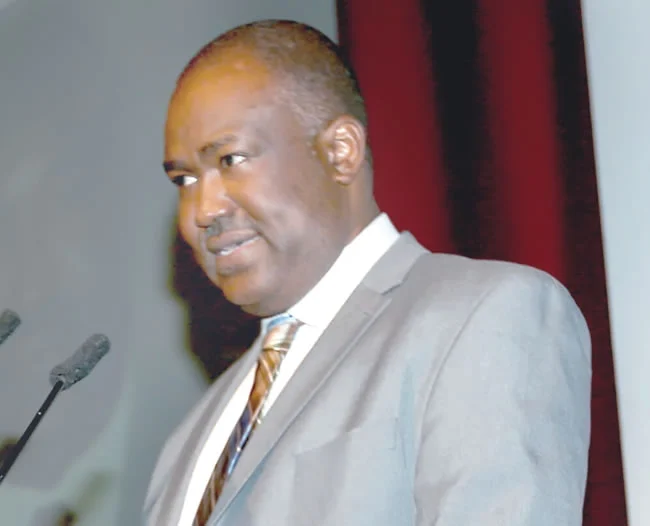
…says turnout fell to 26.71% in 2023
Former presidential candidate of the People’s Trust (PT), Gbenga Olawepo-Hashim, has warned that declining public confidence in the electoral process, poverty, and insecurity are discouraging voter participation ahead of the 2027 general elections.
He cited figures showing that turnout in presidential elections fell to 26.71 per cent in 2023, down from 69.08 per cent in 2003, and urged electoral authorities to address the factors driving voter apathy.
Olawepo-Hashim, who spoke through the Vice-Chancellor of Baze University, Prof. Abiodun Gabriel Adeniyi, made the remarks in a keynote address at a colloquium marking the 60th birthday of civic advocate Chief Ezenwa Nwagwu and the public presentation of Nwagwu’s book, Eze Unhinged: Electoral Reforms, A Participant’s View and Reflection, in Abuja.
Citing figures from International IDEA, he said the decline in presidential election turnout highlighted the need to rebuild public confidence in the electoral process before the next general elections.
He identified distrust in the process, insecurity, logistical difficulties, dissatisfaction with candidates and perceptions that election outcomes were predetermined as factors contributing to low voter participation.
The former presidential candidate urged electoral authorities to make voting safer, more accessible, and more transparent, arguing that citizens should not be blamed for withdrawing from a democratic process in which they had lost confidence.
He also identified poverty as a barrier to meaningful democratic participation, noting that economic hardship could limit citizens’ ability to exercise their political rights.
“Poverty does not extinguish political rights, but it can diminish the capacity to exercise them when survival consumes the time, resources, and energy required for meaningful participation,” he said.
He argued that the quality of democracy should be assessed not only by the institutions a country establishes but also by the opportunities they provide for citizens to live with dignity and contribute to national development.
“Democracy must therefore be judged not only by the institutions a country establishes but also by the opportunities those institutions create for citizens to live with dignity and contribute to national development,” he said.
ALSO READ: APC has engineered massive economic collapse, we must rescue Nigeria now — Gbenga Olawepo-Hashim
According to him, Nigeria could conduct elections and maintain constitutional institutions while millions of citizens struggled to afford food, housing, healthcare, transportation, and education.
He called for economic reforms that would translate the country’s natural resources into jobs, enterprises, productive capacity, and improved living standards. He added that the benefits of national wealth should be reflected in the living conditions of households and the operating environment for businesses.
Olawepo-Hashim cited high energy costs as an example of the gap between Nigeria’s resource wealth and the economic realities facing citizens and businesses.
He advocated transparent cost accounting, reliable domestic crude supply and efficient refining, alongside measures addressing foreign exchange, logistics and taxation, to reduce energy costs.
The remarks come as the Independent National Electoral Commission (INEC) prepares for the 2027 general elections, with voter apathy, declining public trust and the spread of misinformation and disinformation among the challenges facing the electoral process.
INEC has reported that its Continuous Voter Registration exercise, conducted in three phases between August 2025 and July 2026, recorded more than 10.7 million new registrants. However, the increase in registration has raised questions about whether more eligible voters will participate in the forthcoming elections.
Also speaking at the colloquium, former Kogi West Senator Dino Melaye criticized Nigerian political parties for what he described as a lack of clear ideological direction. He argued that the country had yet to establish a sustainable democratic system despite 27 years of uninterrupted civilian rule.
Melaye urged Nigerians to take greater responsibility for democratic governance by questioning elected officials and demanding accountability.
He identified representation, lawmaking, and oversight as the three fundamental responsibilities of legislators, arguing that effective performance of these duties would strengthen democratic governance.
The former senator also called for a national identity that guaranteed Nigerians equal civic rights regardless of where they lived within the federation. He urged political parties to create meaningful opportunities for women and young people.
Nwagwu identified restrictive cultural practices, financial constraints, and political interests as barriers to inclusive democracy, particularly the participation of women in political parties.
He criticized the limited representation of women in party leadership structures, arguing that assigning them designated women’s leadership positions did not necessarily give them sufficient influence over party decisions.
Nwagwu called on political parties to remove the financial, cultural, and political barriers preventing women and other underrepresented groups from participating fully in politics.
The President of the Nigerian Institute of Public Relations, Dr. Ike Neliaku, called for greater collaboration across ethnic, religious, and generational lines, saying inclusion was necessary for national progress.
He said younger Nigerians contributed energy, creativity, and innovation, while older generations offered experience, networks, and institutional knowledge that could complement the contributions of young people.
Earlier, the chairman of the colloquium, Prof. Isa Hayatu Chiroma, SAN, called for independent democratic institutions, broader economic opportunities and a national identity that transcended ethnic loyalties.
He said Nigeria needed to move away from a system dominated by powerful individuals towards one in which institutions operated independently and protected citizens regardless of their political affiliation or social status.