
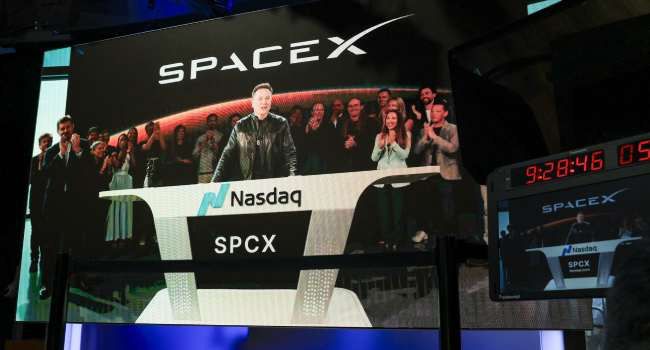
The landmark IPO raised more than $75 billion and is widely expected to pave the way for a wave of public listings by leading artificial intelligence companies in the months ahead.
The company’s arrival on the Nasdaq stock exchange in New York followed weeks of intense investor enthusiasm surrounding SpaceX, which has evolved from a rocket manufacturer into a sprawling satellite and artificial intelligence conglomerate.
Speaking at a launch event in Starbase, Texas, Musk outlined the company’s long-term ambitions.
“SpaceX wants to be able to take you to the moon, take you to Mars, and ultimately beyond,” Musk said.
“I’m confident at this point that with the incredible team that we have here at SpaceX, that we will do that for you,” Musk added.
The historic market debut was celebrated in New York, where supporters gathered outside Nasdaq headquarters. A giant neon sign in Times Square displayed the message, “Building the infrastructure to the future.”
Among those attending was Sarin Sio of financial firm Dovetail, who pointed to Musk’s vision as a key driver of investor excitement.
“Musk sets very futuristic goals that no one else is doing, and I think that has got a lot of people excited,” Sio said.
According to a regulatory filing submitted on Thursday, SpaceX sold more than 555 million shares at $135 each, placing the company’s valuation at nearly $1.8 trillion before trading began.
Following Friday’s rally, the company’s market value climbed to roughly $2 trillion, making it one of the ten most valuable publicly traded companies in the United States, surpassing Tesla, Meta and Walmart. Additional share options could increase the total amount raised from the offering to more than $86 billion.
Founded by Musk in 2002, SpaceX has expanded far beyond its origins as a rocket startup. The company now operates a major satellite network through Starlink and has integrated Musk’s artificial intelligence venture, xAI, which also owns the social media platform X, formerly known as Twitter.
Trading under the ticker symbol “SPCX,” the company is being closely watched by investors and analysts as a test of market appetite for major AI-focused listings. SpaceX is the first among several prominent AI companies preparing to enter public markets, with OpenAI and Anthropic having already begun regulatory filing processes.
The offering comes a little more than a year after Musk departed President Donald Trump’s administration, where he spent several months overseeing the controversial DOGE initiative aimed at reducing government spending while simultaneously leading Tesla and SpaceX.
Musk’s political endorsements, including support for Trump and several right-wing populist movements in Europe, alongside a series of controversial posts on X, have transformed him into one of the most divisive figures in business and politics.
Despite that controversy, investor demand for the IPO remained exceptionally strong. Bloomberg reported that the share sale attracted orders worth more than four times the number of shares available. Retail investors also showed significant interest, with 20 per cent of the shares reserved for individual buyers.
The public offering is expected to create thousands of new millionaires and several billionaires among current and former employees, as well as early investors who have backed the company throughout its nearly 25-year history.
However, some analysts remain cautious about the company’s valuation. Much of SpaceX’s future worth depends on Musk delivering on ambitious projects, including plans to establish data centres in space and transport humans to Mars using technology that remains largely unproven.
The company is also counting on rapid expansion of its Starlink satellite internet business and the growth of xAI, the developer of the Grok chatbot, which competes with OpenAI and Anthropic but has yet to achieve comparable market influence.
Financial filings show that SpaceX generated $18.7 billion in revenue in 2025. Despite the strong growth, the company recorded a net loss of $4.9 billion, largely due to heavy investment in artificial intelligence infrastructure.