
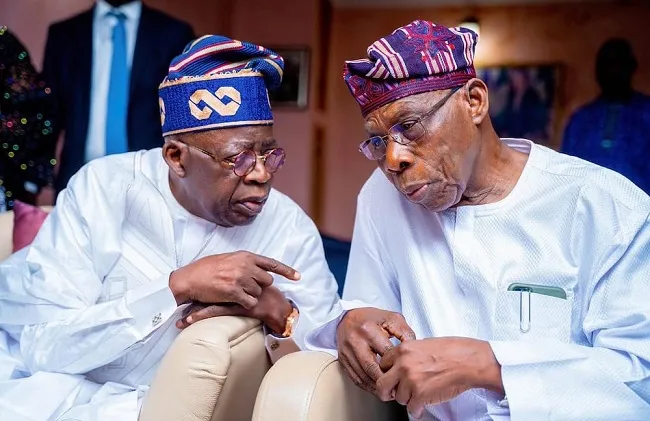
Former President Olusegun Obasanjo has faulted Bola Tinubu’s administration over Nigeria’s rising debt profile, questioning the continued resort to borrowing amid the country’s economic challenges.
Obasanjo, who spoke on Friday in Abeokuta, Ogun State, at the Ajibosin Platform, a public forum themed “Leveraging Artificial Intelligence to solve grassroots problems and accelerate National Development”, warned that rising debt could harm future generations of Nigerians.
The former Nigerian leader’s remark comes after the presidency defended Tinubu’s administration’s borrowing policy, saying that the government would keep borrowing when needed and insisted this should not be seen in a negative light.
The president’s remarks have since attracted criticism because of Nigeria’s growing debt burden and the increasing national revenue committed to servicing debts.
Clearly not amused by Tinubu’s comment, Obasanjo argued that the consequences of debt transcend the current generation, noting that leprosy can destroy one person at a time, while debt destroys generations.
Obasanjo said: “And for anybody to say debt is no leprosy, is absolute nonsense. Debt is worse than leprosy. Because leprosy destroys only one person. Debt destroys generations.”
The former Nigerian president recalled when he started his farm 47 years ago, the naira exchanged at N1 to $1.85, picked holes in the current economic management of the country.
“When I started my farm, 47 years ago, Naira to the dollar was one Naira to $1.85. Forty-seven years ago. What has Nigeria done in 47 years that we now have N1,500 to the dollar? What have we done?” he fumed.
Obasanjo also further questioned the knowledge and capacity of the country’s political leadership to make decisions that would improve the lives of Nigerians.
“What do our leaders know? And what do they not know? And from what they know, what can they do for us?” he asked.
He also faulted Nigeria’s dependence on foreign institutions, particularly the World Bank and International Monetary Fund (IMF), arguing that their policies were not necessarily designed to address the country’s peculiar circumstances.
According to him, Nigeria was discouraged from subsidising agriculture in spite of the agricultural support available to farmers in developed countries.
“World Bank and IMF were not designed for us. They were not built by us. They were built before we became independent. And that’s the people who would determine what we do,” he said.
Obasanjo cautioned against blindly adopting economic prescriptions from foreign-trained experts without considering Nigeria’s local circumstances.