
By NaijaonpointInvestigations
The Federal Ministry of Interior does not ordinarily need to route payments for government services through the personal bank accounts of its employees.
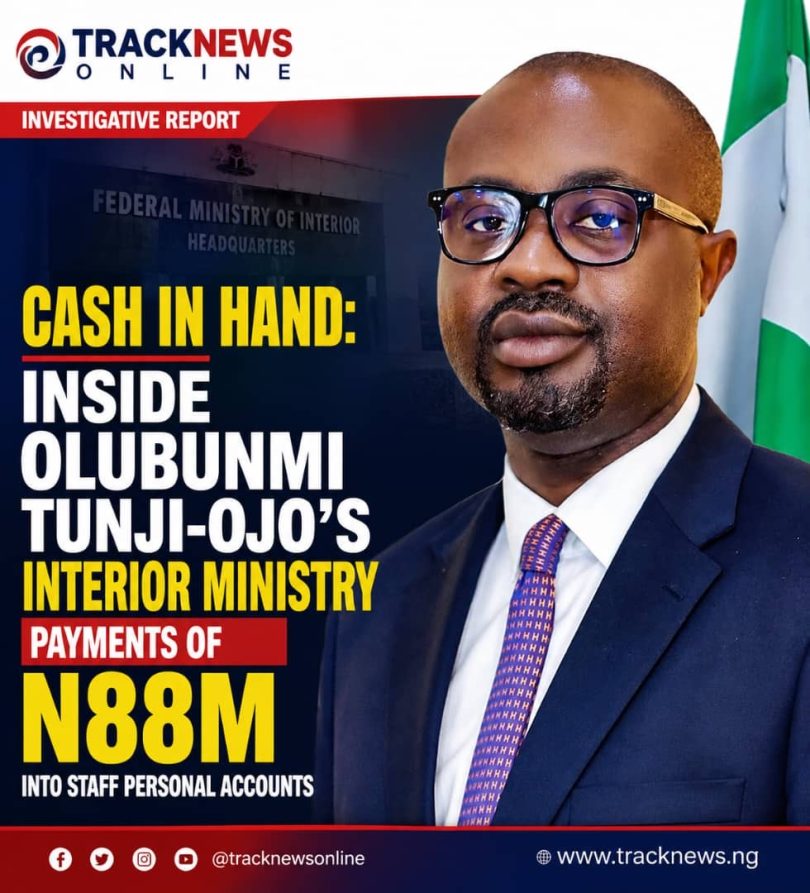
But a review of payment records from the ministry’s headquarters between 2024 and 2026 has raised questions over ₦88,039,739.74 allegedly paid across 13 transactions into the personal accounts of 11 named officers, according to documents reviewed by TrackNews.
The payments were variously described as allowances, advances, estacode, duty tour allowances, course fees, fuel expenses and other official expenditures.
The transactions occurred under the administration of Interior Minister Olubunmi Tunji-Ojo, who has increasingly featured in political discussions ahead of the 2027 elections and has been linked to interest in the Ondo State governorship race.
Naijaonpointis not alleging that the identified officers personally diverted public funds or that the minister personally benefited from any of the payments. Rather, the concern arising from the records is why substantial public funds meant for specific government activities, vendors or groups were routed through individual staff accounts instead of being paid directly to the relevant beneficiaries or service providers.
₦10.7m Labour Week Payment Into Officer’s Account
On April 28, 2026, Elabor Mohammed Segir received ₦10,705,000.00.
The payment description stated that the money was for payment “to the above-named officer and others” in connection with the Joint Union Negotiation Council’s celebration of Labour Week.
The record, however, raises a basic accountability question: why was more than ₦10 million for an activity involving multiple beneficiaries routed through one officer’s personal account?
₦9.23m For Company’s Training Services Paid Through Individual
On May 13, 2025, Okonji, Mr. Dumebi Emmanuel received ₦9,236,976.74.
The payment description referred to expenses involving IFO ADS Prestige Ltd for the delivery and facilitation of a four-day training programme.
The company was specifically identified in the payment description, yet the money was transferred to an individual officer rather than directly to the named service provider.
That transaction is particularly significant because it raises questions about the ministry’s procurement and payment controls and whether the company ultimately received the money for which the payment was made.
₦8.79m UNGA 80 Estacode
On December 24, 2025, Attamah Emmanuel Amaechi received ₦8,793,813.00, described as an estacode allowance for attending UNGA 80, the 80th United Nations General Assembly.
On the same day, Hafusat Suleiman Ahmed received ₦7.5 million, described as a “non-personal advance” for a course fee.
Both transactions were processed on Christmas Eve, adding to the questions surrounding the timing and documentation of the payments.
₦6.9m For Fuel Paid To Individual
Another transaction reviewed by Naijaonpointoccurred on December 27, 2024.
Mr. Sunday received ₦6,900,000.00 for the “fuelling of Ministry utility vehicles” for the Honourable Minister and Permanent Secretary’s fourth-quarter 2024 requirements.
The issue is not that government vehicles require fuel. They obviously do.
The question is why ₦6.9 million allocated for fuel was paid into an individual staff member’s account rather than directly to a fuel supplier or through an established procurement arrangement.
The ministry’s records reportedly contain payments to companies for diesel and other supplies, making the routing of this particular fuel-related expenditure through an individual officer worthy of clarification.
₦12.37m Routed Through One Officer For NSCDC Personnel
The records also show that Mrs. Ori Mary Edward-Amodu received a combined ₦12,375,000.00 across two transactions.
One payment of ₦5,475,000.00 was made in July 2024, while another ₦6,900,000.00 was made in December 2025.
Both were described as allowances for NSCDC personnel deployed to the ministry, with the payments made “in favour of” several officers.
Again, the central accountability question is why money apparently intended for multiple personnel was consolidated and transferred through a single individual account.
₦11.9m Duty Tour Allowances
Garba Lawal Muhammed received a combined ₦11,920,450.00 in two Duty Tour Allowance payments in April 2024.
The first payment, ₦6,312,000.00, was described as money to accompany the Permanent Secretary to Kano.
The second, ₦5,608,450.00, was for accompanying the Permanent Secretary to Lagos, Osogbo and Akure.
While official duty travel naturally attracts legitimate expenses, the size of the payments and the documentation supporting their retirement are matters that should be available for public financial scrutiny.
Christmas Eve Batch Raises Fresh Questions
Perhaps the most striking pattern in the records reviewed by Naijaonpointoccurred on December 24, 2025.
Five separate payments were processed under the same batch number: 1001364002.
The beneficiaries included:
– Atta Dudu Yemi Karis
– Okezie Chinomoso Francisca Okwuchi
– Yakubu Rabiat
– Hafusat Suleiman Ahmed
– Attamah Emmanuel Amaechi
The transactions were described using terms including “non-personal advance,” “calibration by appraiser committee of staff,” “course fee” and “estacode allowance.”
The combined value of the five transactions was ₦31,902,313.00.
The fact that millions of naira were moved into five individual accounts on the same day, under one payment batch and with generic descriptions, does not by itself establish financial misconduct.
But it does raise questions about approval processes, supporting documentation, retirement of advances and the identities of the ultimate beneficiaries of the funds.
What Exactly Is A “Non-Personal Advance”?
The phrase “non-personal advance” deserves particular attention.
An advance issued to an officer for official expenditure is generally expected to be accounted for through supporting documents showing how the money was spent.
That means the relevant questions are straightforward:
Was each advance subsequently retired?
Were receipts and other supporting documents submitted?
Were unused balances returned to government coffers?
Who ultimately received the money where the payment description referred to other individuals, vendors or committees?
And, perhaps most importantly:
Why were payments for identifiable goods, services or multiple beneficiaries routed through individual officers instead of being paid directly to the appropriate vendors or beneficiaries?
The TSA And Vendor Payment Question
The issue becomes even more significant where a payment description identifies a company.
For example, the ₦9.236 million transaction involving IFO ADS Prestige Ltd raises questions about why the money was paid to an individual officer when a company was identified as the provider of the training services.
Similarly, the ₦6.9 million fuel payment raises questions about the ministry’s procurement controls when fuel suppliers can ordinarily be identified and paid through formal vendor channels.
These transactions therefore warrant examination beyond the payment voucher itself.
An audit would need to establish whether the officers subsequently transferred the money to the intended vendors or beneficiaries and whether complete retirement documents exist.
What The Records Do — And Do Not — Establish
The payment records reviewed by Naijaonpointestablish that the listed amounts were processed to named individuals for stated official purposes.
They do not, on their own, establish that the officers stole or personally converted the money.
That distinction is important.
The investigative concern is the payment architecture: large sums of public money being routed through individual staff accounts for expenses that, in several cases, appear to involve vendors, groups, committees, fuel suppliers or multiple beneficiaries.
If all the transactions were properly authorised, fully documented and subsequently retired, the ministry should be able to demonstrate this through its records.
If they were not, then the transactions could represent serious weaknesses in public financial management.
Questions For Minister Tunji-Ojo
Naijaonpointcontacted the Minister of Interior, Olubunmi Tunji-Ojo, seeking clarification on the transactions.
Among the issues requiring explanation are:
1. Why were millions of naira paid into individual staff accounts rather than directly to identified vendors and service providers?
2. What documentation supports the ₦31.9 million batch processed on December 24, 2025?
3. Were all “non-personal advances” subsequently retired?
4. Why was ₦6.9 million for vehicle fuelling paid to an individual rather than a fuel supplier?
5. Why was ₦9.23 million associated with IFO ADS Prestige Ltd paid through an individual officer?
6. Who were the ultimate beneficiaries of payments made through officers on behalf of groups or multiple staff?
7. Were unused portions of the advances returned to the Treasury?
8. What internal controls were applied before these payments were approved?
As of publication, the minister had not provided a response to the questions sent to him. The ministry and the named officers are entitled to respond, and Naijaonpointwill publish any substantive clarification received.
The Bigger Question
The central issue is not whether government officers can legitimately receive allowances or advances. They can.
The bigger question is whether public money should routinely pass through individual personal accounts when the underlying expenditure relates to vendors, services, fuel, training, committees or multiple beneficiaries.
With ₦88.04 million across 13 transactions involving 11 individuals, the pattern identified in the records deserves an independent review by the appropriate financial oversight authorities.
For a ministry entrusted with public funds, transparency should not depend on an investigation uncovering the transactions.
Every naira should have a clear trail — from appropriation, to approval, to payment, to final beneficiary, and ultimately to documented retirement.