
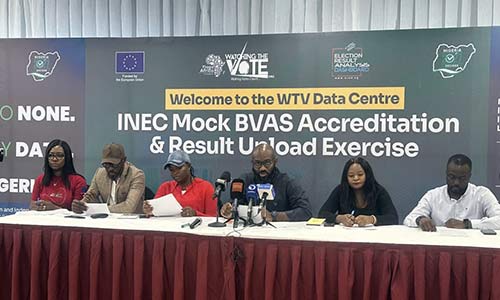
Yiaga Africa has raised concerns over technical failures involving the Bimodal Voter Accreditation System (BVAS), difficulties in uploading election results, delayed commencement of voting activities and a discrepancy involving 47 registration areas during the Independent National Electoral Commission’s (INEC) nationwide mock accreditation and results upload exercise ahead of the 2027 general elections.
The election observation organisation disclosed that although BVAS performed satisfactorily in most polling units monitored, the exercise exposed operational, technological and procedural weaknesses that could affect the credibility and efficiency of the electoral process if not addressed before the general elections.
Yiaga Africa also questioned the configuration of INEC’s Election Results Viewing Portal (IReV), revealing that while the mock exercise was designed to cover 8,838 registration areas, its analysis of the platform’s configuration identified only 8,791, leaving a shortfall of 47 registration areas.
The organisation maintained that the discrepancy required immediate investigation and correction to ensure that all designated polling units and registration areas were properly captured in the electronic results management system.
Speaking during Yiaga Africa’s post-exercise briefing on Saturday, November 28, 2026, its Executive Director, Samson Itodo, presented preliminary findings from the organisation’s independent observation of INEC’s nationwide mock election.
Itodo said the assessment revealed shortcomings in the deployment of electoral personnel, the functioning of accreditation devices, electronic transmission of results, public participation and compliance with established procedures.
“Overall, Yiaga Africa’s preliminary findings indicate that the BVAS functioned optimally in observed polling units. However, the exercise revealed important operational, technological, and procedural issues that require attention,” he stated.
Yiaga Africa explained that it deployed its Process and Results Verification for Transparency (PRVT) methodology to observe 300 sampled polling units across the country.
The organisation also used its Election Results Analysis Dashboard (ERAD 2.0) to monitor and analyse the upload of polling-unit results to INEC’s IReV portal.
According to Itodo, the assessment concentrated on four critical areas: efficiency, functionality, integrity and accessibility.
One of the major challenges identified was the late arrival of INEC personnel and electoral materials at several polling units.
Yiaga Africa disclosed that only 36 per cent of the polling units it observed had commenced the exercise by 9:30 a.m., despite INEC’s scheduled commencement time of 8:30 a.m.
The proportion increased to 64 per cent by 10:00 a.m., indicating that a significant number of observed polling units experienced delays.
Itodo cited specific instances where electoral officials arrived several hours after the scheduled commencement.
“In polling unit 006, Fadan Karshi in Sanga Local Government Area, INEC officials arrived at 1:40 p.m.,” he said.
He also identified Wanikade Playground in Cross River State as another location where INEC officials had not arrived as of 1:30 p.m.
Yiaga Africa warned that such delays could undermine the effectiveness of electoral operations, particularly during general elections involving larger numbers of voters.
The organisation also expressed concern about low public participation in the mock exercise, which it partly attributed to inadequate voter sensitisation and declining public trust in the electoral process.
Itodo recalled that Yiaga Africa had urged INEC on November 19 to publish the operational framework and list of designated polling units early enough to allow citizens to prepare for the exercise.
Although INEC subsequently released the information, the organisation said the publication came 48 hours after its appeal, leaving limited time for public mobilisation.
“This limited mobilisation period may have adversely affected public participation and also diminished the capacity of this mock exercise to simulate actual election conditions,” Itodo explained.
On the performance of BVAS, Yiaga Africa acknowledged that the accreditation technology functioned efficiently in most of the polling units monitored.
It disclosed that voter accreditation took between one and two minutes in 68 per cent of observed polling units.
In another 27 per cent, the average accreditation time ranged between three and five minutes, while four per cent recorded processing times of between six and 10 minutes.
However, the organisation documented instances where BVAS devices malfunctioned, disrupting accreditation and delaying the exercise.
Itodo cited incidents at Gumbe Wajake and a location in Sokoto State, where technical problems disrupted proceedings for approximately one hour.
He also referred to a polling unit in Niger State with 512 registered voters where a BVAS malfunction affected the accreditation process.
The organisation maintained that these incidents demonstrated the need for adequate technical support and contingency arrangements to prevent equipment failures from disrupting voting during the general elections.
“These incidents reinforce the need for INEC to ensure effective real-time technical support and troubleshooting, and also contingency arrangements for the BVAS devices,” Itodo said.
Beyond accreditation, Yiaga Africa identified challenges associated with the electronic upload of polling-unit results.
The organisation disclosed that some BVAS devices repeatedly failed to scan and upload result sheets despite several attempts by presiding officers.
According to Itodo, the difficulties were partly connected to additional safeguards introduced into the devices to strengthen the integrity and quality of electronically transmitted polling-unit results.
He explained that the safeguards were designed to detect inconsistencies between information appearing on result sheets and the codes configured on the machines.
However, in certain instances, the devices rejected the result sheets, preventing their successful capture and upload.
Itodo said he personally witnessed an incident where a presiding officer made repeated attempts to capture a polling-unit result sheet, but the BVAS device declined to process it.
Yiaga Africa acknowledged the importance of safeguards intended to prevent manipulation and ensure the authenticity of electronically transmitted results.
Nevertheless, it warned that such protective measures must be sufficiently tested to prevent them from obstructing the upload of legitimate election results.
“While safeguards that strengthen the integrity of electronically transmitted results are important, they should be sufficiently tested to ensure that they do not inadvertently impede the timely upload of legitimate polling-unit results,” Itodo stated.
The organisation further disclosed that it observed delays in the upload of results to IReV, which it linked partly to the technical challenges identified during the exercise.
Yiaga Africa said it was continuing to monitor the results upload process as part of its broader assessment.
Another major concern involved discrepancies in the configuration of registration areas and polling units on INEC’s electronic results platform.
Itodo explained that the mock exercise was designed to cover 8,838 registration areas, with two polling units selected from each area.
However, the organisation’s examination of the IReV configuration indicated that only 8,791 registration areas had been configured.
The difference of 47 registration areas raised questions about the completeness and accuracy of the system’s configuration.
Yiaga Africa called on INEC to investigate the discrepancy, reconcile the figures and ensure that the electronic platform accurately reflects the designated registration areas and polling units ahead of the general elections.
The organisation also questioned the selection of polling units with relatively small numbers of registered voters and historically low turnout.
Itodo argued that the selection limited the ability of the mock exercise to demonstrate how BVAS would perform under conditions of heavy voter traffic.
He noted that INEC planned to deploy 57,000 newly procured BVAS machines during the general elections, making comprehensive testing particularly important.
Yiaga Africa therefore recommended that future mock accreditation exercises should include densely populated polling units and locations with historically high voter turnout.
“This will enable rigorous stress testing of the BVAS, especially in a situation where 57,000 new BVAS machines were procured and will be used for the general elections,” Itodo said.
The organisation also identified procedural irregularities involving some presiding officers during the results upload process.
In one incident in Kano State, a presiding officer allegedly refused to photograph the polling-unit result sheet at the designated location.
Instead, the official directed stakeholders to proceed to the INEC office to complete the process.
Yiaga Africa questioned the departure from the prescribed procedure, maintaining that election officials should comply with established requirements governing the capture and transmission of polling-unit results.
Itodo also expressed concern that some presiding officers relied on personal mobile phone hotspots to connect BVAS devices to the internet for transmitting accreditation data and uploading results.
According to him, the use of personal internet connections raised questions about the security of sensitive electoral information and the adequacy of INEC’s official connectivity arrangements.
He urged the commission to provide reliable and secure internet services for electoral personnel to reduce dependence on privately supplied connections.
The organisation also assessed the presence of political party agents at the polling units observed during the mock exercise.
According to its findings, agents of the All Progressives Congress (APC) were present in 49 per cent of the observed polling units.
The African Democratic Congress (ADC) had agents in 19 per cent, while the Peoples Democratic Party (PDP) was represented in 16 per cent.
Agents of the Nigeria Democratic Congress (NDC) were present in 13 per cent of observed polling units, while the Allied Peoples Movement (APM) recorded five per cent.
Itodo said the findings demonstrated differences in the levels of political party representation and oversight during the exercise.
He criticised political parties for failing to mobilise their supporters and agents adequately, stressing that political stakeholders had a responsibility to support processes intended to strengthen electoral transparency.
Yiaga Africa subsequently presented a series of recommendations aimed at addressing the shortcomings identified during the exercise.
The organisation urged INEC to improve public sensitisation and publish essential electoral information sufficiently early to enable voters and other stakeholders to participate effectively.
It also recommended a comprehensive review of the BVAS malfunctions, stronger technical support, improved internet connectivity and clearer procedures for resolving problems encountered during accreditation and results transmission.
On electronic result management, Yiaga Africa called for additional system-level controls on IReV to prevent the upload of polling-unit results before the stipulated 2:30 p.m. threshold under the procedures being assessed.
It further urged INEC to review the 47-registration-area discrepancy and ensure that election officials receive adequate training on the proper handling of technical difficulties.
The organisation maintained that resolving the identified problems before the general elections was essential to improving electoral efficiency, transparency and public confidence.
Itodo emphasised that the mock exercise had provided an opportunity to identify weaknesses that might otherwise become more difficult to address during actual elections.
While acknowledging that BVAS performed efficiently in most observed locations, he insisted that operational delays, failed result uploads, connectivity problems and configuration discrepancies required corrective action.
Yiaga Africa said it would publish a comprehensive report after completing its assessment of the exercise.
The organisation also reaffirmed its independence and commitment to evidence-based election observation.
“Yiaga Africa’s Watching The Vote is driven by data. It is for all Nigerians, and we are beholden to none,” Itodo declared.
The findings place renewed attention on INEC’s preparations for the 2027 general elections, particularly the reliability of BVAS, the integrity of electronic result transmission and the commission’s ability to address technical and logistical challenges before election day.
Although the preliminary assessment did not establish that the identified shortcomings would necessarily recur during the elections, Yiaga Africa maintained that the mock exercise had exposed weaknesses requiring attention to ensure a more reliable electoral process.
Post Title: “BVAS Functioned Optimally, But Challenges Remain” — Yiaga Africa Flags Result Upload Failures, 47-Area Discrepancy In INEC Mock Election By Naijaonpoint.