
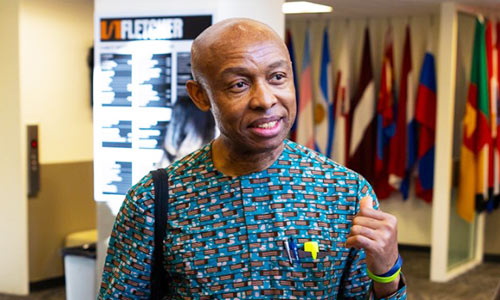
Human rights lawyer and former Chairman of the National Human Rights Commission, Professor Chidi Anselm Odinkalu, has renewed his warning about a possible third-term agenda for President Bola Tinubu following comments by former Osun State Governor and All Progressives Congress (APC) chieftain, Chief Bisi Akande, that the President should remain in office for another 10 years if possible.
Akande’s remarks have raised questions about presidential tenure limits, with concerns emerging over whether influential figures within the ruling party are contemplating an extension of Tinubu’s presidency beyond the eight years permitted under the existing constitutional framework.
The former Osun State Governor made the remarks during an interview on the Frankly Speaking with Icon podcast, published on Friday, November 27, 2026, where he argued that Tinubu needed more time to complete his administration’s reforms and development projects.
Reacting to the interview in a post on X, formerly Twitter, Odinkalu linked Akande’s proposed 10-year extension to his earlier warning about an alleged plan to secure a third presidential term for Tinubu.
Odinkalu suggested that Akande’s comments were consistent with his suspicion that an attempt could be made to amend Nigeria’s Constitution to permit a six-year presidential term after 2031.
“When I said there will be a #ThirdTerm, @OfficialAPCNg activated their #WhatsAppGroups,” Odinkalu wrote.
He continued by drawing attention to Akande’s position within the ruling party and the significance he attached to the proposed additional years in office.
“Well, Bisi Akande, a true grandee of the ruling party says @officialABAT should remain in office for 10 years, if possible to complete the work he has started,” he stated.
The lawyer then linked the proposed period to the expiration of a possible second term for Tinubu in 2031.
“That time horizon rhymes exactly with 2031 + an amended presidential term of 6 yrs. We can continue to behave like we don’t see the evidence,” Odinkalu declared.
His comments revived concerns about the possibility of extending presidential tenure beyond the existing constitutional limit.
Tinubu, who assumed office on May 29, 2023, is serving his first four-year term, which is scheduled to end on May 28, 2027.
If re-elected in 2027, he would ordinarily complete a second and final four-year term in May 2031 under the current constitutional arrangement.
However, Odinkalu’s argument suggests that the 10-year period mentioned by Akande could be connected to a hypothetical constitutional amendment allowing Tinubu to remain in office for an additional six years after 2031, extending his presidency to 2037.
The allegation remains Odinkalu’s interpretation of the political developments. Akande did not expressly announce a constitutional amendment proposal or state that the APC had adopted a plan to extend Tinubu’s tenure.
Nevertheless, his comments have revived questions about the intentions behind suggestions that the President should remain in office beyond the period currently permitted by law.
During the podcast, Akande maintained that Tinubu’s administration needed continuity to complete infrastructure projects and implement economic reforms.
He argued that the President had inherited longstanding challenges created by decades of poor governance and the effects of military rule.
Akande specifically referred to road construction projects in the South-West, including routes linking Ijebu-Ode, Abeokuta, Oyo and Ikire.
He cited comments attributed to the Olubadan, who, according to him, had praised the ongoing infrastructure projects and expressed support for Tinubu to serve another four-year term.
Quoting the traditional ruler, Akande said:
“If you are working like this, and this had not been done 50 years before you, what again do we still say you should do, and you have not done?
“But so that you will be able to complete this good job that you started, Ibadan people and Oyo State people are supporting you to do another four years.”
Akande subsequently expressed his own position, supporting a second term for Tinubu before suggesting that the President should remain in office for an even longer period if possible.
“What else do you want me to say? So Bola Tinubu should be allowed to do another four years to be able to complete that good job he has started.
“He should remain in office, if possible, for another 10 years; otherwise, we go back to the situation of Ebinpawa because there has been a foundation for hunger,” he said.
The former governor attributed Nigeria’s economic and developmental problems to decisions taken during successive military administrations.
He argued that those administrations weakened agriculture, education, employment and other important sectors, creating structural problems that could not be resolved within a short period.
“Forty years before he came, since 1966, when the military started ruling you, you have been laying the foundation for hunger. You have abandoned your farms. You have abandoned the job. You have refused to be educated. You have refused to be modernised,” Akande stated.
He maintained that the country needed sustained reforms to overcome the consequences of those earlier policies.
The APC chieftain also expressed confidence that improvements in electricity supply and modernisation would become more visible if the current reforms were sustained.
“So in another 10 years there will be electricity everywhere. There will be modernisation,” he said.
Akande specifically praised the liberalisation of the electricity sector, arguing that the policy had created opportunities for individuals, communities and businesses to participate in electricity generation and distribution.
“They liberalised electricity. If you have money today, you can create electricity in your home. You can create it in your city. You can create it around you,” he stated.
He contrasted the development with restrictions he said existed under military governments.
“Unlike what the military did before, if you tried to create electricity, they would arrest you. They would make you a debtor. They wouldn’t let you do it. They said only the Federal Government could do it. Tinubu came and said everybody can do it,” Akande added.
While Akande presented his argument as a case for policy continuity and the completion of government projects, Odinkalu interpreted the proposed 10-year period differently.
For the former National Human Rights Commission Chairman, the significance of the statement lay not merely in the endorsement of Tinubu’s policies but in the possibility that a prominent APC figure was preparing public opinion for an extension of presidential tenure.
His reference to 2031 and a proposed six-year term reflected a concern that the existing constitutional arrangement could become the subject of a future amendment designed to extend Tinubu’s stay in office.
The controversy also raises a fundamental constitutional question.
Under Section 135(2) of the Constitution of the Federal Republic of Nigeria, 1999, as amended, a presidential term lasts four years.
Section 137(1)(b) further disqualifies a person from election to the office of President if the person has previously been elected to that office at two elections.
The combined effect of these provisions is that a President elected in the ordinary circumstances cannot serve more than two four-year terms.
Consequently, Tinubu cannot lawfully remain in office for an additional 10 years under the existing constitutional tenure provisions merely because party leaders consider such an extension desirable.
Any proposal to alter the constitutional limitation would have to undergo the amendment process prescribed by Section 9 of the Constitution, including the required legislative approvals at the federal and state levels.
Even then, the legal effect of any proposed amendment would depend on its precise wording and compliance with constitutional requirements.
The debate has also drawn attention to the importance of public participation in the 2027 general elections.
One reaction to Akande’s comments expressed concern that the ruling party could be laying the groundwork for a prolonged presidency, describing the possibility as an attempt to establish a president who could remain in power indefinitely.
The reaction urged Nigerians to turn out en masse during elections and protect their votes through peaceful and lawful means, arguing that widespread participation and vigilance could make electoral manipulation more difficult.
However, the suggestion that the APC is planning to install a life president remains an allegation rather than an established fact. Similarly, large voter turnout, while important to democratic participation, does not by itself guarantee an election free from irregularities.
The concerns nevertheless underscore why transparent elections, respect for constitutional term limits and effective electoral oversight remain central to discussions about Nigeria’s democratic future.
Odinkalu’s warning is not the first time concerns about a possible extension of Tinubu’s presidency have entered public debate.
Earlier in 2026, the lawyer raised allegations about a possible third-term plan, including speculation concerning an extension of presidential tenure through constitutional amendments.
Other political figures have also publicly discussed the possibility of Tinubu remaining in office beyond the current two-term limit.
However, these statements and allegations do not, on their own, establish that the Presidency or the APC has formally initiated a constitutional amendment to extend Tinubu’s tenure.
In September 2026, First Lady Senator Oluremi Tinubu publicly rejected the suggestion that her husband intended to seek a third term.
Speaking while appealing for support for the President’s re-election, she declared:
“By the grace of God, we will all finish our eight years, because they will say I want to be there forever. There is no third term. Just give us a second term, we are good.”
Her remarks presented a different position from the concern subsequently expressed by Odinkalu following Akande’s interview.
The immediate controversy therefore centres on whether Akande’s proposal was simply an expression of confidence in Tinubu’s leadership or a signal of a broader political ambition to extend presidential tenure.
Akande’s argument was that the President should be given sufficient time to complete projects and consolidate reforms.
Odinkalu, however, viewed the proposed additional 10 years as consistent with his earlier warning about a possible third-term arrangement.
His position remains a political and constitutional interpretation requiring further evidence before it can be established as an actual plan.
For now, the Constitution limits presidential tenure to two four-year terms, while the 2027 general election remains the immediate constitutional route through which Tinubu could seek another term.
The renewed debate highlights the importance of distinguishing political endorsements from legally binding proposals, particularly where questions of presidential tenure and constitutional amendment are involved.
It also places renewed attention on the responsibility of political leaders to clarify proposals that could have implications for constitutional democracy.
For Odinkalu, Akande’s comments were sufficiently significant to justify renewed scrutiny of the possibility of a third-term agenda.
“We can continue to behave like we don’t see the evidence,” the lawyer warned, maintaining that the 10-year proposal was consistent with the concerns he had previously expressed.
Post Title: “2031 Plus An Amended Six-Year Term” — Odinkalu Links Akande’s 10-Year Proposal To Possible Constitutional Amendment For Tinubu By Naijaonpoint.