
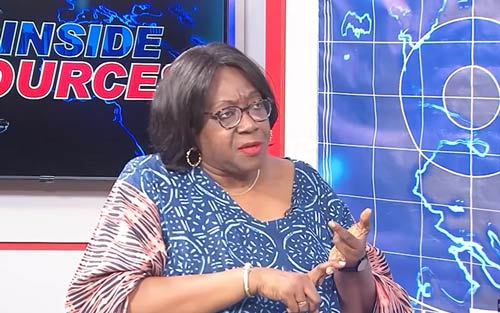
A veteran journalist and columnist Donu Kogbara has faulted President Bola Ahmed Tinubu over his decision to change Nigeria’s national anthem without what she considered adequate consultation, describing his leadership style as “imperial” and accusing him of using unfair tactics to suppress the opposition and consolidate his political position.
The journalist, however, acknowledged some of the President’s achievements, particularly his efforts to facilitate the resumption of oil and gas exploration in Ogoniland and the establishment of the Nigerian Education Loan Fund (NELFUND).
Speaking on the television programme Inside Sources, she also discussed the state of the nation, the proposed establishment of state police, the opposition, the 2023 presidential election, Peter Obi and the political crisis between the Minister of the Federal Capital Territory (FCT), Nyesom Wike, and Rivers State Governor, Siminalayi Fubara.
Asked about Tinubu’s democratic credentials and criticisms from the opposition, the journalist questioned the circumstances surrounding the change of Nigeria’s national anthem, accusing the President of taking the decision without adequate consultation.
She said Tinubu “arbitrarily changes our national anthem without really consulting anybody”.
Although she expressed admiration for both the former and current national anthems, she questioned the necessity of the decision and the President’s priorities.
“I don’t care. I like both versions,” she said, adding that both “Nigeria, We Hail Thee” and “Arise, O Compatriots” have “the right patriotic lyrics”.
“But the point is, please, who are you to come and be doing that kind of thing? And how important is it? His priorities are dicey,” she stated.
She also alleged that the National Assembly was “expected to bow to his wishes”, referring to occasions when lawmakers stood and sang “On Your Mandate We Shall Stand”.
The programme’s host, however, said he did not think the President expected lawmakers to sing for him, adding that “they sing it nonetheless”.
The host further explained that he had been informed that restoring the former national anthem was part of an understanding reached among members of the National Democratic Coalition (NADECO).
According to him, the understanding was that any member of the coalition who became President would reverse the change because the anthem had been composed under military rule.
Responding, the journalist pointed out that Nigeria’s Constitution was also written under military rule but had not been replaced.
She maintained that her concern was the alleged absence of adequate consultation before the decision was taken.
“You didn’t discuss it, you just did it,” she said.
The journalist further accused Tinubu of falling “into the age-old trap of using unfair tactics to suppress the opposition and enhance his own position”.
“His leadership style is imperial,” she declared, adding, “He’s almost a dictator.”
She described Tinubu as a disappointment to those who believed that his involvement in the struggle for democracy would translate into democratic leadership.
“Since he became governor of Lagos State in 1999 and then progressed to the presidency, I’ve seen little or no evidence that he respects democracy,” she said.
“He controlled Lagos like an emperor and now he’s doing the same thing to Nigeria.”
She suggested that the development could be attributable to “old age or the fact that power corrupts”.
The programme’s host had earlier noted that Tinubu came into office with considerable democratic credentials, given his involvement with NADECO and his sacrifices during the struggle against military rule.
The journalist also criticised what she described as arbitrary decisions concerning the award of major government contracts, particularly the coastal road project.
She faulted what she described as “arbitrary actions like awarding massive contracts like the coastal road to your cronies”, referring to the Chagourys.
She alleged that a substantial portion of the money was going to the family and its business partners.
However, she clarified that she was not opposed to Lebanese families who had lived in Nigeria for generations receiving government contracts.
According to her, she believed that “the world should be an open space for everybody”, but maintained that greater opportunities should be provided to Nigerian contractors.
“It’s too much,” she said, adding that “he’s not giving Nigerian contractors enough. There are lots of business people who are gasping for air right now.”
The host noted that the contractors had maintained that they worked with local partners.
The journalist equally criticised the removal of the fuel subsidy, announced by Tinubu on May 29, 2023, alleging that the decision was taken with “no proper consultation, no safety net”.
She also condemned the President’s handling of the political crisis in Rivers State.
According to her, what Tinubu “has done in Rivers State in partnership with Wike is an absolute disgrace”.
Despite her criticisms, the journalist acknowledged some of the President’s achievements and personal strengths, describing him as “highly intelligent”.
She disclosed that she was a member of a presidential committee established to facilitate the resumption of oil and gas exploration in Ogoniland.
According to her, oil exploration activities in the area had been suspended since 1993 following the crisis involving the late environmental activist, Ken Saro-Wiwa.
She commended President Tinubu “for genuinely wanting to resolve that impasse”, expressing confidence that the resumption of oil activities in Ogoniland “will change lives”.
She also praised the Nigerian Education Loan Fund, which she said “seems to be working well”, with “over 1.6 million students now impacted”.
The journalist identified political discipline as one of Tinubu’s strengths, describing him as someone who “builds gradually, silently” and remained committed to his political party.
She agreed with the host that Tinubu had experienced marginalisation under former President Muhammadu Buhari after 2015, including the rejection of his preferred nominees for the vice presidency.
According to her, Tinubu “took all of that in his stride and waited for his time”.
When the host recalled Tinubu’s public expression of dissatisfaction through his “Emi lokan” declaration, she explained that the political contest had already commenced at the time and that he was asserting his position.
Speaking on the general state of the nation, the journalist expressed concern over Nigeria’s economic, security and democratic challenges.
“It’s very obvious that we’re on a failing trajectory. We are going down rather than staying on level ground or moving upwards,” she said.
She noted that economic experts supporting the President frequently maintained that his reforms were producing the desired results, but said her assessment differed from theirs.
“I’m seeing that we’re in a dangerous position of failure, disintegration and despair,” she stated.
The journalist cited inflation, rising living costs and insecurity as major concerns, explaining that even relatively privileged Nigerians were experiencing financial anxiety.
“My heart beats with anxiety when it is time to pay the NEPA bill or to fill my car with fuel,” she said.
She also claimed that insecurity had worsened since Buhari handed over power to Tinubu, identifying what she described as “massive corruption and erosion of democracy” as additional challenges confronting the country.
On the proposed establishment of state police, the journalist said she remained “totally neutral”, arguing that the effectiveness of policing institutions depended largely on the integrity of those responsible for managing them.
“If you’re dealing with criminally inclined governors, and many of them are in fact criminally inclined, it doesn’t matter if they’re in charge of the police,” she said.
“I don’t really care whether they are controlled from Abuja or controlled from Port Harcourt or Jalingo.”
She maintained that until society became “ethically and legally sound”, institutions could still be subjected to abuse regardless of their organisational structures.
The journalist alleged that the police in Rivers State, where she comes from, had played “a largely nefarious role” over the decades.
She, however, recalled a Commissioner of Police whom she respected and who was in office when she was kidnapped in 2015.
“I just want the police to be properly resourced and to do what is right. I want them to be properly paid. And I want them to be led by lions, not donkeys,” she said, drawing on the First World War expression describing soldiers as “lions led by donkeys”.
She acknowledged that state police could be useful “to the extent that it has the capacity to move us into a real federal structure”.
Recalling her involvement in the presidential committee that drafted the initial Petroleum Industry Bill, she argued that laws alone could not guarantee responsible governance.
“If you have crooks running the show, it doesn’t matter which law you bring, they will still break it,” she stated.
The programme’s host agreed that her observation was “an important point”.
Addressing the challenges facing opposition political parties, the journalist maintained that opposition leaders also had a responsibility to develop effective strategies for confronting the ruling party.
She said the opposition “also has to take responsibility for fighting back in the most productive possible way”, something she believed its members had not adequately done.
She nevertheless acknowledged that opposition politicians were “trying, with one hand tied behind their back”.
The host recalled that Tinubu had experienced marginalisation in 2015 without leaving his political party and questioned why members of the opposition could not demonstrate similar political discipline, including by supporting a southern presidential candidate.
Reflecting on the 2022 presidential primaries of the All Progressives Congress (APC), the journalist expressed the view that, without Tinubu’s participation, Buhari would have preferred to retain the presidency in the North.
She disclosed that she had preferred former Vice President Yemi Osinbajo, whom she considered “the most impressive” intellectually and ethically.
According to her, several foreign ambassadors had also expressed disappointment that Osinbajo did not emerge as the party’s presidential candidate.
She questioned why Tinubu had to personally pursue the presidency rather than support another candidate.
“He could have supported somebody else. He’s way too old anyway,” she said.
“When I see him walking down the steps of a plane… I just think, Oga, don’t you want to rest?”
Speaking on the relationship between Tinubu and Wike, the journalist recalled her involvement in facilitating a meeting between the two politicians in London.
The programme’s host suggested that she was among those who facilitated Wike’s first meeting with Tinubu before 2022.
However, she clarified that she was uncertain whether it was their first meeting.
She recalled that the meeting took place around 2018 or 2019, when Wike, then Governor of Rivers State, travelled to London to speak at Chatham House.
According to her, after learning that Tinubu had lost his son, Wike expressed a desire to visit him and offer his condolences.
She said she contacted a senior aide to Tinubu, who facilitated the meeting.
“That was how it happened,” she recalled, describing the meeting as cordial.
She added that she “had no idea that that meeting and probably any prior meeting or subsequent meetings would lead to the situation we’re facing today in Rivers State”.
According to her, the political situation in Rivers State was “built on that connection, and not in a good way”.
Turning to the emergence of Fubara as Governor of Rivers State, the journalist disclosed that she had reservations about Wike’s decision to support him as his successor.
She said she wrote to Wike in 2022 or 2023, “complaining bitterly” about his choice of Fubara.
According to her, during the governorship campaign, Wike did most of the talking while Fubara sat “like a sack of garri”.
She said Wike initially ignored her concerns and that they only discussed the matter years later.
The journalist alleged that there was “something deadly and untrustworthy about” Fubara and claimed that he and Wike had been “partnering on many kinds of dodgy activities” during the period when Fubara served as Accountant-General and Wike was governor.
She further accused Wike of practising the political godfatherism he had previously promised to avoid.
According to her, Wike “had already done it by forcing Fubara down our throat”.
She also expressed doubts about the outcome of the 2023 Rivers State governorship election, alleging that Fubara “was a beneficiary of the same electoral fraud that got Tinubu announced as the winner”.
The programme’s host stated that results on the Independent National Electoral Commission Result Viewing Portal (IReV) showed that Peter Obi won Rivers State, but maintained that Tinubu would still have won the presidential election without the state’s figures.
Responding, the journalist argued that alleged manipulation in one state raised concerns about what could have occurred elsewhere.
“If he could do that in Rivers State, he could do it anywhere else,” she said.
“I still believe that either Peter or Atiku won in 2023.”
Recalling her intervention after the disagreement between Wike and Fubara began, the journalist said she advised the FCT Minister to allow his successor to govern Rivers State independently.
She recalled telling Wike to “let it be”.
“Let you take Abuja, they gave you FCT, you’re almost a governor again in FCT. Let Fubara do his own thing, you can’t be a power broker forever,” she said.
According to her, Wike disagreed with her position and “was very furious”.
She explained that some of the views she expressed privately to Wike were also communicated publicly.
Asked about what transpired between Wike and Fubara, the journalist said she had received conflicting accounts from different individuals.
“I was told that Fubara was actually quite mean to him,” she said.
“Someone told me that Fubara was so rude to him on one occasion that Wike broke down and cried, in Fubara’s presence. I wasn’t there.”
However, she disclosed that other individuals had given her a different account of their relationship.
“Others said, ‘No, don’t mind Wike. He was so nasty to Fubara that Fubara wanted to resign within three months.’”
She acknowledged that the conflicting accounts made it difficult to establish exactly what transpired, saying “it depends on who you listen to”.
The journalist also expressed disappointment with Fubara, questioning why he had not maintained his position after challenging his political godfather, particularly after Rivers people rallied behind him.
“Why didn’t you see it through to the end?” she asked.
She explained that she had supported Fubara “as a matter of principle”, despite her personal friendship with Wike.
“Instinctively, Wike is the one who is my friend,” she said.
The journalist recalled adopting a similar position when former Minister of Transportation, Rotimi Amaechi, allegedly attempted to “torment” Wike during his tenure as Rivers State Governor.
She said she advised Amaechi to “let him go”, following which he stopped speaking to her.
Commenting on Wike’s preferred successor, whom she did not identify, the journalist described him as a decent individual but questioned the political considerations surrounding his emergence.
“The guy he’s chosen is not a bad guy, a very decent human being,” she said.
However, she noted that the individual belonged to the same ethnic group as Wike and questioned why the FCT Minister should seek to impose another political leader on Rivers people.
She lamented that the Ogoni people, her ethnic group, had never produced a governor of Rivers State.
The journalist accused Wike of disregarding other ethnic groups, including the Ogoni and Kalabari, because of what she alleged was his desire to maintain his ethnic group’s control over the state’s political leadership and resources.
She further alleged that “they’ve amassed so much money” while “Rivers people are suffering”.
“That’s why I’m fighting them,” she stated.
Speaking on Peter Obi, the journalist acknowledged concerns about his political organisational abilities and movement across different political parties.
The programme’s host questioned Obi’s ability to build a sustainable political organisation, considering his movement from the Peoples Democratic Party (PDP) to the All Progressives Grand Alliance (APGA), back to the PDP, and subsequently to the Labour Party, African Democratic Congress (ADC) and Nigeria Democratic Congress (NDC).
The journalist responded that political leaders had different strengths and weaknesses.
“Tinubu has party discipline. Peter Obi is the opposite. He has hopped around,” she acknowledged.
However, she expressed the opinion that Tinubu “is very inferior to Peter ethically”.
“Peter Obi is a good man. I agree that he could be better at team building and organisational structure,” she said.
When the host pointed out that several individuals had abandoned Obi politically, the journalist maintained that other political leaders had experienced similar situations and that personal weaknesses differed considerably.
She illustrated her argument by referring generally to personal weaknesses such as paedophilia and alcoholism, maintaining that Obi’s organisational shortcomings were not comparable to such issues.
She expressed confidence in Obi’s personal integrity and claimed that his emergence as President would reduce corruption.
“If he takes over this country, the corruption level will go down drastically,” she said.
She also cited Obi’s donations to schools and maternity homes, maintaining that he used his personal resources to support such causes.
When the host noted that the NDC had indicated that it lacked sufficient campaign funds, the journalist said she was unaware of the party’s financial circumstances.
Responding to allegations concerning Obi, including those associated with the Pandora Papers, she acknowledged that she had not independently investigated the matter.
She said she had been informed that the arrangement involved legal tax avoidance and expressed doubts about a separate allegation that Obi invested Anambra State funds in a private business.
The journalist maintained that even if Obi had committed certain infractions, she considered them relatively minor compared with the conduct of some other political figures.
“That’s why I’m supporting Peter, because I think he’s a fundamentally honest man. Nobody’s perfect. He’s not a saint. He’s not a genius. But I’m telling you that the moral climate in this country will improve if he becomes president,” she said.
The programme’s host concluded by expressing hope that the journalist would return for another discussion before January.
Post Title: “Who Are You To Be Doing That Kind Of Thing?” — Kogbara Faults Tinubu Over Anthem Change, Calls His Style “Imperial” And Him “Almost A Dictator” By Naijaonpoint.