
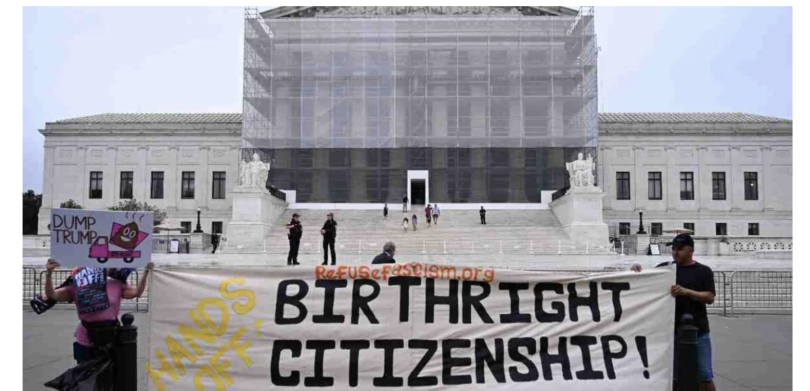
BREAKING: Supreme Court Rules On United States Birthright Citizenship [DETAILS]
Advertisement. Scroll to continue reading.
The United States (U.S) Supreme Court on Tuesday struck down U.S President Donald Trump’s challenge against birthright citizenship.
The U.S apex court also ruled that the constitutional guarantee of automatic birthright citizenship remains absolute, delivering a major blow to Trump’s second-term immigration agenda.
By a 6–3 majority in the case of Trump v. Barbara, the High Court struck down Executive Order 14160, a day-one presidential directive aimed at stripping automatic citizenship from children born on U.S. soil to undocumented parents or those on temporary visas.
The ruling firmly preserves a bedrock legal principle that has shaped American identity since the aftermath of the Civil War.
Chief Justice John Roberts, authoring the majority opinion, explicitly rejected Trump’s attempt to challenge birthright citizenship through executive fiat.
The ruling was written by Chief Justice John Roberts, who said that children born to parents who are in the U.S unlawfully or temporarily are “citizens at birth” under the U.S. Constitution.
In the ruling, he invoked the history of the 14th Amendment, which was passed in the wake of the U.S Civil War to settle the question of the citizenship of freed, American-born former slaves.
“Citizenship, then and now, was the right to have rights – to freely participate in our political community. The Framers of the Fourteenth Amendment extended that promise to ‘every free-born person in this land,’” Roberts wrote. “We keep that promise today.”
However, three justices dissented from today’s decision to uphold birthright citizenship. The three justices are Justices Clarence Thomas, Neil Gorsuch and Samuel Alito.
The three justices cite several reasons for disagreeing with the majority decision.
Justice Alito used more dramatic language in his dissent, saying the ruling was “one of the most important decisions in the history of the Court, and in my judgment, the Court has made a serious mistake”.
He said Tuesday’s ruling “confers citizenship on virtually everyone who happens to be born in this country, including the children of ‘birth tourists,’ women who come here solely for the purpose of giving birth to a child and then promptly return home”.
Alito argued that “careful analysis” of the 14th Amendment gives citizenship to “only those children who, at birth, owe allegiance solely to this country”.
In a 91-page dissent, Justice Clarence Thomas blasted the court for knocking Trump’s effort to end birthright citizenship, saying his colleagues’ decision “devalues” citizenship as it was understood by the framers of the 14th Amendment.
“I am not sure that today’s opinion will stand the test of time,” he wrote.
“The Citizenship Clause ‘added greatly to the dignity and glory of American citizenship.’ Today’s opinion devalues that citizenship. I respectfully dissent,” he wrote.
Thomas, whose dissent was joined by fellow conservative Justice Neil Gorsuch, said the majority had “repurposed the Fourteenth Amendment to protect its own set of preferred rights” and that its decision could not be squared with the text of the amendment.
Pan-Atlantic Kompass reports that with the Supreme Court upholding birthright citizenship, the undocumented population is expected to decrease over the next few decades.
If the Supreme Court had allowed Trump’s executive order to continue, those born to parents who are undocumented would also have been considered unlawful residents, subsequently increasing the undocumented population.
Birthright citizenship is a 160-year practice granting citizenship to anyone born on American soil, enshrined in the Constitution by the 14th Amendment.