
By Onoja Baba
As Governor Umo Eno prepares to unveil the Ibom International Hospital as the flagship project of the proposed Ibom Medical City in Uyo, questions are mounting over the fate of the existing Ibom Multi Specialty Hospital, a multi-billion-naira healthcare facility established to achieve many of the same objectives now being advanced for the new project.
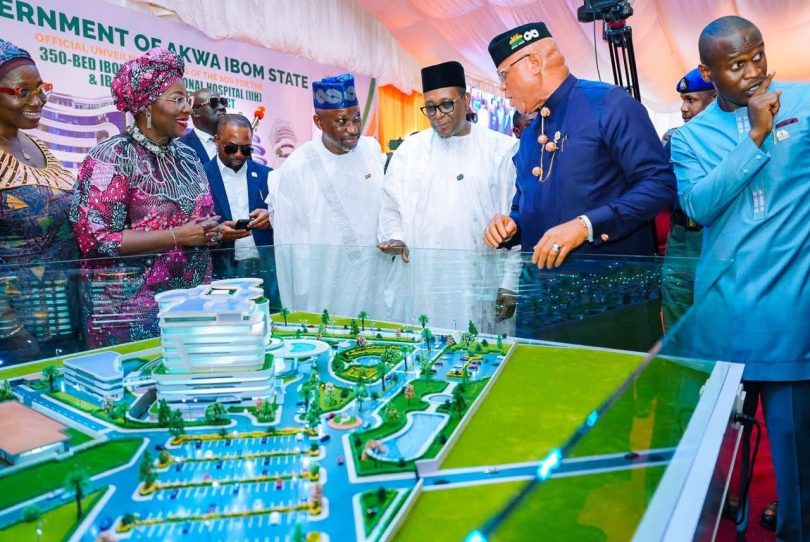
The Ibom International Hospital, scheduled for unveiling on June 24, 2026, has been presented by the Akwa Ibom State Government as a transformative healthcare initiative designed to reduce medical tourism and position the state as a regional destination for advanced medical care.
According to government officials, the proposed facility will feature 350 beds, robotic surgical theatres, advanced oncology services, PET-CT scanning equipment, 3-Tesla MRI systems, transplant units, spinal surgery centers, cancer treatment facilities and research institutions.
The Commissioner for Information, Dr. Aniekan Umanah, has described the project as a healthcare revolution capable of attracting patients from across Nigeria and other African countries while reducing the need for overseas medical treatment.
However, an investigation by Secrets Reporters has uncovered lingering concerns about the state’s existing flagship healthcare facility and whether lessons from that project have been fully addressed before embarking on another major investment.
A N41 Billion Vision
Less than a decade ago, Akwa Ibom State reportedly spent about N41 billion constructing and equipping the Ibom Multi Specialty Hospital in Uyo.
Commissioned in 2015 during the administration of former Governor Godswill Akpabio, the hospital was similarly promoted as a world-class healthcare institution that would reverse medical tourism and provide specialist services previously unavailable in Nigeria.
Located along the Uyo–Ikot Ekpene Road corridor, the hospital was designed as a 302-bed tertiary healthcare facility equipped with specialist diagnostic and treatment units. At the time of commissioning, it was described as one of the most advanced medical facilities in West Africa.
Yet nearly a decade later, investigations suggest the hospital has struggled to fully realize that vision.
Unfinished Sections, Unmet Expectations
Findings by SecretsReporters indicate that significant sections of the facility remained incomplete years after commissioning.
During visits to the hospital, this reporter observed areas with unfinished works, exposed installations, missing fittings and sections that appeared not to be fully operational. Sources familiar with the facility’s development also alleged that some specialized components contained in the original project design were either incomplete or never fully deployed.
Multiple sources within the health sector claimed that parts of the hospital were commissioned before all planned infrastructure and services had been completed.
Although these claims require official clarification, they raise important questions about the extent to which the facility has achieved the objectives for which it was established.
Governor’s Admission
Concerns about the hospital’s performance gained further attention when Governor Umo Eno acknowledged that the facility had not fully achieved its founding objectives.
In his 2025 New Year broadcast, the governor announced plans to reorganize the Ibom Multi Specialty Hospital as a standalone institution and stated that the facility would be repositioned to fulfil the vision behind its establishment.
“We will reorganize Ibom Multi Specialty Hospital to achieve its founding objective,” the governor stated.
The governor’s remarks, which remain reflected on the hospital’s official platform, have been interpreted by observers as an acknowledgement that the hospital has yet to fully deliver on its original mandate more than a decade after commissioning.
Another N105 Billion Commitment
Despite the unresolved issues surrounding the existing facility, the state government has committed substantial resources to the proposed Ibom Medical City project.
Documents reviewed by Secrets Reporters from the Akwa Ibom State 2026 Approved Budget indicate that N100 billion has been allocated for the construction of the Ibom International Hospital under the Ministry of Health.
An additional N5 billion has been earmarked for the construction, equipping and take-off of a Mental Rehabilitation Centre within the broader Medical City framework.
The allocations form part of the state’s N1.584 trillion 2026 budget and represent one of the largest single health infrastructure commitments in the state’s history.
Accountability Questions
The emergence of the new project has triggered questions about the future of the existing hospital and the utilization of previous investments.
If the Ibom Multi Specialty Hospital was originally established to reduce medical tourism, provide advanced specialist care and position Akwa Ibom as a healthcare destination, why is another N100 billion hospital being developed around similar objectives?
What is the current operational status of the specialized units installed at the existing facility?
How much has the state spent on maintaining, upgrading and operating the hospital since its commissioning in 2015?
To what extent have the hospital’s original targets been achieved?
Would completing and expanding the existing facility provide a more cost-effective alternative to constructing a new hospital complex?
These questions remain unanswered.

Experts Raise Concerns
Health policy analysts who spoke to this newspaper noted that major healthcare investments are most effective when governments maximize the value of existing infrastructure before embarking on new capital-intensive projects.
According to them, Nigeria’s public sector has often struggled with sustaining large-scale projects, resulting in underutilized facilities and repeated spending on similar initiatives.
While state officials maintain that the Ibom Multi Specialty Hospital is not being abandoned and will coexist with the proposed Medical City, concerns remain over whether substantial portions of the existing facility are being fully utilized.
The Need for Transparency
For many residents, healthcare stakeholders and public finance advocates, the central issue is accountability.
Before committing another N105 billion in public funds to a new medical complex, stakeholders argue that government should provide a comprehensive public account of the Ibom Multi Specialty Hospital’s development, including the total amount spent, facilities delivered, current operational status, outstanding challenges and plans for optimization.
Such transparency, they contend, would help the public assess whether the new investment represents an expansion of healthcare capacity or an attempt to address shortcomings in an earlier project.
As preparations continue for the unveiling of the Ibom International Hospital, the debate is likely to intensify.
Whether the new facility becomes a transformative healthcare milestone or raises further questions about public infrastructure planning may ultimately depend on how government addresses the unresolved concerns surrounding the hospital that came before it.