
Naijaonpoint
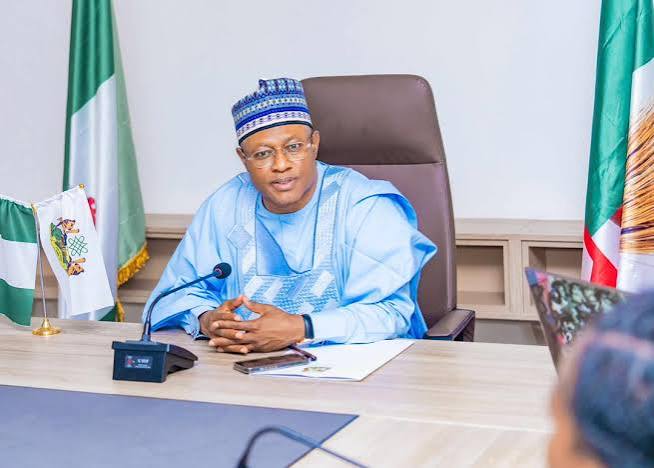
Uba Sani took office as Governor of Kaduna State on 29 May 2023, and he has built his public account of the state’s finances on the debt he inherited. At a town hall on 30 March 2024 he told the state he met $587 million of foreign debt, N85 billion of domestic debt and N115 billion of contractual liabilities. Those are his own figures, repeated by him since, and he has put the deductions taken from the state’s federal allocation for the inherited debts at N6.7 billion a month, running to 2048. His commissioners carried the account further and placed it on record that the state had not borrowed one kobo under him. A Premium Times fact check of 16 September 2026 examined that claim against the financial statements and rated it misleading.
The state’s own debt sustainability analysis records what sat inside the domestic debt stock at the end of 2023, seven months into his tenure: pension and gratuity arrears of N6,756,990,000 and contractors’ arrears of N8,969,920,000.
The state’s official spending records carry a different account of the borrowing. In 2024, Kaduna drew N52,263,425,009.93 in loans. Every naira of it was international. Domestic loans drawn in 2024 were nil, in records examined by SecretsReporters.
In 2025 the drawdowns rose to N81,941,507,218.15. Financial institutions accounted for N61,539,443,155.33 of it and government entities for N13,427,064,062.82. The capital market accounted for N6,975,000,000, drawn at 136.4 percent of the N5,113,357,150 provided for that source in the budget. Drawing above the provision made for a loan source is borrowing beyond what the Appropriation Law authorised for it.
The audited statements present the same year in a different figure. Their cash flow statement records loan receipts of N875,965,000 for 2025, where the spending records record N81,941,507,218.15 drawn. The difference between the state’s two presentations of its 2025 borrowing is N81,065,542,218.15. The spending records are the state’s quarterly account of its own receipts and spending, published through the year, and the audited statements are its certified account of the same year. The quarterly account puts the year’s loan receipts at more than ninety times the figure the certified account records, and no published document of the state reconciles the two presentations.
In the first half of 2026 the state drew a further N9,146,317,506.83, again all international, against a loans provision of N145,762,107,684.47 in the 2026 budget, which is 6.3 percent of the provision taken by June. The cumulative drawdowns recorded in the spending records for 2024, 2025 and the first half of 2026 come to N143,351,239,735.91. Domestic drawdowns are nil in every one of those periods.
The debt itself carries charges, and the records price them on the budget basis, the basis on which the state records principal repayment as a charge. By September 2025 the state had paid N48,658,044,116 in public debt charges, a figure that stands in the 2026 budget book’s record of the previous year’s performance. Of that sum, N36,821,500,256.25 was repayment of foreign principal, made against a revised provision of N14,721,596,968.30 for foreign principal for the whole of 2025, so the repayment had passed the full-year provision by September, at two and a half times the amount provided. The fourth quarter of 2025 alone carried public debt charges of N15,656,954,165.70. For 2026, the budget provides N54,000,000,000 for the repayment of foreign principal alone.
The Fiscal Responsibility framework requires public borrowing to be disclosed fully and tied to the capital projects it finances. The drawdowns above stand in the state’s own spending records for the same years covered by the claim that the state had not borrowed one kobo, and no published document of the state reconciles the claim with the records.
The spending records for the third quarter of 2026, which would carry the drawdowns of that quarter, had not been published at the time the records were examined by SecretsReporters.
Source: …Secretsreporters