
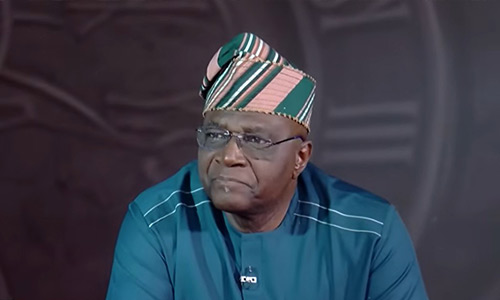
Special Adviser to President Bola Tinubu on Information and Strategy, Bayo Onanuga, has defended the President’s economic record and growing political support from state governors, declaring that “thirty-three governors cannot be wrong” in backing Tinubu for another term.
Onanuga made the assertion on Friday while reacting to a television discussion on the state of the economy, arguing that critics were continuing to push what he described as an outdated opposition narrative that nothing had improved since Tinubu assumed office in May 2023.
“TV anchors keep pushing the opposition’s narrative that nothing has changed, positively, indeed, massively, since 2023,” Onanuga said, accusing some commentators of questioning National Bureau of Statistics data showing a moderation in inflation.
He urged critics to return to the markets, claiming that food prices were falling and citing rice as an example.
“The favourite rice that at a time was selling for N120k a bag has crashed below N50k. In my hometown, a bag now sells for N45K,” he said.
According to the presidential aide, those price movements, together with improving foreign reserves, greater availability of foreign exchange and renewed foreign investment, showed that the administration’s economic reforms were beginning to produce results.
“Our reserves are close to $60 billion. Nigerians are now able to use their Naira cards abroad, something that was impossible before Tinubu’s presidency,” he said.
He also argued that businesses could now obtain foreign exchange for the importation of raw materials and equipment, while rejecting suggestions that capital returning to the country consisted mainly of short-term portfolio investment.
Onanuga maintained that foreign direct investors were also bringing money into Nigeria and creating jobs, before pointing to the political support Tinubu has received from governors as another indication of confidence in the administration.
“Under President Tinubu, Nigeria is making tremendous progress. Thirty-three governors cannot be wrong in casting their support for President Tinubu,” he said.
The declaration, however, touches directly on a wider argument already dominating public discussion ahead of the 2027 election: whether the support of governors should be treated as a measure of how ordinary Nigerians themselves assess the administration.
Critics of that argument point out that governors and the governments they control have been major beneficiaries of the sharp rise in Federation Account allocations following the removal of petrol subsidy and other fiscal reforms, while millions of citizens have continued to complain about the cost of fuel, transportation, food and other essentials.
Indeed, government revenue available for distribution has risen considerably since the subsidy removal. In July 2026 alone, FAAC distributions reached a record ₦3.007 trillion, after ₦2.551 trillion was shared in June. A separate analysis put allocations to the three tiers of government between January and May 2026 at ₦10.45 trillion, up 25.85 per cent from ₦8.30 trillion during the corresponding period of 2025.
Nasarawa State Governor Abdullahi Sule, for instance, said in August that his state’s monthly allocation had risen from about ₦4.5 billion to approximately ₦16 billion following the removal of fuel subsidy and other reforms.
That increase in government revenues has itself fuelled demands for greater accountability. Civil society groups have argued that considerably higher allocations have not translated sufficiently into improved living conditions for ordinary Nigerians, while public debate has increasingly focused on how states are spending the additional revenues generated in the post-subsidy era.
Former federal lawmaker Sam Onuigbo similarly said this week that governors should account for the increased revenues accruing to their states from the subsidy-removal era and ensure that the additional resources translate into tangible improvements at the grassroots.
Against that backdrop, some Nigerians and government critics are increasingly framing the approaching election not simply as a contest determined by endorsements from political officeholders, but as a test of whether the millions of citizens who have borne the immediate costs of the economic reforms share the governors’ assessment.
Their argument is that 33 governors, regardless of their political influence, constitute only 33 individuals and cannot by themselves be treated as a substitute for the judgement of Nigeria’s much larger voting population. They also contend that governors whose states have benefited from substantially increased federal allocations occupy a materially different position from ordinary households struggling with fuel, transport and living costs.
The criticism does not establish that the governors’ support is insincere, nor does it determine how Nigerians will vote. But it highlights the political divide Onanuga’s statement has brought into sharper focus: the Presidency points to improving macroeconomic indicators and the backing of 33 governors as evidence that Tinubu’s reforms are working, while critics insist that the ultimate verdict belongs to millions of voters whose assessment will depend largely on whether those gains have reached their homes and reduced the hardship they experience.
That tension is particularly important because the economic benefits of subsidy removal have not been evenly experienced. While governments have received larger allocations, the Federal Government has also said that much of the fiscal gains from subsidy removal and foreign-exchange reforms have been absorbed by higher debt-service costs and increased public expenditure. At the same time, the reforms have contributed to a severe cost-of-living squeeze for many households.
For Onanuga, however, the direction of the economy is clear. He accused critics of allowing partisan hostility to obscure what he described as the administration’s achievements.
“These facts are clear to anyone not blinded by partisanship and hatred for the leader who has laid a solid foundation for the economy and is poised to take the nation to a higher level of shared prosperity,” he said.
Post Title: “Thirty-Three Governors Are Only 33 People” — Nigerians Challenge Onanuga, Say Millions Facing Hardship Will Decide 2027 Election By Naijaonpoint.