
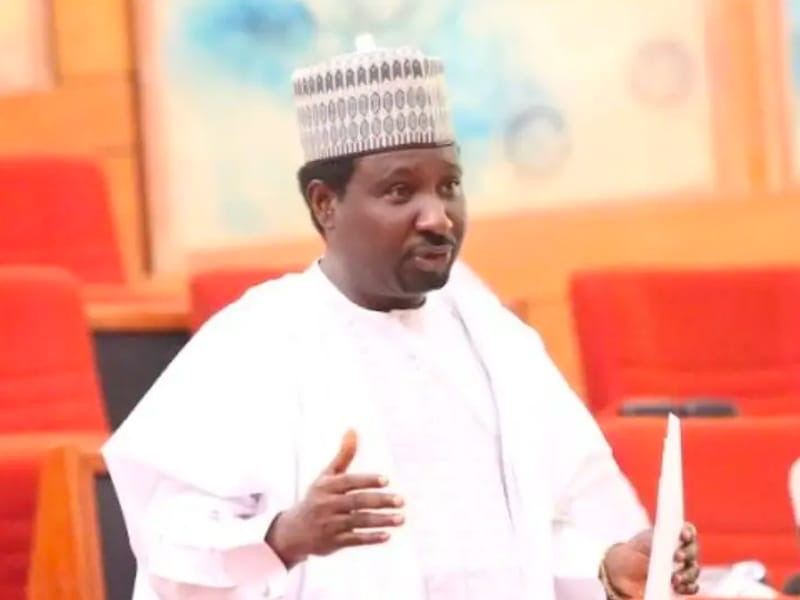
Deputy Senate President cites NELFUND, highway projects and global conflicts amid concerns over rising living costs.
Deputy President of the Senate, Senator Jibrin Barau, has defended President Bola Tinubu’s economic reforms, arguing that inadequate communication by political leaders has contributed to public dissatisfaction with the government.
Barau made the remarks on Wednesday during a public lecture titled “Democracy and Development: Rethinking the Leadership Question,” organised in Yola, Adamawa State, to mark the 59th birthday of Governor Ahmadu Umaru Fintiri.
He was responding to concerns raised by former Vice President Yemi Osinbajo about economic hardship, declining public confidence in democratic institutions and limited youth participation in electoral politics.
While acknowledging the concerns, Barau argued that public perceptions of government performance were partly influenced by the failure of leaders to adequately explain their policies, interventions and development projects.
“The issue of communication between the leaders and the led” was a major factor behind the gloomy picture presented by surveys, he said, insisting that government needed to engage citizens more effectively.
Barau Highlights Education and Infrastructure Projects
The deputy Senate president cited the Nigerian Education Loan Fund (NELFUND) as an example of the Tinubu administration’s efforts to expand access to tertiary education, particularly for students from financially disadvantaged backgrounds.
He argued that the initiative could help address barriers to education and create opportunities for young Nigerians.
Barau also pointed to major infrastructure projects, including the Lagos-Calabar Coastal Highway and the Badagry-Sokoto Highway, as evidence of ongoing efforts to address Nigeria’s infrastructure deficit.
According to him, investments in roads, water supply and other essential facilities are necessary to stimulate economic activity, improve transportation and attract investment.
He maintained, however, that the government must do more to explain the objectives and progress of its programmes so that citizens can better understand their intended benefits.
Global Conflicts Contributing to Economic Pressure
Barau also attributed part of the rising cost of living to international developments, including the Russia-Ukraine war and conflicts in the Middle East.
He said the conflicts had disrupted global supply chains, increased energy costs and raised the prices of goods and services.
The senator noted that Nigeria’s economy was connected to international markets and could not be insulated from global economic shocks.
“Nigeria is not an island,” he said, stressing that international developments also influenced domestic economic conditions.
Osinbajo Raises Concerns Over Democracy
Osinbajo, who served as vice president from 2015 to 2023, had highlighted widespread economic anxiety and dissatisfaction with democratic governance across Africa.
Citing Afrobarometer survey findings, he noted that although 64 per cent of Africans preferred democracy to other forms of government, only 38 per cent were satisfied with how democracy was functioning in their countries.
He also referenced findings indicating that 59 per cent of Africans considered their national economies to be in poor condition, while 51 per cent believed their economies had deteriorated.
Osinbajo warned that persistent hardship and the failure of democratic institutions to meet citizens’ expectations could weaken public confidence, particularly among young people.
The debate comes amid continuing concerns over the impact of Tinubu’s economic reforms on household incomes, transportation costs and the prices of essential commodities.
While the Federal Government has defended the reforms as necessary to address longstanding economic challenges, questions remain about how quickly their benefits will translate into improved living conditions for Nigerians.
Barau maintained that better communication must complement tangible results, urging political leaders at all levels to engage citizens, explain policy decisions and provide credible updates on government interventions.