
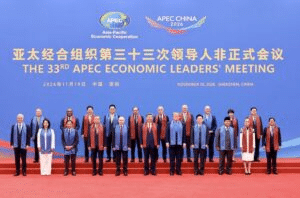
For the Economic Community of West African States (ECOWAS), the experience of the Asia-Pacific Economic Cooperation (APEC) offers valuable lessons on translating regional integration into sustainable economic growth.
The 33rd APEC Economic Leaders’ Summit, held from Nov. 18 to Nov. 19, in Shenzhen, China, demonstrated how economies at different levels of development could pursue shared interests through openness, innovation and mutually beneficial cooperation.
Held under the theme, “Building an Asia-Pacific Community to Prosper Together,” the summit ended with the adoption of the Shenzhen Outlook, reaffirming commitments to regional integration and inclusive economic development.
The summit was preceded by the APEC CEO Summit a day earlier and attracted more than 2,000 representatives from the bloc’s 21 member economies, including business leaders, government officials and representatives of international organisations.
Chinese President Xi Jinping, addressing the gathering, identified peace, openness, innovation and mutually beneficial cooperation as essential foundations for regional prosperity.
He urged APEC economies to strengthen unity, resist protectionism and unilateralism, and defend multilateralism amid growing geopolitical tensions and global economic uncertainty.
Xi also advocated deeper cooperation in digital trade, cross-border e-commerce, smart customs, industrial supply chains, artificial intelligence and green technologies.
He identified China’s 15th Five-Year Plan, covering 2026 to 2030, as an opportunity for international businesses to participate in the country’s modernisation.
According to him, opportunities would span electric vehicles, robotics, autonomous driving, smart homes, drone delivery, tourism and other emerging industries.
He further reaffirmed China’s commitment to opening its markets, improving investment conditions and advancing high-quality Belt and Road cooperation.
Similarly, Russian President Vladimir Putin identified the Asia-Pacific as a major global economic, industrial and technological centre, driven increasingly by emerging Asian economies.
He noted that APEC economies accounted for more than 60 per cent of global Gross Domestic Product (GDP) and approximately half of global merchandise trade.
Putin also disclosed that the Asia-Pacific’s share of Russia’s foreign trade had risen from about 25 per cent in 2014 to 53 per cent.
He advocated stronger regional logistics, transport infrastructure, digital transformation, agricultural cooperation and investment, while expressing Russia’s readiness to share its technological and agricultural capabilities.
These developments highlight the importance of regional cooperation, technological innovation and sustained commitment to advancing shared economic interests.
For ECOWAS, the lessons are significant.
With an estimated combined nominal GDP of approximately 642.4 billion dollars and a population of about 384 million in 2025, the bloc represents a substantial economic market.
However, its potential remains constrained by fragmented markets, infrastructure deficits and limited industrial integration.
ECOWAS accounts for approximately 0.6 per cent of global GDP, compared with APEC’s 60 per cent.
This disparity highlights the considerable opportunities available to West Africa in industrialisation, trade expansion and economic diversification.
By comparison, APEC had a combined nominal GDP of 71.7 trillion dollars and a population of approximately 2.99 billion in 2025.
Established in November 1989 in Canberra, Australia, 14 years after ECOWAS was founded, APEC initially brought together 12 economies seeking stronger economic cooperation across the Pacific.
Over the years, its membership expanded to 21 economies across Asia, the Americas and Oceania, while merchandise trade among its members increased more than ninefold.
Official figures also show that average tariffs across APEC economies declined from 17 per cent in 1989 to 5.3 per cent in 2021.
These achievements demonstrate how sustained cooperation, trade liberalisation and investment facilitation can expand markets and strengthen regional production networks.
Another important feature of APEC is its approach to decision-making.
The organisation operates through consensus, voluntary commitments and non-binding cooperation.
This arrangement allows economies with different political systems and development priorities to pursue common objectives.
Such flexibility offers ECOWAS useful lessons as it continues to navigate economic disparities, political disagreements and varying institutional capacities.
Founded on May 28, 1975, in Lagos, Nigeria, ECOWAS was established to promote economic cooperation and integration among West African countries.
Its founding ambition was to build a prosperous and peaceful regional community through collaboration in trade, agriculture, industry, transportation, energy and other sectors.
Following the withdrawal of Burkina Faso, Mali and Niger, which took effect on January 29, 2025, ECOWAS now comprises 12 member states.
In spite of its achievements, the bloc continues to face trade barriers, infrastructure deficits, insecurity, political disagreements and weak implementation of regional protocols.
Consequently, businesses and citizens have yet to enjoy the full benefits of regional economic integration.
One fundamental lesson from APEC is that political commitments must translate into practical programmes, supported by measurable targets and sustained implementation.
For ECOWAS, this requires strengthening existing regional trade instruments, especially the ECOWAS Trade Liberalisation Scheme, the Common External Tariff and the Customs Code.
Although these frameworks provide a foundation for economic integration, inconsistent implementation, complicated customs procedures and regulatory differences continue to impede regional commerce.
The bloc must therefore strengthen mechanisms for addressing non-tariff barriers, including arbitrary charges, border delays and inconsistent regulatory requirements.
Simplified customs administration, harmonised standards and efficient border management would reduce business costs and facilitate the movement of goods and services.
A more integrated regional market would also enable businesses to expand production, attract investment and benefit from economies of scale.