
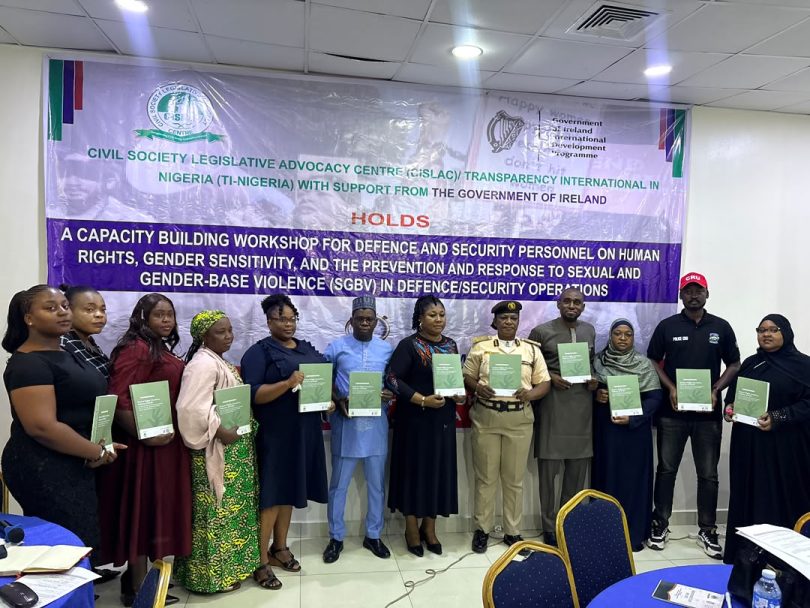
The Civil Society Legislative Advocacy Centre (CISLAC) has called on defence and security agencies to establish confidential reporting channels for sexual and gender-based violence (SGBV), protect complainants against retaliation and ensure prompt investigation of reported cases.
The organisation also urged security institutions to strengthen internal accountability systems, warning that weak complaint mechanisms, delayed investigations and inadequate disciplinary measures could undermine efforts to prevent sexual violence and abuse of authority during security operations.
The recommendations formed part of a communiqué jointly signed by the Executive Director, CISLAC/TI Nigeria, Auwal Rafsanjani and Mr Maurice Chukwu, Researcher, Amnesty International in Nigeria, issued at the end of a capacity-building workshop on human rights, gender sensitivity and SGBV prevention and response in security operations in Nigeria, organised by CISLAC/Transparency International Nigeria (TI-Nigeria), with support from the Government of Ireland.
The workshop was held in Abuja, brought together defence and security personnel, government officials, oversight institutions, civil society organisations, women’s rights activists and the media.
Participants called for accessible and confidential reporting channels, including dedicated hotlines, official telephone numbers, email addresses, complaint boxes and secure digital platforms, to encourage victims and affected personnel to report incidents without fear of intimidation or victimisation.
They also recommended strengthening Gender Desks and equipping them with trained personnel to receive, document and refer complaints.
The communiqué called for clear investigation procedures and timelines to ensure that reported SGBV cases are handled promptly, impartially and professionally. It further urged institutions to apply appropriate disciplinary measures against personnel found responsible for misconduct and refer suspected criminal offences to relevant law enforcement and prosecutorial authorities.
The participants also recommended periodic institutional reviews and annual reporting on complaints received, investigations conducted, cases resolved and disciplinary outcomes, while safeguarding the identities and confidentiality of survivors.
A major highlight of the workshop was the launch of a validated baseline assessment report titled, “Human Rights Practices, Patterns of SGBV and the Effectiveness of Existing Complaint and Accountability Mechanisms Within Defence and Security Agencies”.
The report was launched by the Executive Secretary of the National Human Rights Commission (NHRC), Chief Anthony Okechukwu Ojukwu, represented by the Director of the Commission’s Women and Children Department, Mrs Ngozi Okore.
The assessment examined human rights practices, patterns of SGBV and the effectiveness of existing complaint and accountability mechanisms across the defence and security agencies assessed.
Participants identified unequal power relations between senior and junior personnel as a major institutional risk, noting that dependence on superior officers for promotion and career progression could expose subordinates to intimidation, harassment, exploitation and abuse of authority.
They also raised concerns about inadequate supervision during night duties and field operations, poor accommodation arrangements, insufficient resting facilities and gender imbalances in duty assignments.
The communiqué further warned that inappropriate search procedures, particularly where female civilians are searched without the involvement of female officers, could expose them to harassment and abuse.
It called for female officers to participate in searches involving women, alongside stronger monitoring of security checkpoints and other operational environments where personnel exercise authority over civilians.
On prevention, participants urged defence and security institutions to conduct SGBV risk assessments before, during and after security operations, strengthen supervision through regular and unannounced inspections, and establish clear operational guidelines against harassment, exploitation and abuse.
They also recommended adequate and separate accommodation, restrooms, changing areas and resting facilities for male and female personnel during deployments and field operations.
The workshop further called for the elimination of gender-based discrimination in recruitment, appointments, promotions, training and leadership opportunities.
Participants recommended increased representation of women in decision-making structures, the appointment or strengthening of gender advisers and focal persons, and mandatory gender and cultural sensitivity training for personnel across all ranks.
On support for survivors, the communiqué urged security agencies to develop referral directories linking affected persons to organisations and service providers offering psychosocial care, healthcare, legal assistance, shelter and other protection services.
It also called for stronger collaboration with the NHRC, civil society organisations, healthcare providers and relevant law enforcement agencies to improve referrals and survivor protection.
The participants recommended temporary safe accommodation for survivors facing threats or intimidation and support to access legal remedies, including protection orders under the Violence Against Persons (Prohibition) Act, 2015, where applicable.
To ensure implementation, the communiqué urged participating agencies to designate focal persons and develop institution-specific action plans with clear priorities, responsible departments, timelines and measurable indicators.
It also called for regular capacity-building programmes and periodic assessments to monitor compliance with human rights standards, gender-responsive policies and SGBV accountability mechanisms.
The participants reaffirmed that effective prevention of sexual and gender-based violence required institutional safeguards, professional conduct, accessible reporting channels, survivor-centred responses and consistent accountability.