
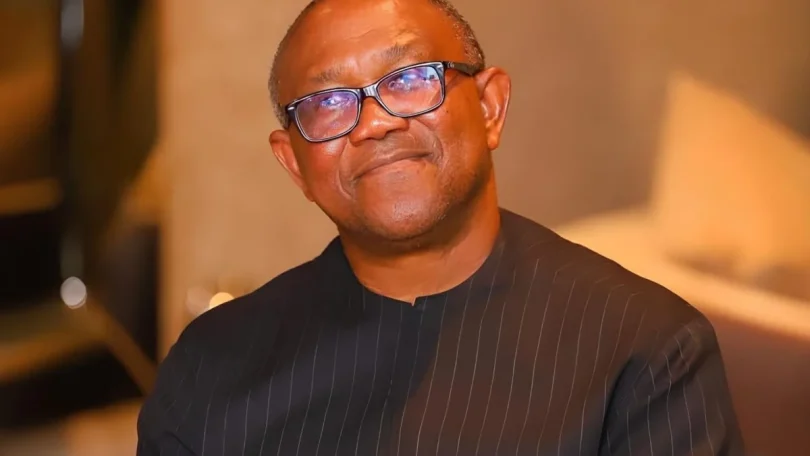
The Northern Youth Assembly has issued a 72-hour ultimatum to presidential candidate of the Nigeria Democratic Congress (NDC), Peter Obi, and some of his associates to publicly apologise over the singing of Nigeria’s former national anthem at a political gathering in Lagos.
This was just as the group also demanded that Obi clarify his position on the country’s officially recognised national anthem, Nigeria, We Hail Thee, and reaffirm his commitment to national unity and constitutional order.
Politics Nigeria reports that the demands were contained in a statement issued by the Assembly’s National Publicity Secretary, Adikwu Omaji Joshua.
The Assembly said it was concerned about the incident at the NDC town hall meeting in Lagos, where some participants allegedly declined to sing the current national anthem and instead rendered the former anthem, Arise, O Compatriots.
It described the action as inappropriate, particularly at a political gathering associated with a prominent political figure and presidential aspirant.
While acknowledging Nigerians’ constitutional rights to freedom of expression, peaceful assembly and political association, the group insisted that such rights should be exercised with respect for the country’s sovereignty and national symbols.
According to the Assembly, the national anthem represents Nigeria’s collective identity and should not be used as a political campaign tool or a means of expressing grievances against the government.
It maintained that national symbols should remain above partisan interests, ethnic affiliations and religious differences.
The group further argued that Obi’s influence in Nigeria’s political space placed a responsibility on him to promote national cohesion and responsible citizenship.
It urged political leaders to exercise restraint and ensure that the enthusiasm of their supporters did not undermine national unity and peaceful coexistence.
The Assembly warned against the use of political disagreements to justify disrespect for national institutions and symbols, noting that Nigeria had experienced the consequences of disunity, ethnic divisions and separatist agitations.
Consequently, it demanded that Obi and others it said were directly involved in the incident issue a public apology within 72 hours of its statement.
It also asked the political figures to declare their position on Nigeria’s officially recognised national symbols and reaffirm their commitment to the country’s unity, sovereignty and constitutional order.
The group urged them to caution their supporters against turning political disagreements into hostility towards national institutions.
It said the ultimatum was intended to give those involved an opportunity to demonstrate patriotism and respect for Nigerians, warning that failure to receive a satisfactory response could prompt it to pursue further lawful action.
However, the Assembly stressed that its position was not intended to suppress opposition or legitimate criticism of the Federal Government.
It called on political leaders, youth organisations and civil society groups to promote responsible citizenship and defend Nigeria’s unity across ethnic, religious and regional divides.
The controversy followed an incident at an NDC town hall meeting in the Oregun area of Lagos State, where some attendees sang the former national anthem, Arise, O Compatriots, instead of the current anthem, Nigeria, We Hail Thee.
Obi was among those seen participating in the singing of the former anthem and making the party’s two-finger gesture.
However, Funso Doherty, the NDC governorship candidate in Lagos State, subsequently described the singing as a spontaneous reaction by attendees in an emotional atmosphere.
Doherty said the current national anthem was also performed at the gathering, stressing that Nigeria had only one officially recognised national anthem.
Recall that the controversy came after the Federal Government reinstated Nigeria, We Hail Thee in May 2024, replacing Arise, O Compatriots, which had been in use since 1978.
The National Assembly passed the National Anthem Bill, which was subsequently signed into law by President Bola Tinubu on May 29, 2024. The restored anthem was originally adopted when Nigeria gained independence in 1960 before being replaced 18 years later.