
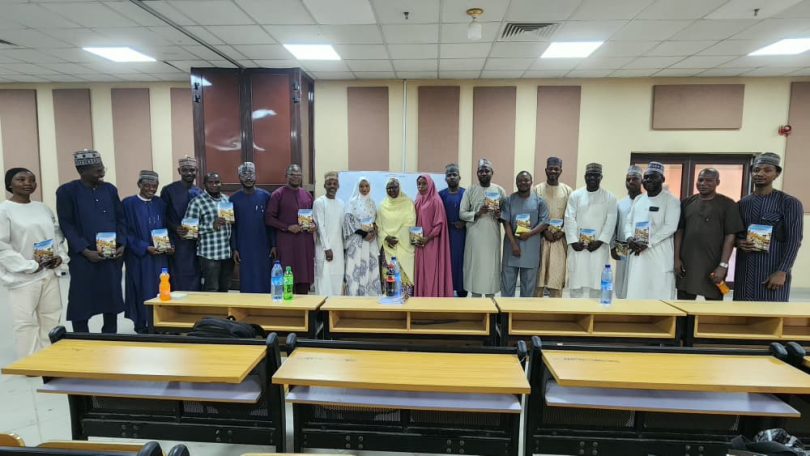
The Centre for Information Technology and Development (CITAD) says rural girls and women in Kano State face abuse, exploitation and social stigma in their experiences of domestic work in urban households and after returning to their communities.
The organisation disclosed this on Thursday during the presentation of a research book titled Post-Domestic Work Experiences of Rural Girls and Women in Kano: The Case of Kubarachi and Dosan in Madobi and Dawakin Kudu Local Government Areas, held at the CBN Centre of Excellence, Bayero University, Kano.
The study, conducted with support from Rosa Luxemburg Stiftung, examined the experiences of former domestic workers in Dosan community in Dawakin Kudu and Kubarachi community in Madobi Local Government Areas of the state.
It identified poverty, limited access to education and the desire to acquire bridal furniture as major factors pushing rural girls and women into domestic work in urban centres.
The research also identified parental pressure, peer influence and informal agents as contributing factors to their migration.
According to the findings, while some former domestic workers reported fair treatment by their employers, others experienced exploitation, excessive workloads and abuse, with some having their education disrupted.
It further revealed that returning to their communities exposed some of the women and girls to stigma, social discrimination and gender-related vulnerabilities.
The study adopted qualitative research methods, including focus group discussions, key informant interviews and in-depth interviews with former domestic workers, professionals and community members.
It recommended improved access to education and vocational training in rural communities, enforcement of labour protection laws, and reintegration support through business grants and scholarships.
The researchers also called for community sensitisation and gender-responsive social protection policies to address factors exposing rural girls and women to exploitation.
Speaking at the event, CITAD Executive Director, Malam Yunusa Ya’u, represented by Malam Haruna Adamu Hadejia, said research was important in identifying the root causes of social problems and developing appropriate interventions.
“Research and knowledge production are essential because they reveal the root causes of social issues, ensuring that interventions address real human needs rather than relying on assumptions,” he said.
Ya’u said rural girls and women in Kano engaged in unpaid domestic work within their families, as well as paid and semi-formal domestic services in urban and wealthier households.
He identified poverty, limited access to education and cultural norms as factors influencing their experiences and the value attached to domestic work.
The book was authored by Abdullahi Hamisu Shehu of the Department of History, Bayero University, Kano; Fatima Babakura of CITAD; and Mohammed Aliyu Aminu of the Department of Economics, Bayero University, Kano.
The publication was reviewed by four academics: Prof. Muhammad Shamsuddeen of the Department of Economics, BUK; Prof. Bello Ibrahim of the Department of Sociology, BUK; Dr Safiya Nuhu, Director of the Centre for Gender Studies, BUK; and Prof. Aisha Muhammad, former Deputy Vice-Chancellor of North-West University, Kano.
The reviewers examined the findings and their implications for domestic work, gender relations, women’s rights and the protection of vulnerable girls and women.
The event also featured an interactive session during which participants discussed the findings and raised questions about the experiences documented in the research.