
By Chimezie Godfrey
A retired Major General, MSA Aliyu, has faulted aspects of Nigeria’s military retirement practices, warning that sending experienced officers home following changes in service leadership leads to the loss of valuable institutional knowledge and weakens the military’s capacity to benefit from decades of professional experience.
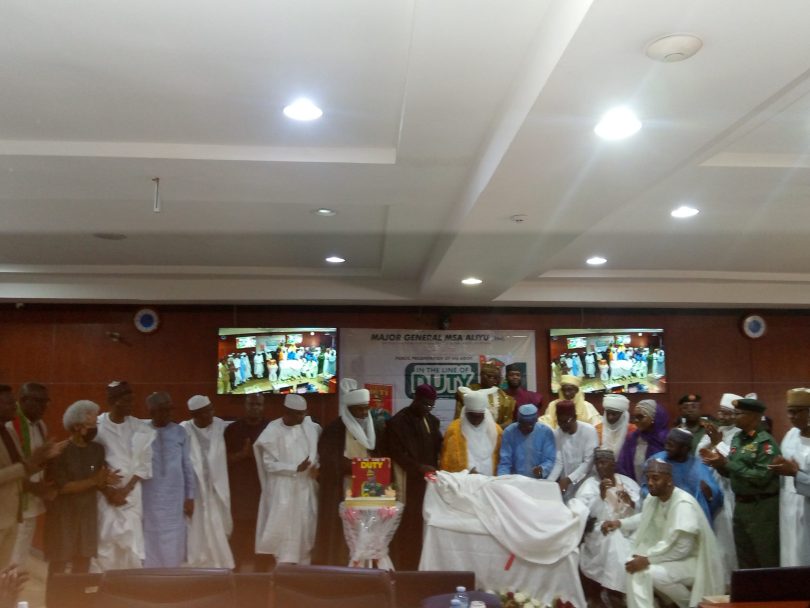
Aliyu raised the concern in his autobiography, titled,”In the Line of Duty”, presented on Thursday at the Nigerian Army Resource Centre, Abuja, where Professor Olayemi Durotimi Akinwumi drew attention to the issue during his review of the book.
The reviewer said the author’s experience raised important questions about the military’s approach to leadership transition, particularly the retirement of senior officers when junior colleagues are appointed to top positions.
Quoting from page 201 of the book, Akinwumi read Aliyu’s account of what he described as a troubling practice.
“This approach to military leadership transition in Nigeria stands out for its unique characteristics. The abandonment of service is often influenced by political consideration rather than strictly by adhering to seniority or qualification, which many of us find troubling,” the author wrote.
Aliyu questioned the rationale for retiring experienced officers when new service chiefs assume command, arguing that such decisions could deprive the military of expertise accumulated over several decades.
“The Chief of Army Staff feeling awkward about addressing a subordinate as ‘sir’ in public functions will prefer to see this experienced officer retired. It strikes me as a trivial reason for losing valuable expertise and experience,” he stated.
He further described the practice as a waste of human resources, particularly when officers who have spent years acquiring military knowledge and operational experience are compelled to leave just as they reach senior positions.
“In my view, this practice is a fruitless misdirection of energy by the government,” Aliyu wrote.
Recalling his personal experience, the retired general said he felt a deep sense of waste after serving for 35 years and reaching the rank of Major General, only to be asked to retire when he believed he was positioned to contribute more to the institution.
“I felt a sense of waste when I considered my case. After 35 years of service, just as I reached the rank of Major General and I was poised to apply all the knowledge and experience I had accumulated, I was told to go home,” he stated.
He warned that the military institution also suffered when the knowledge and experience of retired officers were not retained or made accessible to succeeding leadership.
“The institutional knowledge I possessed, some of which even the new chiefs might not be aware of, was lost to the institution. There are numerous instances where I knew I could have provided valuable insight to benefit the new leadership,” he added.
The author said the retirement arrangement could also discourage consultation between former senior officers and serving commanders, even when their experience could help address operational and institutional challenges.
Akinwumi described the concerns as important issues that military authorities and the Federal Government should examine, warning against the waste of human resources after years of investment in training and professional development.
He argued that the military should explore ways of retaining the expertise of experienced officers rather than allowing leadership transitions to result in the loss of institutional knowledge.
The reviewer made the observations while presenting his assessment of Aliyu’s 17-chapter autobiography, which chronicles his childhood, military career, peacekeeping assignments, military diplomacy, family life and the road accident that left him with life-threatening injuries.
In his remarks, Aliyu said the book was written to share the lessons of his military career with younger officers, researchers and other leaders.
He said his experiences had taught him that effective leadership was founded on character, knowledge, humility, loyalty and patriotism.
“True command is not about legs. It is about character, about knowledge, about humility, and loyalty to superior authority, and patriotism above all,” he said.
The retired general, who turned 60 on Thursday, also acknowledged the support of retired Lieutenant General TY Buratai, whom he described as an elder and friend who helped him continue serving the Nigerian Army after his accident.
He said he decided to document his experiences after officers approached him for interviews as part of leadership studies, adding that he wanted to make his story available to researchers and future generations.
The book presentation was attended by serving and retired military officers, academics, family members and other dignitaries.