
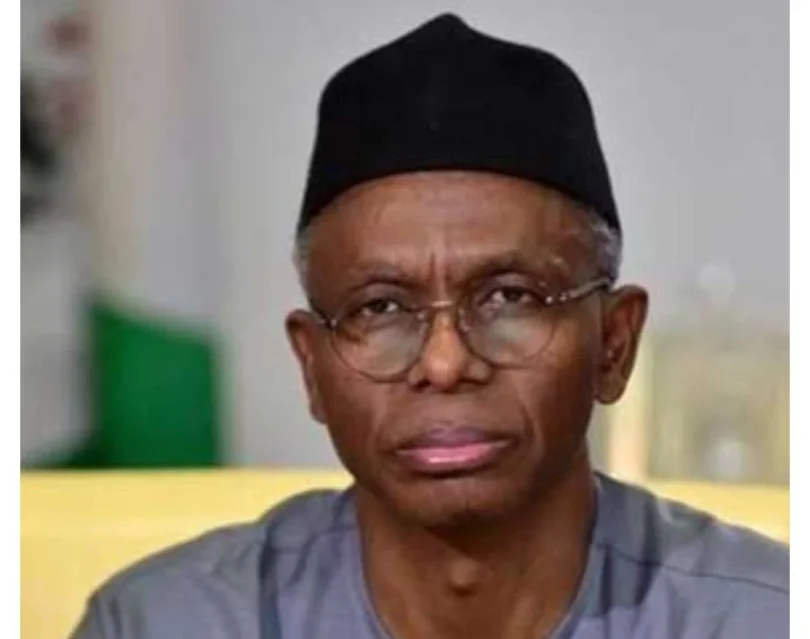
The Independent Corrupt Practices and Other Related Offences Commission (ICPC) has prayed the Federal High Court sitting in Abuja to dismiss a N1 billion fundamental rights suit filed by former Governor of Kaduna State, Mallam Nasir El-Rufai, over alleged refusal to allow him access to his family members.
Also in a separate counter affidavit filed before the court, the Attorney General of the Federation (AGF) urged that the suit, which has been assigned to Justice Chigozie Onah, be dismissed, on the ground that the ICPC is empowered to put in place protocols within its facilities to prevent breach of security.
The detained former governor had filed the suit against the ICPC, its Chairman, Musa Aliyu, SAN, and the AGF as 1st to 3rd respondents, respectively.
El-Rufai, in the Originating Motion, marked: FHC/ABJ/CS/1852/2026 and filed by Ubong Akpan on August 13, sought a N1 billion in damages for allegedly preventing him from having access to his wife, Mrs Aichatou Asabe and son, Abba El-Rufai, while in custody.
The former governor, who alleged that his wife and son were denied to see him, prayed the court to declare that his fundamental human rights guaranteed under Part IV of the 1999 Constitution (as amended) remain inviolable and in force notwithstanding his detention by the Commission and should be honoured.
Responding in a joint counter affidavit filed by the ICPC and its chairman but deposed to by John Uche, a Chief Anti-Corruption Assistant in the Internal Security Support Unit, said, many paragraphs in El-Rufai’s affidavit in support of his suit were false and further averred that the former governor was in the lawful custody of the Commission by an order of the Federal High Court, Kaduna Division, in charge number: FHC/KD/73C/2025.
He said on July 7, in compliance with the order of the Kaduna Federal High Court, permitting access to El-Rufai’s personal physician, the Commission facilitated a medical visit to his personal physician accompanied by their officers and his wife, Asabe.
Shortly after the hospital visit, he said, the ICPC received reports that the said medical visit was turned into a political meeting in breach of its security protocol, demonstrating that the existing access control environment was vulnerable.
Uche said that, against this development, the Commission adopted a temporary access control measure, temporarily restricting non-essential access to the former governor because unrestricted access presented a continuing risk until the vulnerability was understood and adequately mitigated.
The officer said as this was happening on July 7, El-Rufai’s son, Abba, came to their office requesting to visit his father and approached him (Uche) at his desk.
Uche said he then contacted his superior, Mr Henry Hwande, who instructed him to find out the purpose of his visit.
He said he made the enquiry and was told that it was a regular visit and the information was relayed to his superior, who instructed that Abba should wait in the Commission’s waiting area.
The officer said while El-Rufai’s son was waiting, Asabe met him (Abba) and, after conversing with him, began raising her voice and demanding that Abba be granted access to his father.
“That my colleague, Miss Titilayo Remi, tried to speak and reason with her to de-escalate the situation, but she was uncooperative”, Uche said and added that, several minutes later, Abba attempted to proceed into the Commission’s building, but he quickly stood in his way to prevent him and Asabe from gaining access.
“That while being focused on preventing him from gaining access, I fell into a ditch where my leg trapped and I called out for help at which point the applicant’s son and Aichatou Asabe continued to make their way towards the building’s entrance, as captured by the CCTV footage.
“That my cry for help attracted the security personnel, who then swung into action to prevent the unauthorised entry of the applicant’s son while Aichatou Asabe gained access into the building and headed for the detention area.
“That after he was prevented from gaining entry into the building, the applicant’s son lay in the gutter and repeatedly rubbed his leg against the edge of the gutter.
“That the 1st respondent has Closed-Circuit Television (CCTV) cameras installed at various strategic locations within and around its office premises for security and monitoring purposes, which cameras record activities and events occurring with their respective fields of view.”
He said that the contents of the storage system, including the CCTV recordings, remained accurate and were not altered or tampered with during the material period.
Uche said, following a second security breach on July 7, the ICPC determined that its existing access arrangements were no longer adequate warranting an urgent review.
The officer said during the course of the review, the Commission uncovered another security breach involving Asabe; who was allegedly smuggled into the ICPC’s premises on Saturday, July 4 at about 7:35pm after official visiting hours with the connivance of some officers of the Commission, who are currently facing disciplinary action.
He said that based on Asabe’s repeated disregard for access control protocols, the Commission determined that her continued access posed a specific security risk, “As such, her visiting access to the applicant was temporarily suspended pending completion of the security review and implementation of appropriate mitigation measures.”
He said he was informed by Mr Henry Hwande, Head of the Internal Security Support Unit, on August 26, which he believed to be true, that: “On 8th of July, 2026, Asia Ahmed El-Rufai, one of the applicant’s wives wrote requesting audience with the Director of Operations following the incident of 7th July, 2026.
“Further to the letter, the Director of Operations, alongside Mr. Henry Hwande met with Asia Ahmed El-Rufai and a counsel by name, Mr Aremu, at the Director Operations office on the 9th of July, 2026.
“One of the issues discussed at the meeting was the denial of access to Aichatou Asabe to which the Director Operations responded that there was an ongoing investigation and Aichatou Asabe was temporarily suspended from accessing the 1st respondent’s premises until same was completed.
“The 1st respondent, having earlier responded to the issue of Aichatou Asabe’s temporary denial of access, did not see the need to respond to the letter of 16th July, 2026, as nothing new had come up,” he said and added that, contrary to El-Rufai’s claim, other members of his family, including his son who was refused entry on July 7, had severally been granted access to visit him, bringing meals, medication and other necessary supplies after the July 7 incident.
Uche, who attached a copy of the Commission’s visitors log as “Exhibit ICPC D,” to prove their case, said it would be in the interest of justice to dismiss the detained ex-governor’s claim against the 1st and 2nd respondents.
The AGF, in its counter affidavit filed on September 11 and deposed to by Oni Michael, an Administrative Officer in Civil Litigation and Public Law Department of Federal Ministry of Justice, denied some of the averments in El-Rufai’s affidavit.
Michael stated that the AGF, listed as 3rd respondent in the suit, is not saddled with the responsibility of arresting and/or detaining any person suspected to have committed any crime whatsoever, including El-Rufai, and neither does he maintains a detention facility.
“That the alleged infringement of the applicant’s right was not done by the 3rd respondent in any way whatsoever as he is not responsible for the maintenance and control of the 1st and 2nd respondents’ detention facility.”
The admin officer further stated that the AGF was not part of the alleged events of July 7 and at no time did he deny El-Rufai’s family members access to him.
According to Michael, the order of Hon. Justice R.M. Aikawa solely directed the 1st and 2nd respondents to allow the applicant access to his counsel and personal physician.
“That the attached order did not include access to Aichatou Asabe or any other person. That the 1st and 2nd respondents are empowered to put in place protocols within their facilities to prevent breach of security,” he said.
The officer submitted that maintenance of serious security protocols at the ICPC’s detention facility is a matter of national security.
Michael said he was informed by Mosunmola Yetunde, lawyer to ICPC, of the following facts which he verily believed to be true that the Commission, in compliance with court order allowed El-Rufai access to his personal physician accompanied by ICPC’s officers and Asabe, his wife.
“That the medical meeting turned into a political meeting. That the 1st respondent adopted a temporary access control measure which resulted in temporarily restricting non-essential access to the applicant due to vulnerability risk.
“That the restriction put in place was to ensure a serious security protocol, necessary for the maintenance and control of the 1st respondent’s detention facility. That it became necessary following the events of 7th July, 2026, to review the CCTV Security footage of the 1st respondent’s facility.”
Michael, however, corroborated that during the course of the review, it was discovered that there had been an earlier security breach involving Asabe. This, he said, happened in connivance with an ex-officer of the Commission, wherein Asabe was smuggled into the Commission’s facilities after official visiting hours.
“That the act of Aichatou Asabe and the ex-officer of the 1st respondent breached the Ist respondent’s security access protocol. That the officer found liable in smuggling Aichatou Asabe into the 1st respondent’s detention facility has been dismissed from the service of the 1st and 2nd respondents,” he added.