
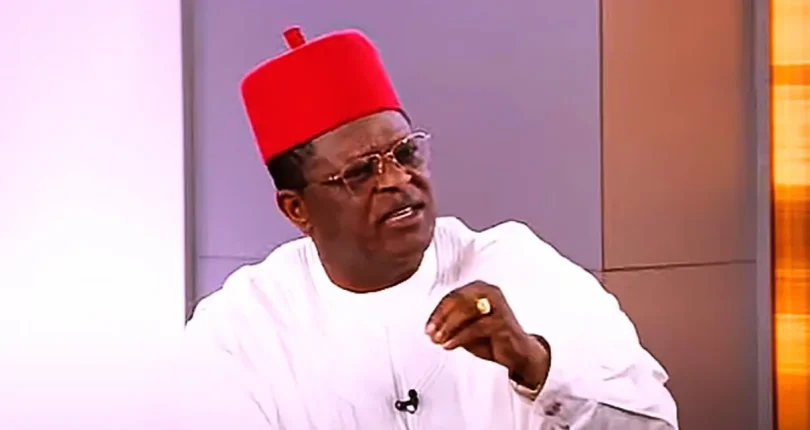
Minister of Works, Senator Dave Umahi, has expressed confidence that President Bola Tinubu will be re-elected in 2027, saying he has faith in God that the President will return for a second term.
Umahi, who spoke on Channels Television’s Politics Today, said Tinubu’s performance and the difficult economic situation he inherited were enough reasons for Nigerians to give him another mandate.
“I have faith in God that God will return him,” the minister declared when asked what gave him the impression that Nigerians might re-elect Tinubu in 2027.
According to him, “Power belongs to God, and God brought him,” stressing that Tinubu assumed office at a particularly challenging period and had been confronted with several obstacles.
Umahi, who dismissed the suggestion that his assessment was based merely on the fact that Tinubu is his principal, said the President was “doing very well” and that his economic reforms, though painful, were necessary to rescue the country.
“He came at a very challenging period. All manner of obstacles were thrown on his way. Power belongs to God, and God brought him,” he said.
The minister acknowledged that the reforms had brought hardship to Nigerians, particularly vulnerable citizens, but argued that the measures were required to address the country’s economic problems.
Responding to concerns that many Nigerians were struggling to feed and were yet to see the benefits of the reforms, Umahi said the administration should be judged against the economic situation it inherited.
He said Nigerians should compare key economic indices at the time Tinubu assumed office with the current situation, insisting that the President had taken difficult decisions in the interest of the country.
Umahi’s prediction came against the backdrop of an earlier assertion during the interview that the Federal Government would complete four major legacy road projects within the next three years “by God’s special grace.”
The minister listed the Lagos-Calabar Coastal Highway, Sokoto-Badagry Road, Trans-Sahara/Trans-Harada corridor and Akwanga-Jos Road among the major projects being pursued by the administration as part of an interconnected road network designed to drive economic activity across the country.
He also defended the administration’s record on inherited road projects, revealing that Tinubu inherited 2,068 projects valued at about N13 trillion when the administration assumed office in 2023.
According to him, about 80 per cent of the projects currently being executed by his ministry were inherited from the previous administration.
Umahi said the President had directed him not to abandon inherited projects because many of them were located on major economic corridors.
On the Lagos-Calabar Coastal Highway, which has attracted controversy over its cost, procurement and financing, the minister rejected allegations of wrongdoing and said he was prepared to take responsibility for the procurement process.
He disclosed that the first section of the project, covering 47.47 kilometres, had been completed, while work on the second section was nearing completion.
Umahi said the government was financing the legacy projects through an Engineering, Procurement, Construction and Financing arrangement, with the Federal Government providing 30 per cent while 70 per cent was being sourced through external financing.
He specifically said Deutsche Bank provided financing for Section One of the coastal highway, adding that the facility was oversubscribed by $100 million.
The minister also maintained that the reforms and infrastructure projects were intended to lay the foundation for long-term economic prosperity, arguing that the current administration should not be judged solely by the immediate hardship accompanying its policies.
Umahi’s declaration is one of the clearest expressions yet from a senior member of the administration of confidence in Tinubu’s return to office in 2027, even as Nigerians continue to grapple with the cost-of-living pressures arising from the government’s economic reforms.