
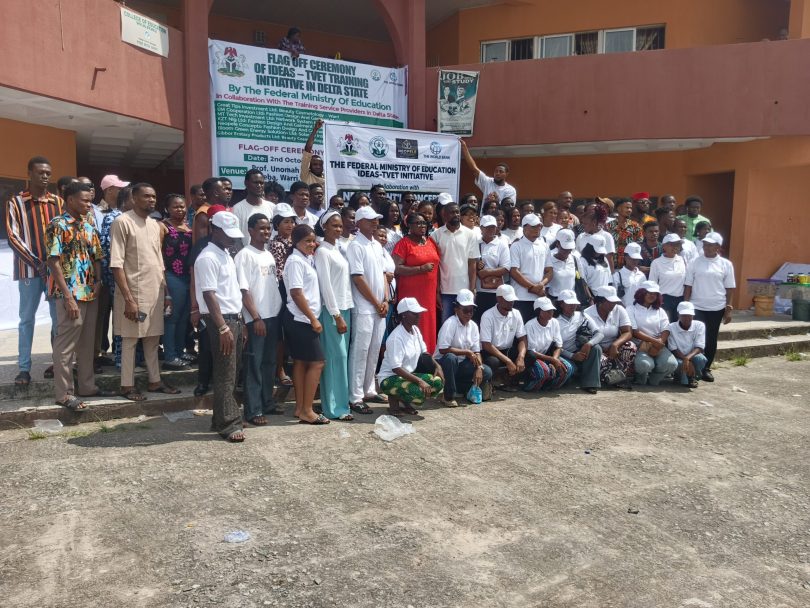
No fewer than 970 youths in Delta State have commenced training in various vocational skills under the Cohort 3 of the IDEAS-TVET Training Initiative of the Federal Ministry of Education, with beneficiaries urged to take the opportunity seriously and use their skills to build sustainable livelihoods.
The programme, implemented with the support of the World Bank, is being delivered in Delta State through seven Training Service Providers covering various skills, including fashion design and garment making, beauty cosmetology, network system installation, creative media, baking and confectionery, and solar photovoltaic installation and maintenance.
The flag-off ceremony was held on October 2, 2026, at Prof. Unomah Hall, College of Education, Edjeba, Warri, Delta State.
Welcoming guests to the ceremony, the Managing Director of EM Cooperation Ltd, Elijah Ojije, who spoke on behalf of the seven Training Service Providers in the state, said the initiative was designed to strengthen Nigeria’s skills development system and produce industry-relevant skills for both the formal and informal sectors.
Ojije said the Nigeria Youth Employment and Skills Acquisition Framework (IDEAS-TVET), implemented through the Innovation Development and Effectiveness in the Acquisition of Skills (IDEAS) Project, was a World Bank-assisted programme with emphasis on quality assurance, industry engagement and technology integration.
He said seven Training Service Providers were currently implementing Cohort 3 of the programme in Delta State.
They are Great Tips Investment Ltd, offering Beauty Cosmetology in Warri; EM Cooperation Ltd, offering Fashion Design and Garment Making in Warri; MT Tech Investment Ltd, offering Network System Installation and Creative Media in Warri; KZT Nig Ltd, offering Fashion Design and Garment Making as well as Baking and Confectionery in Warri; Neopele Concepts, offering Fashion Design and Garment Making in Warri; Bloom Green Energy Solutions Ltd, offering Solar PV Installation and Maintenance in Asaba; and Gibbor Ecstacy Products Ltd, offering Beauty Cosmetology in Issele-Uku.
Ojije said the 970 trainees enrolled in the various skills had already recorded progress since the training commenced in June 2026.
He expressed appreciation to the National Project Coordinator of the IDEAS-TVET Training Initiative and the Federal Ministry of Education for the programme, as well as the Provost of the College of Education, Edjeba, for approving the use of the hall for the ceremony.
Also speaking, the Innovation Grant Manager from the Edo State Project Implementation Unit, Irhiawo Aisha Evelyn, who represented the National Project Implementation Unit and the National Project Coordinator, Mrs Blessing Ogwu, said the flag-off marked more than the commencement of another training programme.
She said the initiative was aimed at creating opportunities, building human capital, strengthening Nigeria’s technical and vocational education ecosystem and equipping young Nigerians with practical skills to participate meaningfully in the economy.
According to her, the IDEAS Project, implemented by the Federal Ministry of Education with World Bank support, had continued to demonstrate that skills development could provide a pathway to employment, entrepreneurship and economic empowerment.
Evelyn said the project had made investments in infrastructure, equipment, human-capacity development and skills training, including the renovation and equipping of workshops across technical colleges and the provision of essential facilities and equipment.
She added that the project had supported the strengthening of institutions and regulators responsible for technical and vocational education, as well as the upskilling of about 4,000 technical teachers and instructors.
Beyond institutional interventions, she said the IDEAS-TVET Initiative had taken skills development directly to about 80,000 Nigerians through Training Service Providers across the country.
She listed some of the occupational areas covered by the programme as fashion design, information and communication technology, agriculture, hospitality, construction, electrical installation, automotive-related trades, welding and fabrication, plumbing and solar installation, among other market-relevant skills.
The representative noted that women and other groups traditionally underrepresented in technical and vocational occupations had also participated in the initiative.
She, however, cautioned the Delta beneficiaries that the opportunity came with responsibilities, urging them to attend their training sessions, ask questions, practise what they were taught, respect their instructors and fellow trainees, and take proper care of training equipment.
Evelyn specifically reminded the trainees that they were required to maintain at least 65 per cent attendance every month to qualify for the N30,000 promised by the Federal Government through the Federal Ministry of Education under the Minister of Education, Dr Maruf Tunji Alausa.
She explained that the attendance requirement was intended to ensure that beneficiaries received sufficient practical exposure, completed the required learning hours and developed the competence expected from the programme.
She urged trainees facing genuine challenges that could affect their attendance to promptly communicate with their Training Service Providers rather than simply staying away from training.
The representative also advised the beneficiaries to see themselves as future entrepreneurs, technicians, artisans, innovators and employers who could contribute to Nigeria’s economy.
She said the certificate to be awarded at the end of the programme was important, but the real value of the training would be determined by how beneficiaries applied the practical skills acquired to generate income, create employment and improve their quality of life.
She said some beneficiaries could establish businesses, secure employment or become trainers who would transfer their knowledge to another generation.
Evelyn also charged the Training Service Providers and facilitators to maintain high standards, provide practical and hands-on training, monitor attendance diligently, mentor trainees and create an environment conducive to effective learning.
She said the success of the IDEAS-TVET programme would not be measured only by the number of people enrolled, but by the number of beneficiaries who successfully acquired relevant skills, secured employment, established businesses, increased their incomes and contributed to their communities.
One of the beneficiaries, Bright Edema Elo Oghene, who is undergoing training in fashion design, expressed appreciation to the Federal Ministry of Education for giving her the opportunity to acquire a skill that could make her self-employed.
She said she had learnt how to sew peplum tops, cut and fit straight gowns and make men’s shirts, adding that she had also been exposed to different types of sewing machines.
Bright said she planned to establish her own fashion shop after completing the programme and become a professional fashion designer.
She said the training would help her pursue self-employment rather than depend on government employment.
Another beneficiary, Miss Oghenemega Eyube, also expressed appreciation to the Federal Government for the empowerment programme, saying she had gained a lot from the training.
Eyube, however, disclosed that she initially did not take the programme seriously until she began to see the benefits, after which she became more committed to the training.
The representative of the National Project Coordinator formally declared the Cohort 3 IDEAS-TVET training programme flagged off on behalf of Mrs Blessing Ogwu.
She congratulated the trainees and expressed hope that the programme would open new opportunities for them and contribute to building a stronger, more skilled and productive Nigeria.