
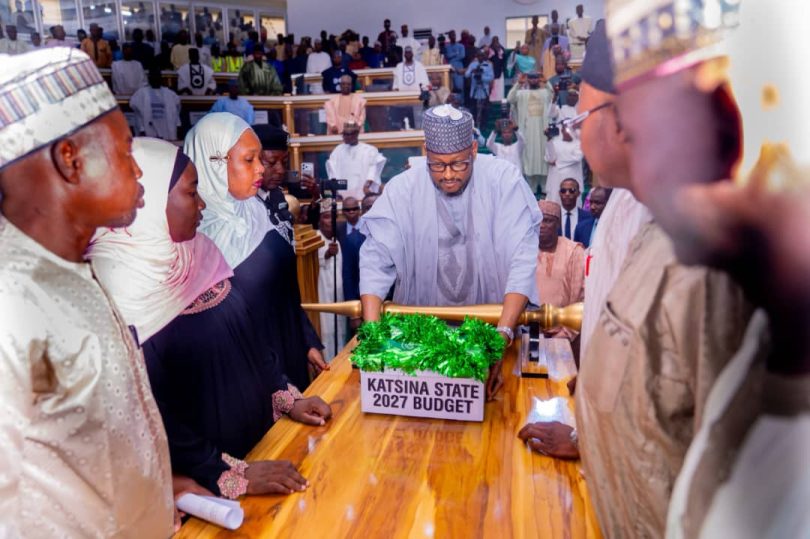
- Governor Radda commends Katsina Assembly for sustained Executive-Legislative partnership
Katsina State Governor, Malam Dikko Umaru Radda, has presented a proposed ₦828.64 billion 2027 budget to the Katsina State House of Assembly, with education, infrastructure, agriculture, healthcare and rural development receiving significant attention.
Presenting the Appropriation Bill, tagged “Building Your Future IV,” before the House on Tuesday, Governor Radda said the fiscal proposal was designed to improve the lives and well-being of citizens while ensuring that the benefits of good governance reach both urban and rural communities.
The Governor explained that the 2027 proposal places strong emphasis on development spending, with ₦637.91 billion, representing 76.98 per cent of the total budget, allocated to capital expenditure, while ₦190.73 billion, or 23.02 per cent, is proposed for recurrent expenditure.
According to him, the proposed budget is 7.71 per cent lower than the approved 2026 budget, representing a decrease of ₦69.23 billion. He said the reduction followed a pragmatic and disciplined assessment of revenue and expenditure expectations.
“We took a pragmatic, disciplined and realistic view of both revenue and expenditure. We reviewed every available funding source to ensure fiscal balance, strengthen implementation and reduce the risk of shortfalls,” Governor Radda said.
He added that Ministries, Departments and Agencies were required to justify their expenditure frameworks against the administration’s Building Your Future development blueprint, available resources and the pressing needs of communities.
Governor Radda described the proposal as the most participatory budget in Katsina State’s history, noting that its priorities were shaped substantially by the Citizens’ Budget Exercise conducted simultaneously across all 361 wards on July 18, 2026.
He explained that residents identified, weighed and ranked their needs, with the first-priority project selected by citizens in each ward forming part of the grassroots framework for the 2027 fiscal year.
“Our people named their needs, weighed them and ranked them. The first priority project chosen by citizens in each ward now forms a clear, grassroots framework for the 2027 Fiscal Year. This budget therefore answers the real and pressing needs of our communities, not assumptions made from afar,” the Governor stated.
He added that each of the 361 wards will receive a special project of its own choosing, while community-generated data will guide other interventions in agriculture, MSMEs, WASH, women empowerment, environment, climate change and security.
Under the sectoral allocations, the Social Sector receives ₦317.73 billion, representing 38.34 per cent of the budget, while the Economic Sector gets ₦303.17 billion, or 36.59 per cent. The Administrative Sector is allocated ₦198.55 billion, while Law and Justice receives ₦9.19 billion.
Of the ₦637.91 billion capital provision, five priority sectors will receive a combined ₦325.45 billion. Basic and Higher Education takes ₦83.82 billion; Works and Housing, ₦71.60 billion; Agriculture and Livestock, ₦65.88 billion; Health, ₦53.64 billion; and Rural Development, ₦50.51 billion. Together, the five sectors account for 51.02 per cent of the proposed capital budget.
Governor Radda said the allocations would support better learning infrastructure and scholarships, roads and housing development, food security and livestock value chains, improved health facilities and stronger rural infrastructure.
The remaining ₦312.47 billion, representing 48.98 per cent of the capital budget, will support other essential sectors, including security and e-governance.
2026 Budget Records Commendable Progress
Reviewing the implementation of the 2026 budget as of August 28, Governor Radda said the administration had recorded considerable progress across education, healthcare, agriculture, infrastructure, water, rural development and security.
According to the revised figures presented by the Governor, the state recorded ₦267.47 billion in recurrent revenue, including opening balance, representing 44.16 per cent performance, while capital receipts stood at ₦116.41 billion, representing 39.84 per cent.
The Governor said total recurrent and capital expenditure had reached ₦295.19 billion, representing an overall budget expenditure performance of 32.88 per cent as of August.
Of this amount, recurrent expenditure stood at ₦102.17 billion, or 59.64 per cent performance, while capital expenditure reached ₦193.02 billion, representing 26.57 per cent of the approved capital provision.
Governor Radda expressed confidence that the performance figures would rise considerably before the end of the year as several ongoing projects reach completion.
“We expect this figure to close much higher in our third and fourth quarterly reports for 2026,” he said, noting that the final four months of the year traditionally record stronger performance as projects are completed.
The Governor also reported that the Administrative Sector had recorded expenditure of ₦63.67 billion, the Economic Sector ₦130.75 billion, Law and Justice ₦3.78 billion, and the Social Sector ₦96.99 billion as of the review period.
In infrastructure, the administration continued major projects including the Katsina and Funtua Urban Renewal projects, Musawa-Gingin-Tabanni Road, Kunduru-Kadanya Road, Daura Western Bypass, housing development and the supply of 30 hybrid buses.
Education also recorded substantial investments, including ₦13.03 billion for renovations and rehabilitation under the TESS Programme, ₦10.53 billion for secondary school renovation and construction under AGILE, and ₦5.88 billion for primary school intervention projects in collaboration with UBEC.
The administration also committed ₦3.55 billion to the construction and maintenance of three special model schools, with the model school in Radda completed and academic activities already commenced.
Another ₦2.07 billion was spent on SSCE examination fees covering WAEC, NECO, NABTEB and NBAIS in collaboration with local government councils, while ₦1.26 billion was committed to scholarships for local and foreign students.
Governor Radda said the education interventions were already helping to decongest classrooms, improve the pupil-teacher ratio and increase enrolment across the state.
In healthcare, the Governor said Katsina State currently has 1,751 primary, secondary and tertiary health institutions, with more than 85 per cent functional.
The administration has spent ₦4.71 billion on the State Emergency Medical Service and Ambulance System Programme this year, alongside other investments in hospitals, drugs and health infrastructure.
Significantly, Governor Radda disclosed that his administration has invested over ₦9.59 billion from 2025 to date in equipping the Medical Imaging Centre at GARSH, Katsina, which will be converted into a World-Class Cancer and Imaging Centre for the state.
Agriculture remained another major area of intervention, with ₦21.43 billion committed to fertiliser procurement in conjunction with local government councils, alongside ₦479.56 million for irrigation development, ₦441.26 million for improved seeds and ₦269.35 million for seed multiplication.
Governor Radda said the investments, coupled with favourable conditions, were projected to deliver a bumper harvest in Katsina State. The administration also spent ₦3.11 billion on rural access roads to ease the movement of agricultural produce and improve marketing activities across the state.
On security, Governor Radda said the administration had continued to confront insecurity through its community-driven approach while increasing financial support for security operations. The state spent ₦1.34 billion on the procurement and management of security assets and ₦6.16 billion on security allowances and operations, bringing the combined expenditure to more than ₦7.5 billion in 2026.
The Governor acknowledged that more remained to be done, but said sustained security efforts had pushed criminal elements into isolated pockets, enabled many communities to return to normal life and allowed farmers in affected areas to return to their fields.
Radda Identifies Security, Education, Health, Water Challenges
Despite the progress recorded, Governor Radda acknowledged that challenges remain, particularly insecurity in frontline communities, inadequate staffing and learning materials in schools, healthcare pressures, water and sanitation gaps and infrastructure deficits.
He said frontline local governments had borne the heaviest burden of insecurity, but improvements in security had enabled farmers in affected communities to return to their fields and improve productivity.
The Governor identified inadequate staffing and learning materials as key education challenges, while malaria, child malnutrition, maternal health and water-borne diseases remain among the major healthcare concerns reported by communities.
He also acknowledged continued pressure on potable water supply, noting that boreholes remain the main source of water for many residents.
Governor Radda said the administration would continue investing in treated water facilities and distribution networks, including the Zobe Phase 1B Water Project, while pursuing its ambition of making Katsina the first open defecation-free state in Nigeria.
According to him, the community needs assessment and statewide town halls have provided the government with concrete community-level data to determine where interventions are most urgently required.
He assured residents that the administration would continue addressing needs in education, healthcare, infrastructure, water and sanitation, agriculture, MSMEs, women empowerment, environment, climate change and security.
Governor Commends Speaker, Assembly for Partnership
Governor Radda commended the Speaker of the Katsina State House of Assembly, Rt. Hon. Nasir Yahaya Daura, and members of the legislature for their constructive partnership with the Executive.
He said the cooperation between both arms of government had helped advance policies and programmes delivering socioeconomic development across the state.
“I thank the Honourable Speaker for his exemplary leadership, and every Honourable Member for your dedication to duty and to your constituents. The constructive relationship between the Executive and the Legislature remains vital to good governance,” Governor Radda stated.
The Governor stressed that legislative oversight remains fundamental to accountability, transparency and prudent management of public resources, reaffirming his administration’s commitment to working closely with the House.
He expressed confidence that lawmakers would constructively consider the 2027 Appropriation Bill and enact it into law in good time.
Governor Radda also thanked the Judiciary, traditional institutions, religious bodies, conventional and local security outfits, development partners and civil servants for their contributions to the development of Katsina State.
He particularly offered prayers for security personnel who lost their lives in the line of duty, describing their sacrifices as an embodiment of courage, patriotism and selfless service.
“On behalf of the Government and the good people of Katsina State, and of all members of the Executive Council, I thank this Honourable House and its distinguished Members for your continued support, cooperation and commitment to the progress of our dear State,” Governor Radda said.
Ibrahim Kaula Mohammed
Chief Press Secretary to the Governor of Katsina State
08 September, 2026