
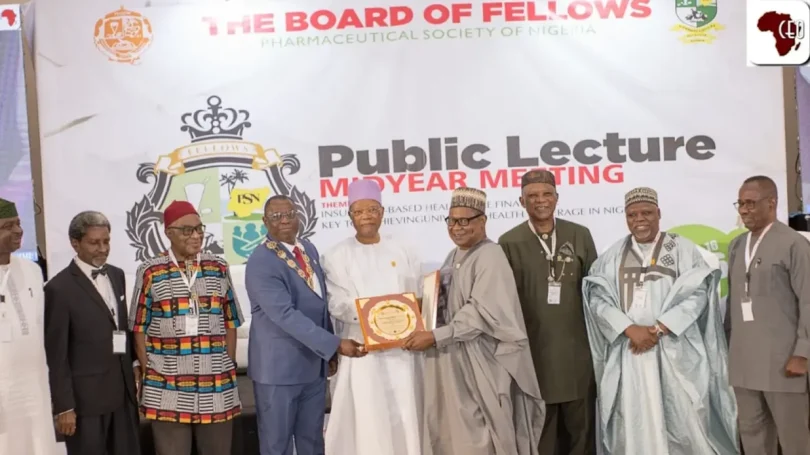
Healthcare leaders, policymakers and pharmacists have warned that over 130 million Nigerians remain uninsured and one illness away from financial ruin due to continued reliance on out-of-pocket healthcare spending.
The warning was issued recently at the 2026 Public Lecture and Mid-Year Meeting of the Board of Fellows of the Pharmaceutical Society of Nigeria, BOF-PSN, held at the Marriott Hotel, Ikeja, Lagos.
Speaking on the theme “Insurance-Based Healthcare Financing: Key to Achieving Universal Health Coverage in Nigeria,” the stakeholders said Nigeria’s poor insurance coverage is deepening poverty and slowing progress toward Universal Health Coverage, UHC.
In his remarks, Managing Director and Chief Executive Officer of Hygeia HMO, John Iwuajoku, said more than 130 million Nigerians currently lack any form of health insurance.
He identified poor public awareness, inadequate government funding and weak healthcare infrastructure as major barriers.
Iwuajoku advocated the integration of the National Identification Number, NIN, and Bank Verification Number, BVN, into health insurance enrolment to improve planning, data management and nationwide coverage.
“More than 130 million Nigerians currently lack any form of health insurance, poor public awareness, inadequate government funding and weak healthcare infrastructure are major barriers of universal health coverage .”
In his speech , Chairman of the BOF-PSN, Uchenna Uzoma Apakama, lamented that only between five and eight per cent of Nigerians currently enjoy health insurance.
According to him, the country’s low insurance penetration has continued to fuel poverty, as families are forced to finance healthcare from personal savings whenever illness strikes.
He stressed that affordable and comprehensive health insurance must no longer be regarded as a privilege but as a fundamental pillar of national development and social protection.
He stressed that affordable and comprehensive health insurance must no longer be regarded as a privilege but as a fundamental pillar of national development and social protection.
Apakama urged members of the National Assembly to dedicate part of their constituency intervention funds to sponsoring health insurance premiums for vulnerable Nigerians.
He also appealed to labour unions, professional associations, market organisations, transport unions and community groups to embrace group health insurance enrolment as a sustainable means of expanding coverage across the country.
According to him, associations such as the National Association of Industrial Pharmacists of Nigeria (NAIP) have already demonstrated that collective enrolment can successfully improve access to quality healthcare.
The BOF Chairman further challenged philanthropists, charitable foundations and corporate organisations to include health insurance sponsorship in their Corporate Social Responsibility initiatives, insisting that protecting citizens’ health should become a national responsibility shared by both government and the private sector.
Apakama however members of the National Assembly to dedicate part of their constituency intervention funds to sponsoring health insurance premiums for vulnerable Nigerians.
He also appealed to labour unions, professional associations, market organisations, transport unions and community groups to embrace group health insurance enrolment while citing the National Association of Industrial Pharmacists of Nigeria, NAIP, as an example of successful collective coverage.
“ This leaves traders, artisans, transport workers, market women and other citizens in the informal sector exposed to catastrophic medical expenses.
“The country’s low insurance penetration has continued to fuel poverty, as families are forced to finance healthcare from personal savings whenever illness strikes,” Apakama said.
Former Minister of Health, Prince Julius Adelusi-Adeluyi, who chaired the occasion, urged Nigerians to place the same value on health as they do on material possessions.
“Why do we willingly insure our cars, houses and gold but neglect health insurance until serious illness leaves us financially devastated?” he asked.
Adelusi-Adeluyi however urged pharmacists to champion health insurance advocacy nationwide, describing the profession as the backbone of Nigeria’s healthcare delivery system.
Delivering the keynote address on behalf of the Director-General of the National Health Insurance Authority, NHIA, Dr. Kelechi Ohiri, Femi Adeoye said healthcare financing remains central to Nigeria’s health sector transformation under the Renewed Hope Agenda.
He noted that UHC cannot be achieved without eliminating financial barriers that prevent citizens from accessing care. He added that NHIA is deploying technology to simplify enrolment and improve provider accreditation.
In his brief remarks, President of the Pharmaceutical Society of Nigeria, PSN ,Ayuba Tanko Ibrahim, reaffirmed the Society’s commitment to positioning pharmacists as critical drivers of insurance expansion at the community level.
A major highlight of the event was the unveiling of Ultimate Health HMO’s U-Health GIFSHIP, a Group, Individual and Family Social Health Insurance Programme designed for the informal sector.